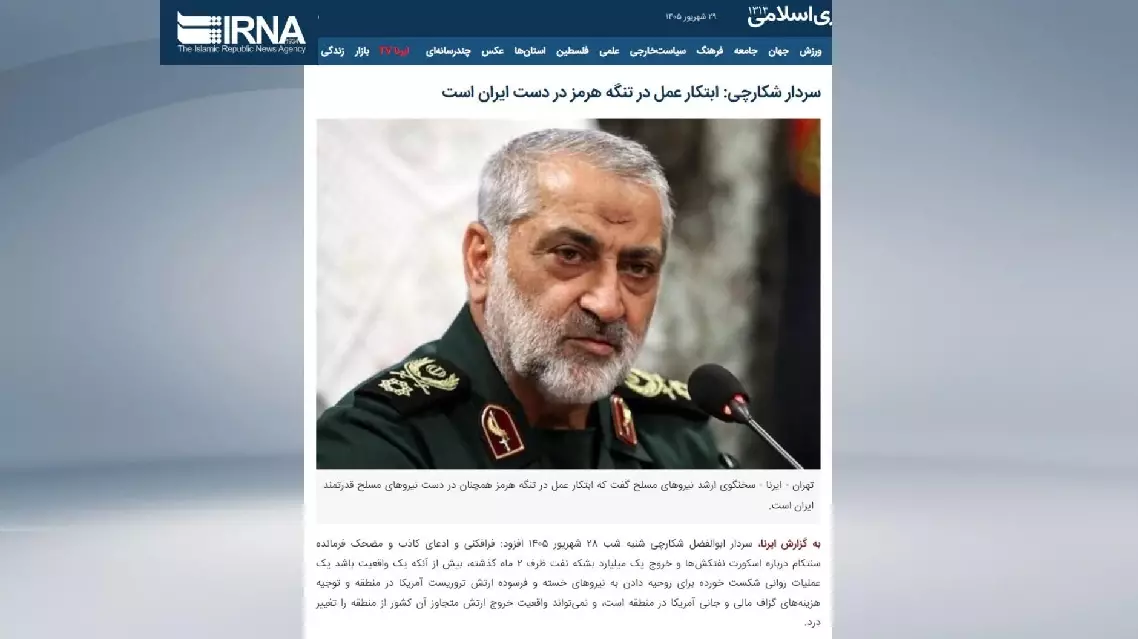
Senior spokesman for Iran's armed forces Abolfazl Shekarchi on Saturday rejected a U.S. Central Command (CENTCOM) claim that U.S. forces had supported the transport of more than 1 billion barrels of oil through the Strait of Hormuz "in the last couple of months."
In a statement carried by Iranian media, Shekarchi described the claim, made earlier in the day by CENTCOM Commander Admiral Brad Cooper, as "false and ridiculous."
He said Cooper's remarks constituted a "projection and a failed psychological operation to boost the morale of the terrorist U.S. Army's exhausted and worn-out forces in the region and justify the exorbitant financial costs and casualties incurred by the United States in the region."
Shekarchi noted that such claims could not change the reality of the expulsion of the "aggressive" U.S. Army from the region, stressing that the initiative in the Strait of Hormuz remained in the hands of Iran's armed forces.
In a video posted on social media on Saturday, Cooper said, "We've reached this significant milestone while assisting over 2,000 commercial ship transits through the strait by providing coordinated protection. Clearly, the momentum is building."
"Thousands of ships have passed through the strait. Over 1 billion barrels of crude have been shipped from Gulf partners through the Strait of Hormuz, and Iran has exported zero barrels thanks to our ironclad blockade," he added.
Also on Saturday, Iranian Parliament Speaker Mohammad Bagher Ghalibaf said the argument of choosing between "war and negotiation" is wrong, stressing that Iran must resist rationally and forcefully and negotiate at an appropriate time with an authoritative and rational attitude.
Ghalibaf said Iran has clearly conveyed its conditions through intermediaries. Unless those conditions are met, Iran's legitimate rights are recognized, and U.S. commitments are fulfilled, there is no possibility of returning to the previous negotiating state or reopening the Strait of Hormuz.
Following U.S.-Israeli strikes on Iran on Feb. 28, Tehran restricted passage through the strategic waterway, while U.S. forces imposed a naval blockade targeting vessels traveling to or from Iranian ports.
Iran denies U.S. claim on Hormuz oil transport
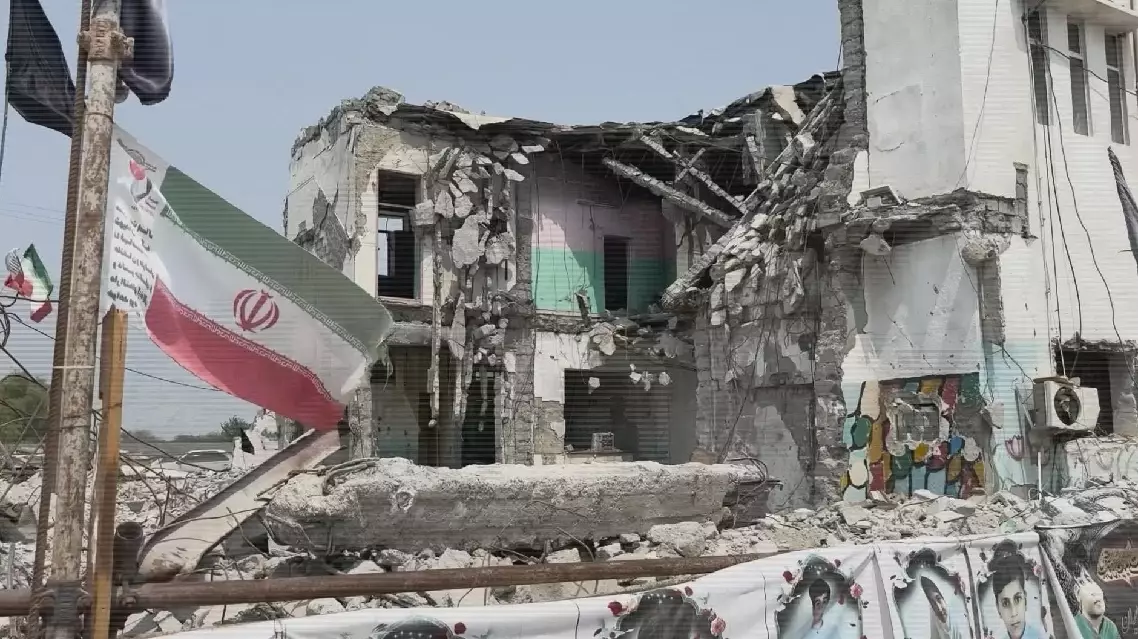
Students across Iran are preparing to return to their classrooms for a new school year. But in the southern city of Minab, where more than 160 pupils and teachers were killed by a U.S. missile strike on February 28, the pain and trauma of loss remain.
Standing at the site of the destroyed Shajarah Tayyebeh elementary school, Yasin, a student who survived the strike, recounted what he saw on the day the missile struck.
"When the sound of the explosion came, we came out of that section and through that door. As we went out, we saw everyone was covered in blood. One held his eye in his hand, another's neck was broken and blood was coming out. I saw one person who was hit by shrapnel here. Everyone was crying and running," said Yasin.
Yasin survived the attack but some of his closest friends did not.
"Amir Mohammad Bagheri was my close friend. He became a martyr. That day, he was standing right here, and I said to him, 'Come on, let's go and take the food container.' He said, 'Yeah,' so we went. But he went out through the hall. I went to pick up my food and came back. When I woke up in the morning, I read the news and saw that he had been martyred," said Yasin.
Months later, Yasin's mother said the attack had left Yasin under intense psychological pressure, and without the excitement he once had for school.
"He has absolutely no enthusiasm or passion for the new school year. He doesn’t say at all 'buy me shoes, buy me a bag for school.' I told him 'come and study,' and he said 'Forget it. I know it. My teacher taught me.' His teacher, of course, was martyred. He has become terribly nervous and aggressive. Whatever he has in his hand, he smashes it against his head. The children who survived the attack are very psychologically devastated, not just Yasin, all of them," said Yasin's mother.
For the new school year, many survivors including Yasin will be transferred to a temporary building to continue their education.
Minab city officials are now building a new school near the old one. Perhaps it will be bigger and better than the one that once stood there. But the pain of what happened there will never leave those who survived the deadly airstrike.
"We miss our friends. New friends will come to our school. We all study together. We learn knowledge. We continue on the path of our friends. I am not the only survivor; there are many others. Our friends are studying in heaven, while we are studying here on Earth," said Yasin.
Students in Iran's Minab endure pain, trauma of war as new school year begins