After more than a decade of restoration efforts by scientists and volunteers, corals in the waters off Dapeng New District in Shenzhen, south China's Guangdong Province, have begun reproducing sexually, a sign of the region's improving marine environment.
For more than a decade, scientists and volunteers have formed a close-knit scientific research team, each contributing their part to marine ecological restoration.
Volunteers planted the shield-shaped coral in 2015. When it was first planted, it measured only five cm in diameter. Now it has reached 50 cm. What excites them even more is that since 2020, they have filmed the spectacular scene of coral spawning in these waters on more than one occasion.
"Some corals spawn only once a year, and coral spawning is a large-scale, mass event -- all the corals release their eggs at the same time. It's a bit like what? We've all seen snow in north China. Snow falls from the sky downward, but coral eggs drift from the seabed upward. This spectacle is extremely rare, and it's a wonderful scene created by life. Because we used many macro cameras to capture it -- bursting out from inside the coral, then drifting bit by bit toward the middle of the sea, then floating up to the surface, and then they form planula larvae and fertilized eggs. The planula larvae eventually settle and become new corals. The spawning is also an affirmation of our entire marine environment," said Xiao Wei, manager of the operation and maintenance department of the Shenzhen Dapeng Coral Conservation Volunteer Federation, widely known as Dive for Love.
Corals were long misunderstood as a kind of plant, but in fact they belong to the class Anthozoa within the phylum Cnidaria -- their outer skeletons are made of calcium carbonate secreted by thousands upon thousands of coral polyps. Living corals continuously grow, much like tree branches or bones, and they also reproduce sexually.
As a seabed animal, whether a coral can spawn normally and reproduce sexually is a better measure of the ecological health index of the waters in which it lives.
"The coral we planted, it not only breeds, right? It can also reproduce sexually, so this is the most touching place in our coral conservation process for so many years," said Wang Xiaoyong, secretary general of Dive for Love.
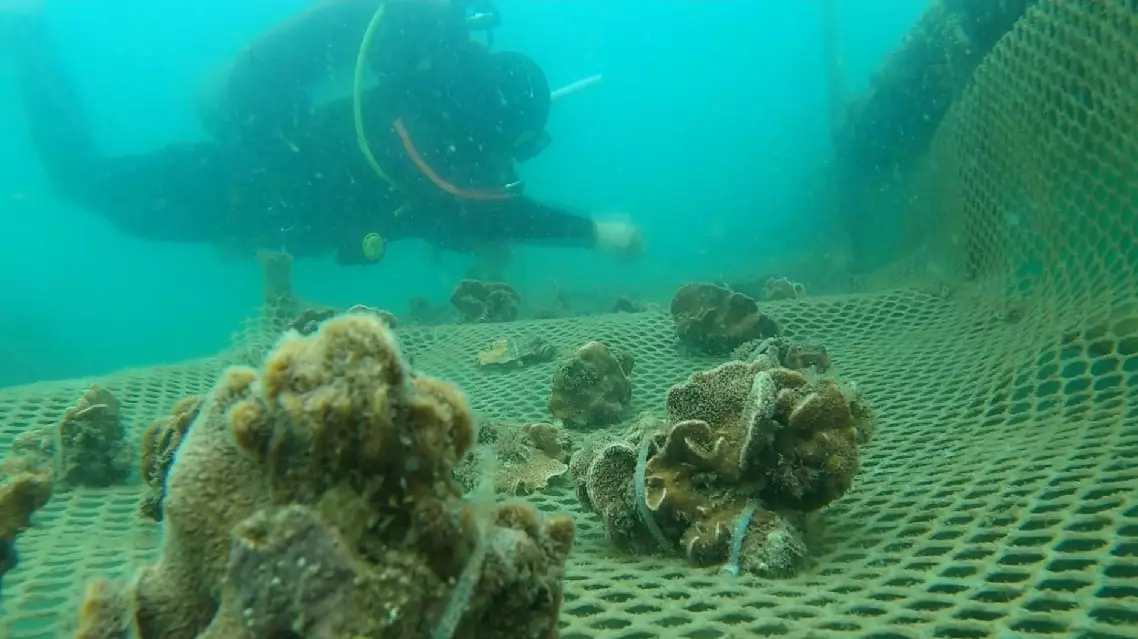
Shenzhen coral restoration bears fruit as corals spawn in wild