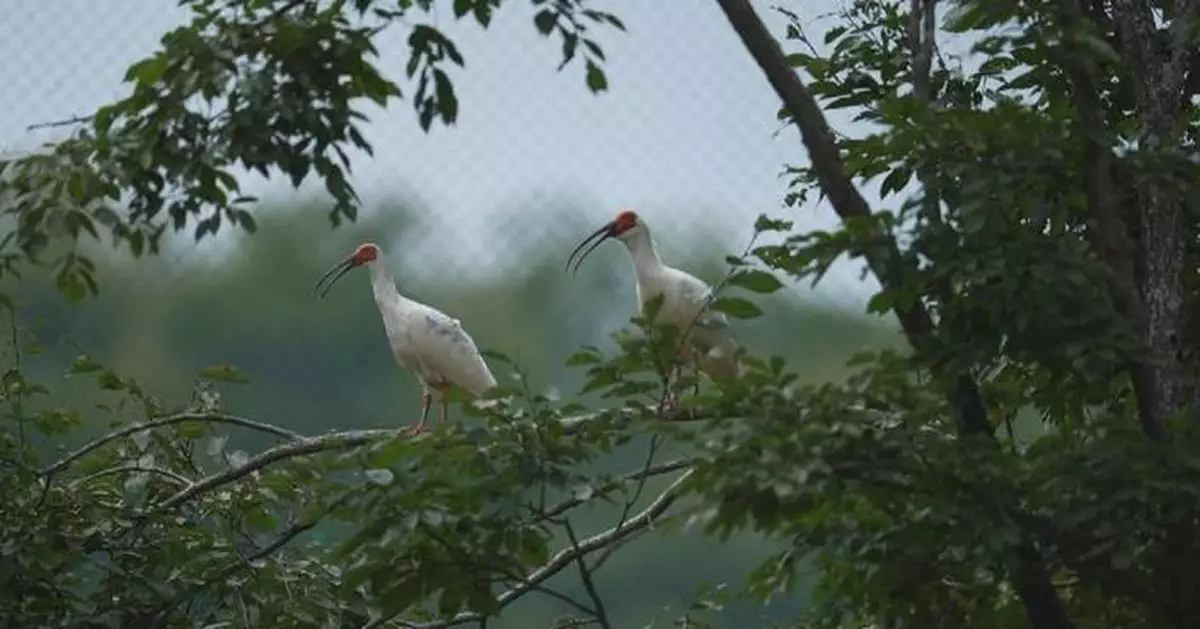
Northwest China's Gansu and Shaanxi Provinces have built a creative ecological model to help crested ibises thrive in the region while promoting the development of local agricultural industry amid intensifying efforts to increase the population of the endangered bird species.
In the latest effort, 20 crested ibises were released into the wild on Sunday in the Xiaolongshan forest area of Gansu, marking China's westernmost and highest-altitude release of the species to date.
The birds were bred at the Longmen Forest Farm's crested ibis ecological park in Tianshui, where the population has grown from 20 introduced in 2023 to 50 today. The release marks Gansu's first wild-release effort and a milestone in establishing high-altitude populations of the species.
Gao Xin, deputy director of the ecological park, said to ensure that the released crested ibises will have enough food source, they have transformed more than three hectares of wasteland into paddy fields, where small fish, shrimps and river snails can breed.
"Our ecological park sits at a relatively high altitude, and water freezes here in winter. Once the river freezes over, crested ibises cannot find food. However, we will keep water running in our paddy fields [in winter]," said Gao.
Conservationists have also cleared and restored nearby natural wetlands and watercourses to help birds forage.
"We dredged the watercourse to a depth of around five to 10 centimeters, the optimal depth for crested ibises to forage," said Gao.
Crested ibises rely on tall trees for nesting and roosting, but dense growth makes it more difficult for them to take off or land.
Gao said the ecological park controls tree density to maintain aerial pathways for the ibises, and conservationists have created an innovative model to recycle the harvested logs.
"We have adopted an agri-forestry integrated development model that is crested ibis-friendly. Since crested ibises need to rest in woodlands, we cut some of the trees and turn them into logs for cultivating wood ear mushroom. After wood ears are harvested, the logs will be crushed to grow other mushrooms. The residual materials will be spread across the woodland to build up humus and boost growth of forest," said Gao.
"Actually, crested ibis serves as a flagship species to drive overall local ecological conservation. We aim to achieve harmonious coexistence between crested ibises and human beings through ecological industrialization and industrial ecological transformation," said Lu Baozhong, former deputy director of the Administration of Crested Ibis National Nature Reserve in Hanzhong City, Shaanxi Province.
Historically widespread in East Asia, the crested ibis nearly disappeared from the wild due to environmental changes and human activity. On May 23, 1981, Chinese scientists discovered the last seven wild crested ibises in Yangxian County in Hanzhong City, Shaanxi. Intensive conservation efforts were launched shortly after that.
As of the end of 2025, the global population of the crested ibis had exceeded 12,000, and its habitat had expanded to more than 20,000 square kilometers, according to the statistics from the Forestry Bureau of Shaanxi Province. The species has been lowered from the "Critically Endangered" status to "Endangered" on the International Union for Conservation of Nature (IUCN) Red List.
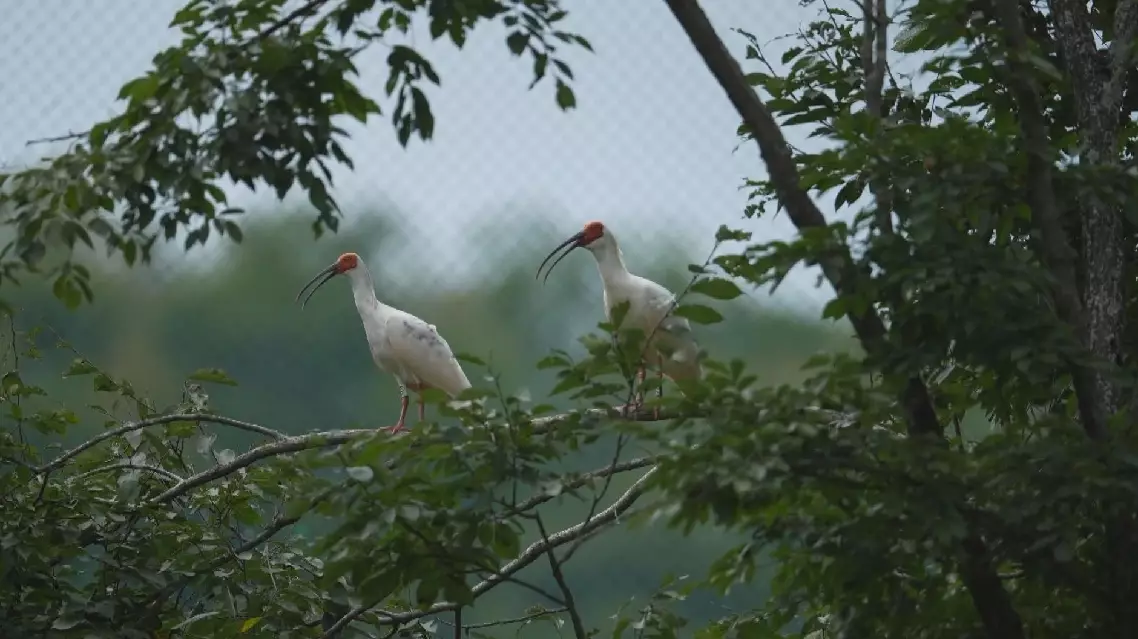
Gansu, Shaanxi in northwest China build creative ecological model for endangered bird species