
Skip to Content Facebook Feature Image

‌Over 300 intelligent robots showcase cutting-edge applications at Hangzhou exhibition

China

‌Over 300 intelligent robots showcase cutting-edge applications at Hangzhou exhibition
China

China

‌Over 300 intelligent robots showcase cutting-edge applications at Hangzhou exhibition

2026-09-20 17:16 Last Updated At:18:47

An intelligent robot exhibition opened Sunday in Hangzhou, east China's Zhejiang Province, featuring over 300 robots showcasing cutting-edge applications from public safety to automated agriculture.

Organized by China Media Group, the Zhejiang leg of the Intelligent Robot Application Skills Exhibition brought together over 60 companies featuring innovations across special operations, smart commerce, and public services.

Visitors at the exhibition saw a distinct shift toward integrated robotic systems working together rather than standalone units. Among the highlights was a complete water rescue suite developed by the Zhejiang Public Security Department, including a robotic rescue boat, an underwater patrol fish, automated flying lifebuoys, a rescue robot, and supportive exoskeletons for police officers.

"This equipment is an enhanced version of our standard police eight-piece gear set. The regular police eight-piece kit weighs around six kilograms, which is relatively heavy during daily on-duty operations and adds extra physical burden to police officers. The police exoskeleton equipment can provide a maximum assist force of 30 kilograms. This model is specially designed for SWAT officers, as it is equipped with a more powerful motor to adapt to the high-intensity tasks of SWAT teams. This other variant is for the traffic policemen, which features a supportive structure on the back, offering back protection for traffic police officers during long hours of on-road duty and stationary posts," said Qiu Yuan, policeman of the Yuhang District Branch under the Hangzhou Public Security Bureau.

A tea-picking robot is also featured at the exhibition. Built with crawler tracks rather than legs, it easily navigates muddy mountainous terrain. Its robotic arm is engineered to mimic human fingers, using a tiny blade to pinch off tender tea leaves with precision.

In actual operation scenarios, the tea-picking robot can pick one tender bud per second on average, and it has achieved full independent research, development and domestic production.

China Media Group launched its first Intelligent Robot Application Skills Exhibition in Beijing in July, aiming to help smart robots find practical use across more fields and inject fresh momentum into economic and social development.

‌Over 300 intelligent robots showcase cutting-edge applications at Hangzhou exhibition

‌Over 300 intelligent robots showcase cutting-edge applications at Hangzhou exhibition
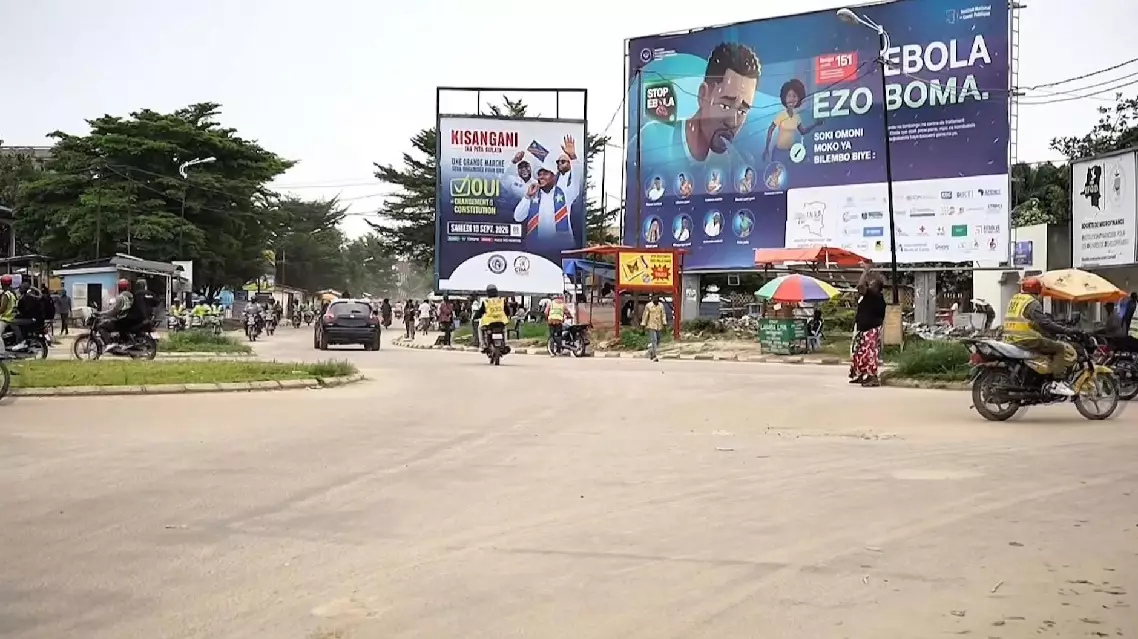
A massive public health blind spot has emerged in the Ebola response in the Democratic Republic of the Congo (DRC), as communication barriers are leaving many people with hearing impairment cut off from crucial health information about the deadly outbreak.

Since the ongoing Ebola epidemic was declared in May, the Congolese Red Cross (CRC) has launched a nationwide awareness-raising campaign, with posters put up on the streets and health messages broadcast on television and radio stations to reach as many residents as possible.

However, for the nation's deaf community, these life-saving updates have been hitting a wall of silence.

In the northeastern city of Kisangani, many deaf people still struggle to understand the message being disseminated, as it is not tailored to their specific needs.

"So far, preventive measures have only been explained to us superficially. We aren't truly equipped. We need adapted educational materials to better understand the signs of the disease and recognize the symptoms of Ebola," said Zacharie Dunga, director of the Espoir School for the Deaf in Kisangani.

The DRC government has announced targeted intervention plans, promising to restructure its public health response to fully integrate people with disabilities.

"We have implemented a range of strategies tailored to each group, including people with disabilities --the visually impaired, and the deaf or hard of hearing. We have produced communication materials in Braille. We are also refining our messaging to see how we can incorporate sign language interpreters to convey information regarding EVD (Ebola Virus Disease)," said Christian Tshilenge, an expert in risk communication and community engagement.

The current outbreak has become the largest and deadliest Ebola epidemic in the DRC's history and the second largest globally, behind the 2014-2016 epidemic in West Africa.

According to the latest data released by the DRC government, the country has recorded 7,541 confirmed Ebola infections as of Saturday, with 3,639 fatalities.

Communication barriers put deaf community at risk amid ebola outbreak in DR Congo

Communication barriers put deaf community at risk amid ebola outbreak in DR Congo

Recommended Articles