MUNICH--(BUSINESS WIRE)--Sep 21, 2026--
Everbridge, the global leader in High Velocity Critical Event Management (CEM) and national public warning solutions, today shared details of the Everbridge European Operational Resilience Summit, taking place 6th October at Allianz Arena in Munich, Germany.
This press release features multimedia. View the full release here: https://www.businesswire.com/news/home/20260921066482/en/
The invitation-only Summit will bring together security, risk, and business continuity leaders from across Europe to discuss how organisations can strengthen operational resilience amid a rapidly changing risk landscape. Senior executives from Everbridge, AWS, Allianz, ServiceNow, Arcadis, and leading European organisations will share perspectives on emerging challenges, best practices, and strategies to prepare for, respond to, and recover from disruption.
European organisations are navigating an increasingly complex operating environment shaped by cyber threats, geopolitical instability, evolving regulatory requirements such as DORA and NIS2, and the rapid adoption of artificial intelligence. These challenges are elevating operational resilience as a board-level priority and increasing the need for coordinated response across people, processes, and technology.
“Organisations across Europe are being asked to prepare for a wider range of disruptions while maintaining continuity of critical operations,” said Graeme Orsborn, Vice President, EMEA, at Everbridge. “This Summit is an opportunity to bring leaders together to share practical experiences, examine what's changing, and discuss how organisations can strengthen resilience by identifying risk earlier, responding faster, and continuously improving how they prepare for disruption.”
Discussions throughout the Summit will explore Europe's risk and regulatory landscape, real-world lessons in crisis leadership, coordination across security, IT, and business operations, and the opportunities and challenges presented by AI and automation. Designed for CSOs, CISOs, CIOs, COOs, heads of operational resilience, and business continuity leaders, the Summit will focus on practical strategies for using AI and automation to improve decision-making and accelerate response while maintaining appropriate governance, transparency, and human oversight.
The Summit follows the recent introduction of Everbridge 360 AI, the next evolution of the company’s High Velocity Critical Event Management platform, which applies purpose-built AI to help organisations strengthen operational resilience.
The Everbridge European Operational Resilience Summit will take place 6th October 2026 at Allianz Arena in Munich. The formal programme runs from 10:30 to 15:30, followed by networking and an optional stadium tour through 17:30.
For more information or to request attendance, visit the event registration page.
About Everbridge
Everbridge helps more than 6,500 enterprises and government organizations manage critical events by enabling them to know earlier, respond faster, and improve continuously. Through an all-in-one AI-powered platform, Everbridge High Velocity CEM™ is autonomous when you want it to be and human-guided when you need it to be, so every incident response is optimized. For more information, visit everbridge.com and follow us on LinkedIn.

Everbridge to Convene European Business Leaders in Munich for Operational Resilience Summit
BERLIN (AP) — German Chancellor Friedrich Merz faced a struggle to stabilize his position and keep his agenda on track Monday after voters inflicted two more defeats on his party, ejecting it from a state legislature for the first time in its eight-decade history.
The unpopular Merz vowed to stay on and push through reforms to Germany, Europe's biggest economy, minutes after polls closed Sunday in regional elections in Berlin and in Mecklenburg-Western Pomerania, a largely rural eastern region on the Baltic Sea coast.
Still, final results underlined the extent of what Merz conceded was a “disaster” in Mecklenburg-Western Pomerania. His center-right Christian Democratic Union fell just below the 5% of the vote needed to keep seats in the regional parliament, the first time that has happened in 77 years of modern Germany's federal republic, after losing more than half its support.
The CDU also dropped to second place in Berlin behind the hard-left Left Party, which is in pole position to lead the next city government — though Merz's party could, depending on how coalition talks go, still retain city hall.
Neither state is one of Germany's political heavyweights. The CDU's 2023 win in Berlin was its only one in the past 25 years in the capital, which has tended to lean left, and the party was already weak in Mecklenburg-Western Pomerania.
But the manner of its defeat in the latter in particular adds to the headwinds Merz faces after a stinging defeat by the far-right Alternative for Germany two weeks ago in Saxony-Anhalt, another region in the formerly communist east, damaged his authority and set off speculation that he might be replaced.
Alternative for Germany, or AfD, emerged as the strongest party in Mecklenburg-Western Pomerania, but the center-left Social Democrats — the junior party in Merz's national governing coalition — were fairly close behind after a campaign focused squarely on the state governor, Manuela Schwesig, as a bulwark against the far-right party. That polarization helped squeeze other mainstream parties, including the CDU.
A left-leaning three-party coalition under Schwesig would have a majority in the new regional legislature.
Schwesig and others in the governing parties have cast doubt on aspects of the federal government's reform agenda, which is meant to bolster a chronically sluggish economy. The reform plans include a potentially painful overhaul of the creaking pension system, a reduction of Germany’s stifling bureaucracy and cuts to income tax for low- and middle-income families.
The head of the Social Democrats' group in the national parliament, Matthias Miersch, said it was clear that “we need reforms.” But he told ARD television that “we must also take people's concerns seriously.”
Merz faces more meetings Monday with his party's leadership. Much will depend on the CDU's influential regional leaders; the party's eight state governors last week backed the chancellor, though questions remained about how wholehearted their support was.
There are at least no more electoral tests this year. However, five state elections are scheduled next year, three of them in April.
They include one in North Rhine-Westphalia, Germany's most populous state, currently led by a prominent CDU figure often cited as a possible successor to Merz, Hendrik Wüst. None of the five elections is in the east, where AfD is strongest.
“I don't see that swapping out a leadership figure would really bring a change,” Education Minister Karin Prien, who is also a deputy CDU leader, told Phoenix television, adding that she doesn't see “another personnel offer” coming.
“So we must now discuss with one another — together with the chancellor as a government, and on the other hand as a party — how we win more acceptance and more credibility among the population,” Prien said.
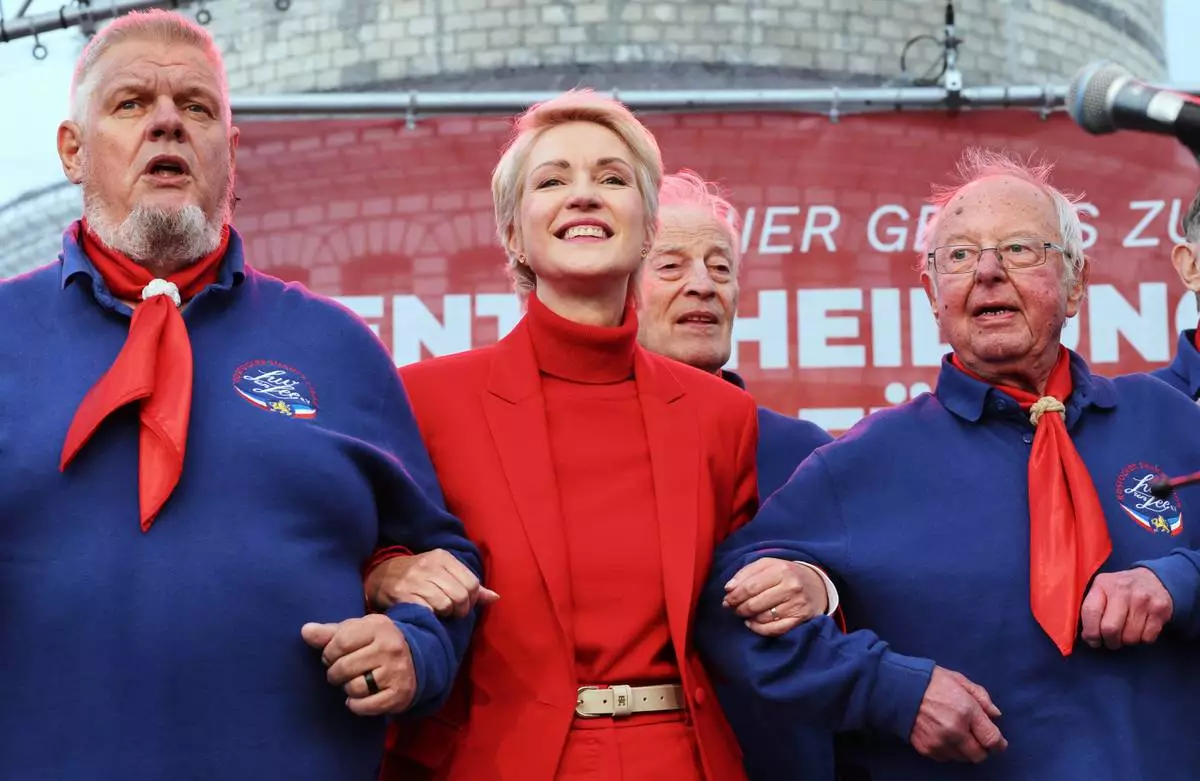
Manuela Schwesig (SPD), center, minister-president of Mecklenburg-Western Pomerania, stands on stage alongside members of the Rostock shanty choir Luv un Lee at a campaign event in Warnemünde, Germany, on Friday, Sept. 18, 2026. (Bernd Wüstneck/dpa/via AP)
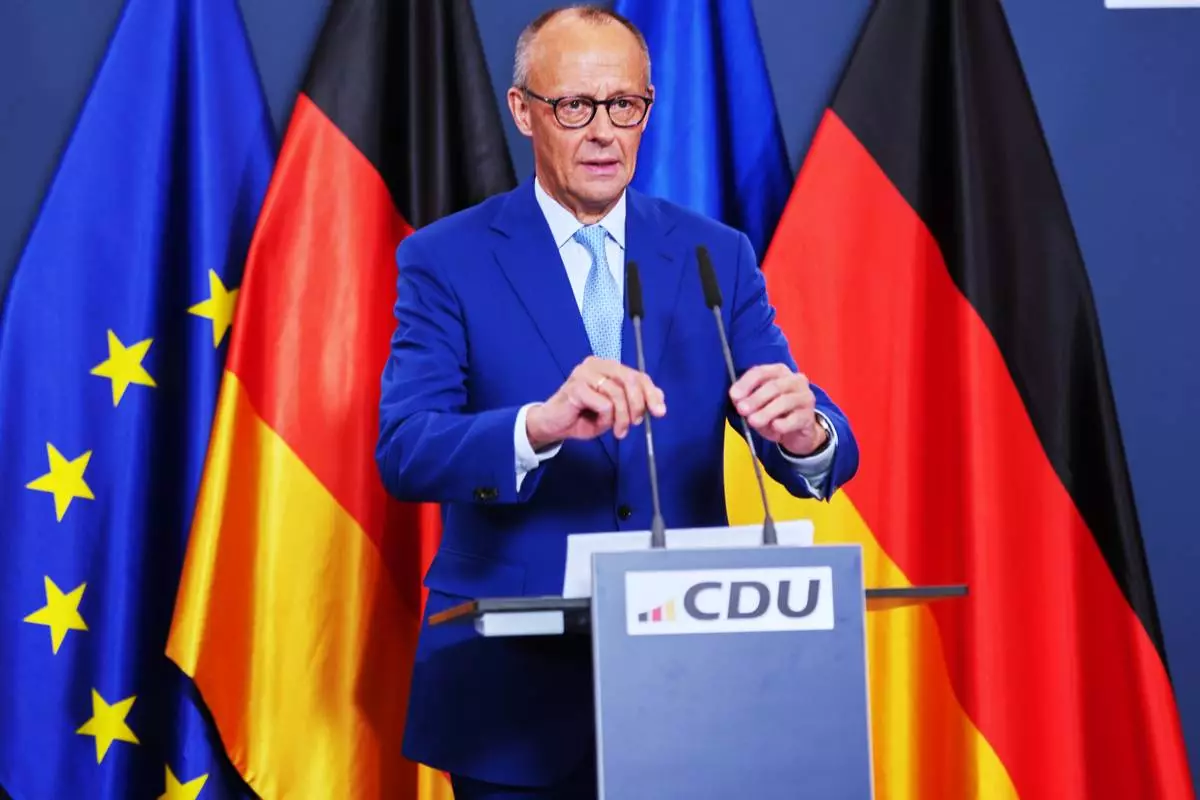
German Chancellor Friedrich Merz speaks to media at the Christian Democratic Union party headquarters in Berlin, Germany, Sunday, Sept. 20, 2026. (AP Photo/Markus Schreiber)