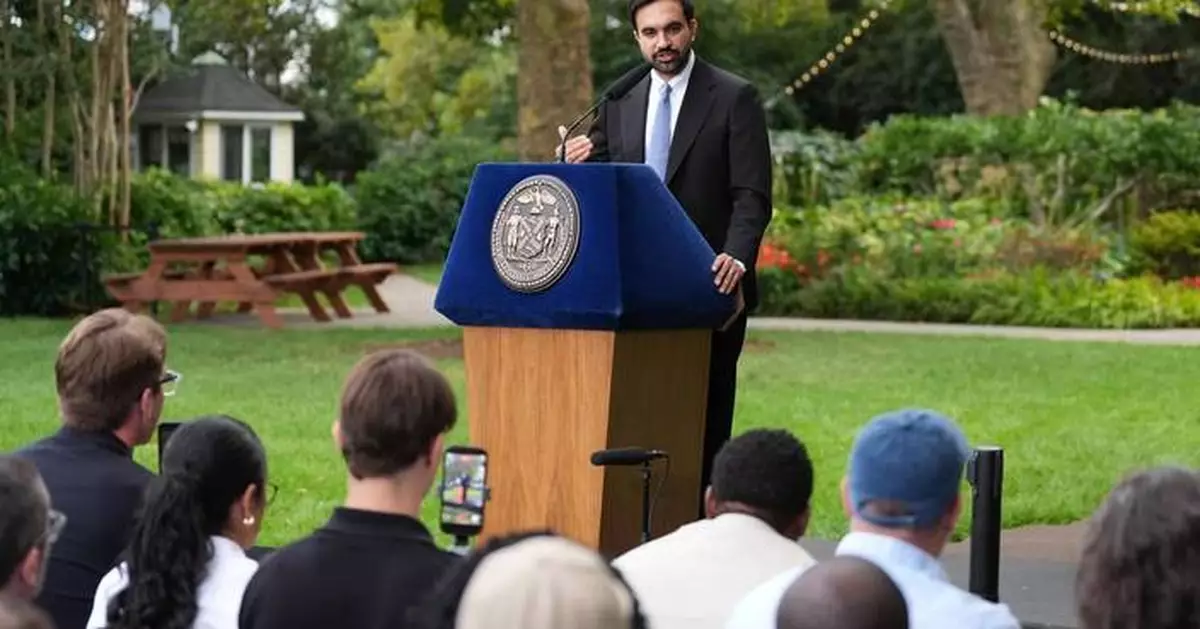
NEW YORK (AP) — President Donald Trump's trip to New York for a speech at the United Nations started Monday with a detour to Gracie Mansion for an hourlong chat — and a trip down memory lane — with Mayor Zohran Mamdani.
The president, appearing with Mamdani after their meeting, reminisced about his previous visits to the official residence of the city's mayors and recalled “great ones and some not so great ones” who have led the city in the past.
"Hopefully you're going to be a great one," he said, giving Mamdani a pat on the back. “And you're off to a start.”
The meeting was the latest cordial encounter between the Republican president and a democratic socialist mayor, who have struck up a surprisingly warm relationship despite their lack of political overlap, and have tried to find common ground in helping the city they both love.
With scores of world leaders arriving in the city for the United Nations General Assembly, there Trump stood beside Mamdani on the lawn of the custard-yellow mayoral mansion in Manhattan.
“I have a lot of meetings right now, very important meetings with heads of different countries, but this is like a little bit of old home week for me,” Trump said, adding “We've done so many things from the beautiful home or house or building standing right behind me.”
Trump and Mamdani told reporters they discussed a potential housing project in the borough of Queens and how to make New York more affordable for the working class.
They have met at least twice previously and have appeared to maintain some level of contact with one another, though the mayor stays tightlipped about any ongoing conversations with the president.
The pair of polarizing leaders first gathered in the Oval Office shortly after Mamdani’s election victory last year for a surprisingly cordial confab that centered on ways to help their shared hometown, a detente that came after months of verbal sparring.
A few months later in February, Mamdani again took a quick jaunt to Washington to present Trump with a mock New York Daily News front page that said “Trump to City: Let’s Build,” as he pitched new housing investments in the city.
As they did after their first Oval Office meeting, Trump and Mamdani acknowledged their political and policy differences while standing side by side.
Mamdani was asked about Trump's decision to bar certain news outlets from the White House, with the mayor saying it was important that those networks, and others, be present for the Gracie Mansion event. Trump then defended his restrictions on the news organizations whose coverage he called biased.
“It’s interesting because they said they were gonna boycott me. But they never boycott me,” the president said, before adding, “I think that these outlets have an obligation to be fair.”
Trump's previous visits to Gracie Mansion included attending the 2003 wedding of former Mayor Rudy Giuliani and a 2007 book party for former Democratic U.S. Rep. Charles Rangel.
After Trump left, Mamdani returned to the lawn to answer a few more questions, telling reporters that he and the president have sharp disagreements but that the relationship has endured nevertheless.
“I will continue to have conversations with the president, and frankly, anyone who can deliver relief to the people of this city,” Mamdani said.
Associated Press writer Kimberlee Kruesi contributed to this report from Providence, Rhode Island.
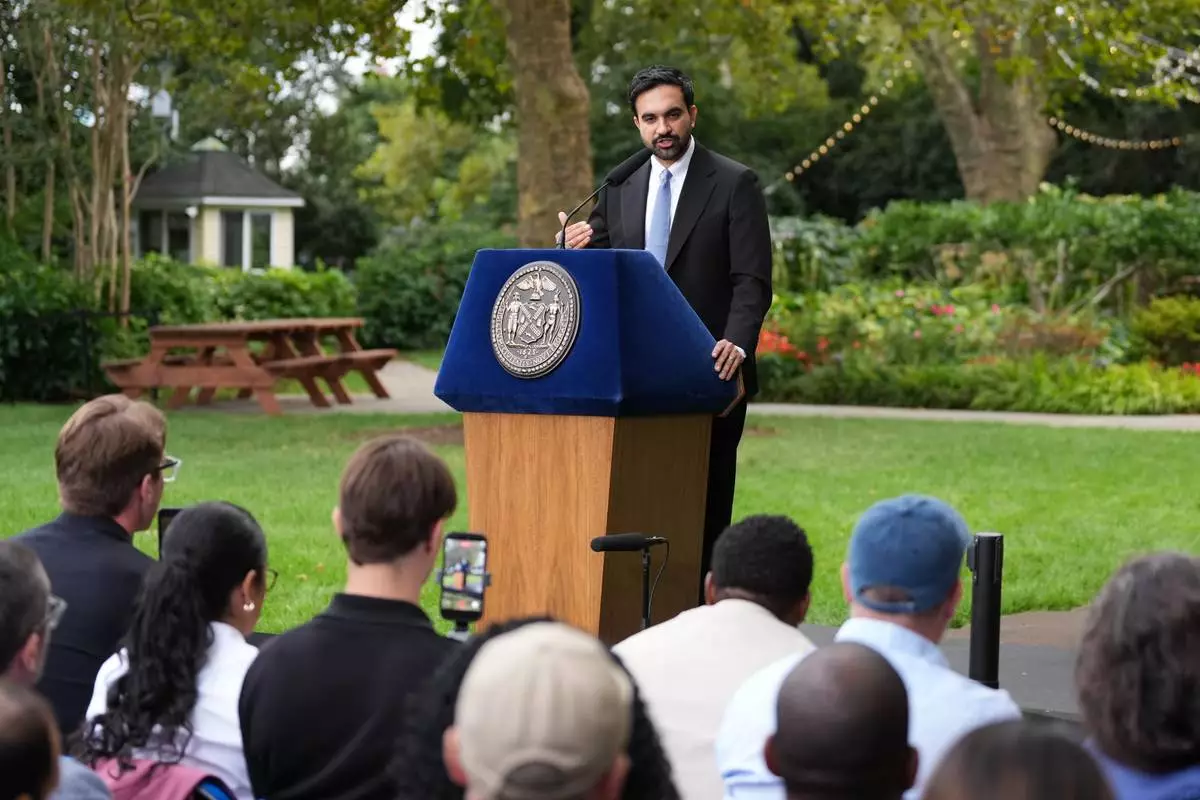
New York City Mayor Zohran Mamdani speaks to media after his meeting with President Donald Trump, Monday, Sept. 21, 2026, in New York. (AP Photo/Adam Gray)
JEFFERSON CITY, Mo. (AP) — A long-running legal fight over Missouri’s congressional map took another turn Monday when a federal appeals panel ruled in favor of new districts backed by President Donald Trump, even though the U.S. Supreme Court has blocked those districts from being used in the November election.
A three-judge panel of the 8th U.S. Circuit Court of Appeals said Missouri should use the new Republican-drawn U.S. House districts in the November election, just as the state did in its August primary. To revert to its prior districts for the general election would violate the U.S. Constitution, the appeals judges said.
The appeals panel directed a lower court judge to issue a permanent injunction against using anything other than the map favored by Trump. But the ruling has no immediate impact. That’s because the panel also ordered the judge to delay the effect of the order for one week to allow time for an appeal. The judge quickly did so.
Opponents of the new map said Monday that they will file an emergency appeal to the U.S. Supreme Court.
The Supreme Court already has twice sided against the Trump-backed map. Earlier this month, it blocked enforcement of a lower court order favoring the new map pending a potential appeal and eventual decision by the high court.
Missouri currently is set to run its November election with the same congressional districts it used in 2024 and 2022, following prior decisions by both the Missouri Supreme Court and the U.S. Supreme Court.
Local elections officials already have sent absentee ballots to overseas citizens and military voters using the 2022 districts. State law requires absentee ballots to be available to all other voters by Tuesday.
Local elections officials theoretically could scramble to change ballots again and could send replacements for ones already distributed. But if voters already have cast an absentee ballot, they cannot change their vote — even if the district boundaries have changed.
Miller County Clerk Clinton Jenkins said he mailed an absentee ballot Friday to a Missouri voter living in Australia and also sent ballots to other overseas voters. But he suggested that other people “wait a little deeper into the absentee period, just in case” the congressional district boundaries get swapped again.
To try to change districts at this late date would be “practically impossible” and cost hundreds of thousands of dollars, the Missouri Association of County Clerks and Election Authorities had told appeals judges in a legal filing.
But an attorney representing Republicans who sued — including U.S. Rep. Bob Onder and state Sen. Rick Brattin, a congressional candidate — suggested during arguments last Thursday that there still is time to revert to the Trump-backed map.
The appeals panel agreed, pointing to other cases in which courts have ordered changes after absentee ballots already had been distributed to overseas citizens and military voters.
The group People Not Politicians, which spearheaded a referendum petition to put the new map to a statewide vote on the November ballot, said it will appeal the latest decision to the U.S. Supreme Court.
“Ballots have been printed, and Missourians have already voted. Thousands more will vote before this order seeks to take effect,” Richard von Glahn, executive director of People Not Politicians Missouri, said in a statement. “Officials should stop wasting taxpayers’ money on pointless legal action and instead focus on administering our elections.”
The 8th Circuit decision puts the federal court at odds with Missouri's top court.
“The Constitution does not permit Missouri to use a different congressional district map in the November 2026 general election than it used in the August 2026 primary election,” the appeals panel wrote in its decision.
The panel consists of Judge James Loken, an appointee of former President George H.W. Bush, and two appointees of Trump — Judges David Stras and Justin Smith. Prior to his June appointment, Smith was an attorney who represented Trump as he unsuccessfully appealed a $5 million jury verdict in a lawsuit filed by the writer E. Jean Carroll to the U.S. Supreme Court.
Earlier this month, the Missouri Supreme Court said the state forbids the use of districts passed last September because opponents submitted thousands of petition signatures in December calling for a statewide vote on the new districts.
Republican Secretary of State Denny Hoskins waited until August — on the same day that the primary was held under the new districts — to reject the petition. He asserted that referendum petitions aren’t allowed for congressional redistricting.
The Missouri Supreme Court reversed Hoskins’ finding, ruling that the state must use the districts approved in 2022 for the November election. The high court then temporarily held Hoskins in contempt when he directed local election officials to use the 2025 map after a federal district court order favoring it.
The new congressional map backed by Trump significantly reshapes a Kansas City-based district held by Democratic Rep. Emanuel Cleaver. Republicans hope the map could help them win seven of the state’s eight House seats — one more than they currently hold.
Cleaver was unopposed in the Democratic primary, and Brattin won a multi-way Republican primary. Brattin praised Monday's appeals panel decision, saying that switching districts after the primary “defies common sense and undermines the entire electoral process.”
About 59% of the 5th District's potential voters are new under the revised map, which also changes several other districts. All told, more than a million potential Missouri voters, or nearly 1 in 4 voters statewide, are affected by the redistricting, according to an Associated Press estimate.
Missouri’s redistricting battle has been the longest and most complex among roughly a dozen states that sought to change their U.S. House districts over the past year. Districts are usually redrawn at the start of each decade, after a census. But Trump spurred a spate of mid-decade redistricting last year when he urged Republican-led states to redraw districts to gain an edge in the midterm elections that will determine control of Congress.
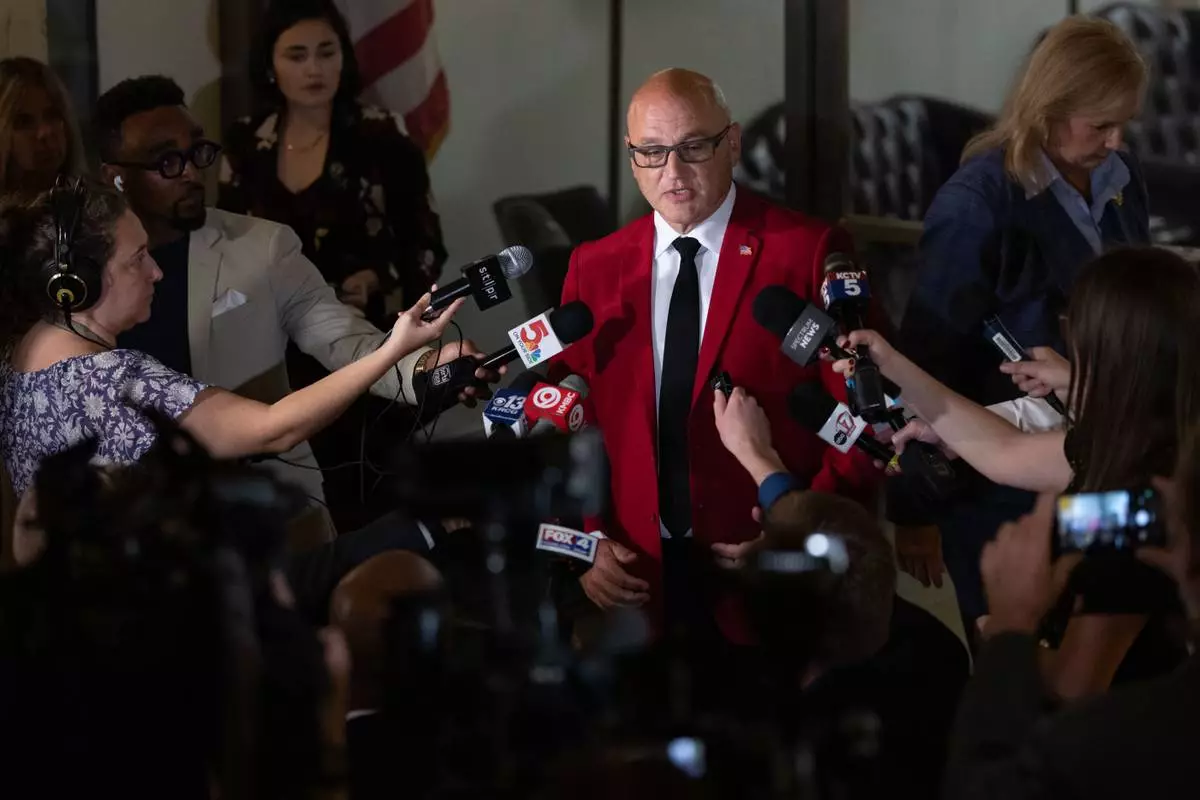
Missouri Secretary of State Denny Hoskins speaks to members of the press after his contempt hearing at the Missouri Supreme Court in Jefferson City, Mo., Thursday, Sept. 10, 2026. (Liz Rymarev/St. Louis Post-Dispatch via AP, Pool)