Skip to Content Facebook Feature Image

40 days to midterms, election officials say new US cyber plan comes too late

News

40 days to midterms, election officials say new US cyber plan comes too late
News

News

40 days to midterms, election officials say new US cyber plan comes too late

2026-09-25 05:35 Last Updated At:05:40

NEW YORK (AP) — The nation’s cybersecurity agency on Thursday released an election infrastructure security plan 40 days before November’s midterms, laying out potential threats to election systems and listing services it would offer to election officials to protect the vote.

Election officials said the plan is both inadequate and belated after the administration gutted the agency’s election security work last year, prompting the officials to pay for private services to ensure they were prepared for the upcoming elections.

“For them to come in five weeks before the election, yeah, nice effort,” said Nevada's Democratic Secretary of State Cisco Aguilar, who added that he would have liked to see the federal government provide more funding for cybersecurity, rather than Nevada taxpayers having to pay for it.

Homeland Security Secretary Markwayne Mullin had originally promised to release the plan by mid-August as part of the Trump administration's move to kickstart election security assistance after a hiatus. He announced the plan at the same time he threatened election officials for not cooperating with the administration's preferred methods to hunt down noncitizen voting, a phenomenon that research shows is extremely rare.

The U.S. Cybersecurity and Infrastructure Security Agency, which is housed under the Department of Homeland Security, has since its founding in 2018 helped warn state and local election officials about potential threats from foreign governments.

But CISA, as it’s known, was largely absent from that role in last year’s elections after the Trump administration dismantled much of its role in election security. The administration cut some 1,000 employees from CISA and slashed $10 million from two cybersecurity initiatives, including one dedicated to helping state and local election officials.

CISA has also gone the entirety of Trump’s second term without a Senate-confirmed director, instead cycling through a series of acting leaders.

The 13-page document released Thursday warns of various threats to election security, including software vulnerabilities, hacks of voter registration databases, insider threats and physical security incidents, such as bomb threats that targeted several polling locations in the 2024 elections.

But it affirms that many longstanding election practices can address such threats and says the agency’s goal is “to ensure the American people can trust voting systems and know that physical safety measures will be in place when they go to their assigned polling locations to cast their votes.”

It states that DHS has “consistently supported CISA’s delivery of cybersecurity and physical security services to election officials,” something numerous election officials around the country have said isn't true.

Multiple secretaries of state told The Associated Press that services previously provided by CISA, such as live tabletop exercises and penetration tests to evaluate security of their systems, were not available in the lead-up to this year's midterms.

Minnesota Secretary of State Scott Simon, a Democrat, said in August that his office expects to spend roughly $250,000 on private vendors to conduct penetration testing, which can expose security vulnerabilities and recommend actionable fixes.

Shenna Bellows, the Democratic secretary of state in Maine, told the AP the same month that communications with CISA had been “sporadic and irregular, to say the least.” She said it would be helpful if the Trump administration could restore intelligence briefings that used to be granted to election officials about threats from foreign adversaries, but noted that trust with federal officials had been broken with the cuts to the agency.

Thursday's plan doesn't mention any specific 2026 threats from adversaries like Russia, Iran or China, all of whom have sought to meddle in U.S. elections — either directly through hacking or indirectly through influence campaigns.

Kris Warner, the Republican secretary of state in West Virginia, said Thursday that some of CISA’s assistance to his state had been continual throughout the Trump administration, including no-cost reviews of its public-facing websites for cybersecurity issues.

Warner acknowledged CISA had cut back under the Trump administration but said he views the agency “as a resource and not as a service provider” and said his office had last year hired a departing CISA election security adviser who has helped fill any gaps that may exist.

In early August, two CISA officials — acting director Nick Anderson and assistant director for integrated operations Jim Harrell — joined a National Association of Secretaries of State call attended by a bipartisan group of secretaries of state, according to several election administrators.

The call grew tense when Arizona's Democratic Secretary of State Adrian Fontes voiced his concerns about the withdrawal of federal resources.

Fontes told the AP at the time that he told the CISA officials he didn’t trust them. He said it seemed to him the officials were there “to cover their butts.”

“They even acknowledged on the call that it was too late for them to do anything for 2026,” he said.

Simon said the officials appeared interested in rebuilding relationships and previewing their future plans, which he appreciated. But he said the effort at goodwill came later than election officials needed.

“Secretaries of state have already moved on and sought other partners and other resources for the services that CISA has retreated from over the last year and a half,” Simon said.

In Michigan, where mail ballots have already been sent out for the Nov. 3 elections, Deputy Secretary of State Aghogho Edevbie said the state’s relationship with CISA has been “nonexistent” this year despite working together closely in previous election cycles.

“If the federal government wants to be helpful, they can’t do so at the 11th hour,” the Democrat said.

Ashiya Brown, the Michigan state director of the voting rights group All Voting Is Local, agreed. She noted the new plan says CISA has 10 regional directors to support election administrators but still doesn't answer her biggest question.

“Does CISA still have the people and capacity to provide that support when clerks need it?” she asked. “I’m glad CISA has put forward a plan, but what matters now is whether the support described in it reaches local election officials before November.”

CISA has been hiring on its website for new positions, Brown said, but it's unclear whether they are all staffed yet.

Meanwhile, Brown, a former security official with the Michigan Department of State, said her group has hired former CISA employees to help provide training and other support to election clerks and fill the gap.

Edevbie said even without collaboration with CISA, he is confident the state’s elections are secure.

“We are always prepared to defend our elections and to ensure that every voter who is eligible to cast a ballot can do so here in Michigan,” he said.

Associated Press writers Jessica Hill in Las Vegas and Jacqueline GaNun in Lansing, Michigan, contributed to this report.
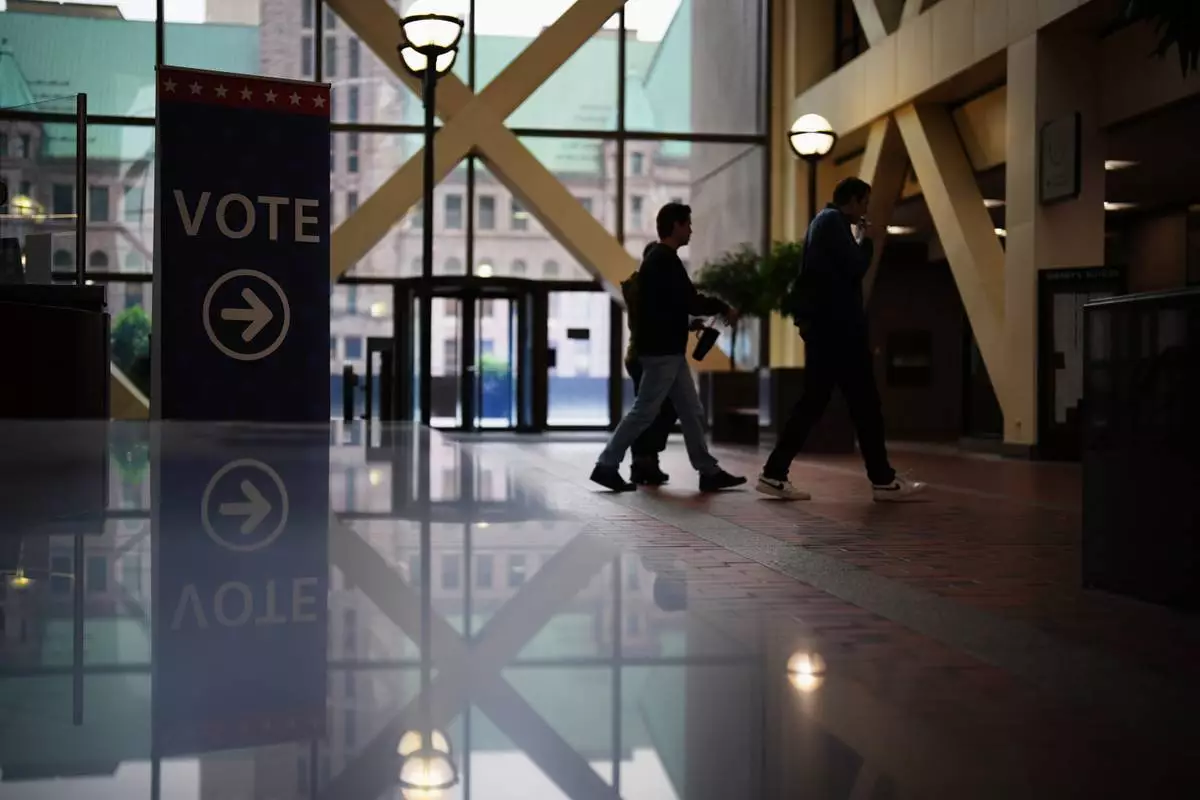
People walk past a sign directing voters on the first day of early voting in Minnesota at the Elections & Voter Services building in Minneapolis, Friday, Sept. 18, 2026. (AP Photo/Ellen Schmidt)
People walk past a sign directing voters on the first day of early voting in Minnesota at the Elections & Voter Services building in Minneapolis, Friday, Sept. 18, 2026. (AP Photo/Ellen Schmidt)

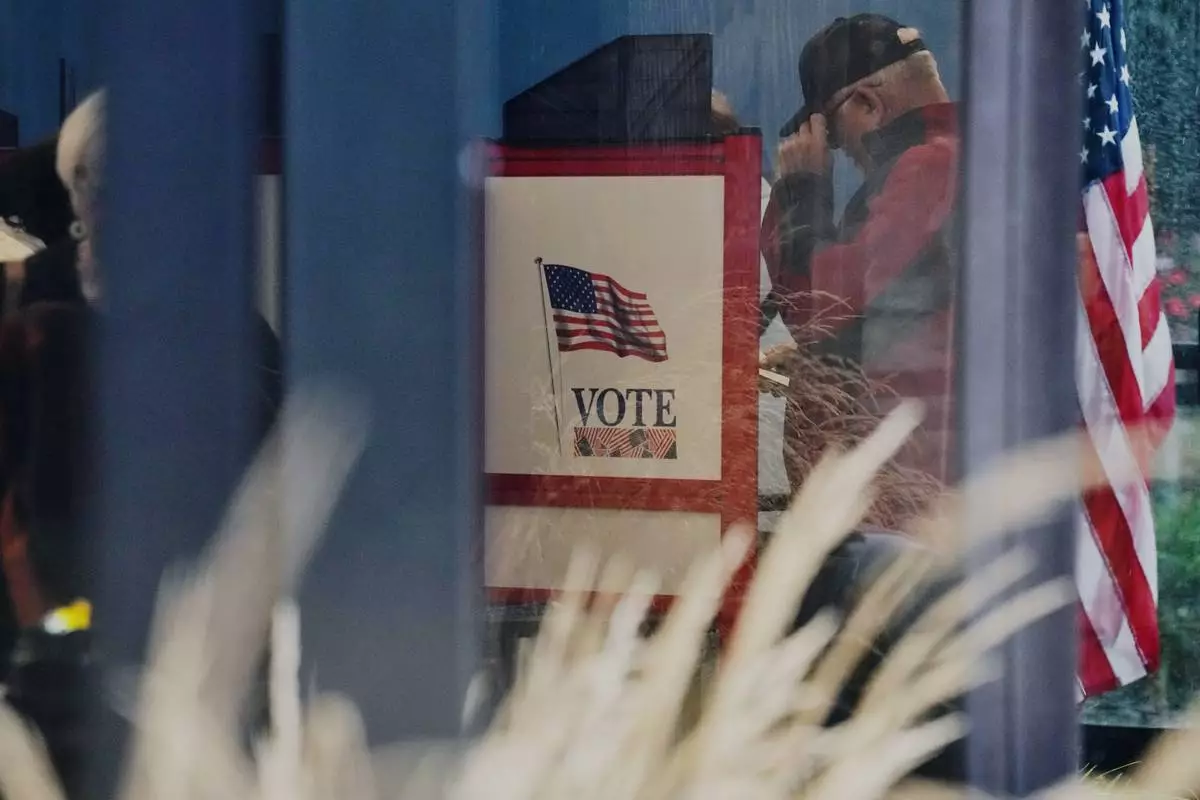
A voter casts a ballot on the first day of early voting in Minnesota at the Elections & Voter Services building, Friday, Sept. 18, 2026, in Minneapolis. (AP Photo/Ellen Schmidt)

A voter casts a ballot on the first day of early voting in Minnesota at the Elections & Voter Services building, Friday, Sept. 18, 2026, in Minneapolis. (AP Photo/Ellen Schmidt)
MEDINAH, Ill. (AP) — Best of friends in golf, winless as partners in team play, Scottie Scheffler and Sam Burns looked like that dubious drought might continue Thursday in the Presidents Cup.

Min Woo Lee and Sungjae Im had the advantage on four straight holes along the back nine and finally converted for a 1-up lead. And then the Americans took over at just the right time. Burns hit an 8-iron to 2 feet on the 14th. Scheffler closed out the International side with a superb bunker shot on the 18th to secure par for a 1-up victory.

The lead fourballs match was the swing match as the Americans took a 3-2 lead.

“We certainly haven’t had the results that we’ve hoped for,” Burns said. “I feel like at times in the past we’ve played pretty well and just gotten beat. So it probably just was a little bit of a sigh of relief to finally get a point and just kind of let that out.”

It was the ninth time in the last 10 Presidents Cup the Americans won the opening session in a competition they have turned into an exhibition with 10 straight victories and only one loss since these matches began in 1994.

The Internationals showed plenty of fighting spirit, right down to the last hole in the lead match. Both captains came away pleased.

“A session win is a session win. We’re going to take it any way we can get it,” Snedeker said.

“We would have loved to have won the session,” International captain Geoff Ogilvy said. “But 2-3, we had a chat when we got back to the room, and I’m proud of the boys and I’m proud of how they played today. They’re all pretty excited to get out there tomorrow.”

Five matches of foursomes are scheduled for Friday at Medinah Country Club. Burns and Scheffler are out first against Canadians Corey Conners and Nick Taylor.

Jackson Koivun also wasted little time getting a point on the board. The 21-year-old Koivun, who turned pro just over three months ago, teamed with Justin Thomas in a 4-and-3 victory over Conners and Nico Echavarria, who managed only three birdies in the easier better-ball format.

Burns already delivered one big moment by making an 18-foot birdie putt on the par-3 ninth with Lee in tight for a sure birdie. But his 8-iron from 172 yards on the 14th swung momentum so much that Scheffler called it the “shot of the match.”

“I was basically out of the hole after my second shot. Sam was essentially was playing two-on-one there,” Scheffler said. “So for him to step up there and hit a really nice shot, I think you can definitely feel the momentum. He was put in a tough spot there, and he responded the way he knows how.”

The Internationals picked up two wins behind Hideki Matsuyama and Ryo Hisatsune — the first time for two Japanese players in the Presidents Cup since 1998 — and Tom Kim and Si Woo Kim in the anchor match.

“It’s been a long time. I’ve been waiting for another guy from Japan to come play with me, and I was really happy today,” Matsuyama said.

The Americans got their other win behind Wyndham Clark and Collin Morikawa, who never trailed against Adam Scott and Ryan Fox in a 3-and-2 win.

For so much of a cloudy afternoon at Medinah, two wins apiece looked certain for the Americans and the Internationals. Up for grabs was the opening match, which was tight the entire way.

Scheffler and Burns, 0-3-1 as partners in the Presidents Cup and Ryder Cup, birdied the opening four holes. The Internationals ran off four straight birdies of their own to square the match through five holes. It was clear for so much of the day this would decide who had the lead.

Im and Lee, whose putting hurt them along the back nine, each missed par putts on the 17th to fall behind. Lee went long of the green, and Im gassed his 40-foot birdie putt some 15 feet by the hole. They couldn't catch up on the closing hole.

Koivun is the first player to win a Walker Cup point and a Presidents Cup point just over a year apart. He was part of Auburn's NCAA title team in June. He won his first PGA Tour title in the 3M Open in his third start. And now he's part of a dominant American team.

He said he told Thomas that “once I get my first tee shot out of the way, I’m going to be good.” His second tee shot went out-of-bounds, though Thomas saved it with a beautiful bunker shot to halve the hole. Koivun's wedge to 7 feet for birdie on the par-5 sixth gave them a 3-up lead, and the Internationals never seriously threatened the rest of the way.

Thomas improved to 7-0 in fourballs at the Presidents Cup.

“First two holes, definitely a little shaky,” Koivun said. “But after that kind of found a groove. Me and J.T., we played really well out there. He picked me up when I didn’t play too hot, so thankful for that, but we had a fun time.”

See AP’s full golf coverage here

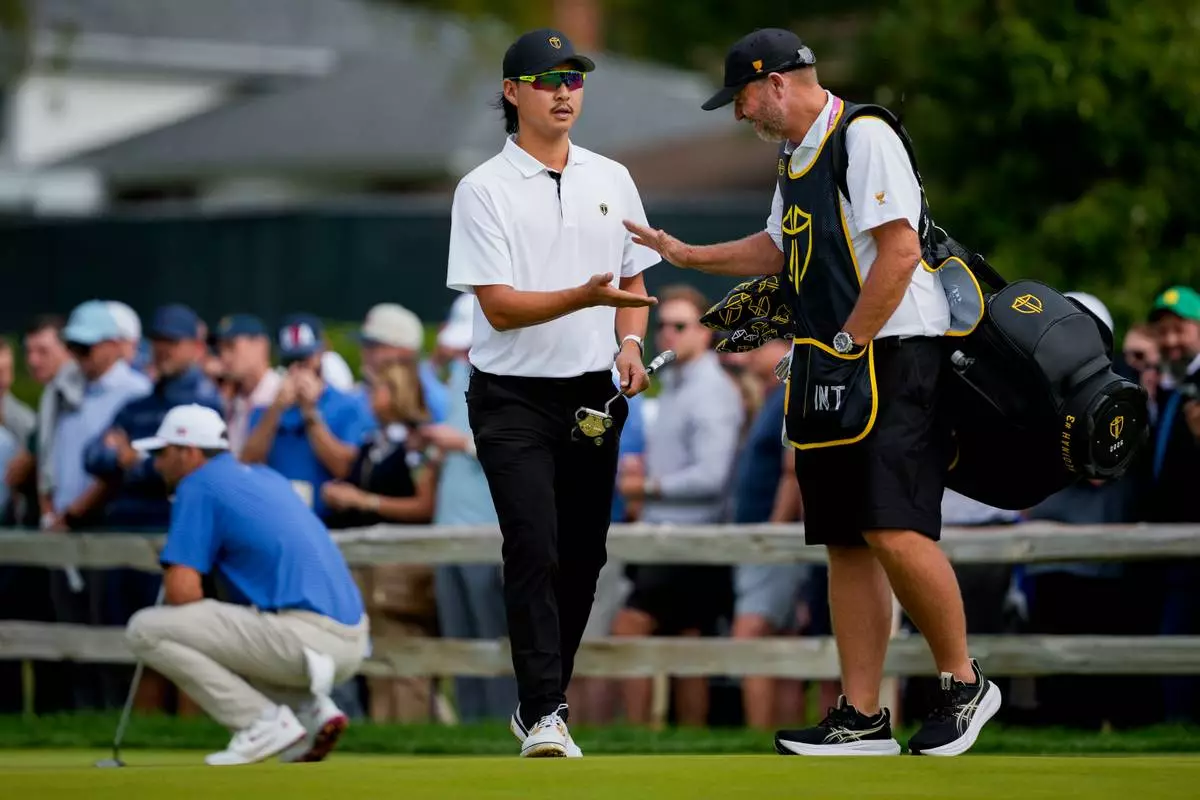
International teams' Min Woo Lee, of Australia, celebrates his birdie on the second hole with his caddie during the first round four-ball match at the Presidents Cup golf tournament at Medinah Country Club, Thursday, Sept. 24, 2026, in Medinah, Ill. (AP Photo/Matt Slocum)

International teams' Min Woo Lee, of Australia, celebrates his birdie on the second hole with his caddie during the first round four-ball match at the Presidents Cup golf tournament at Medinah Country Club, Thursday, Sept. 24, 2026, in Medinah, Ill. (AP Photo/Matt Slocum)

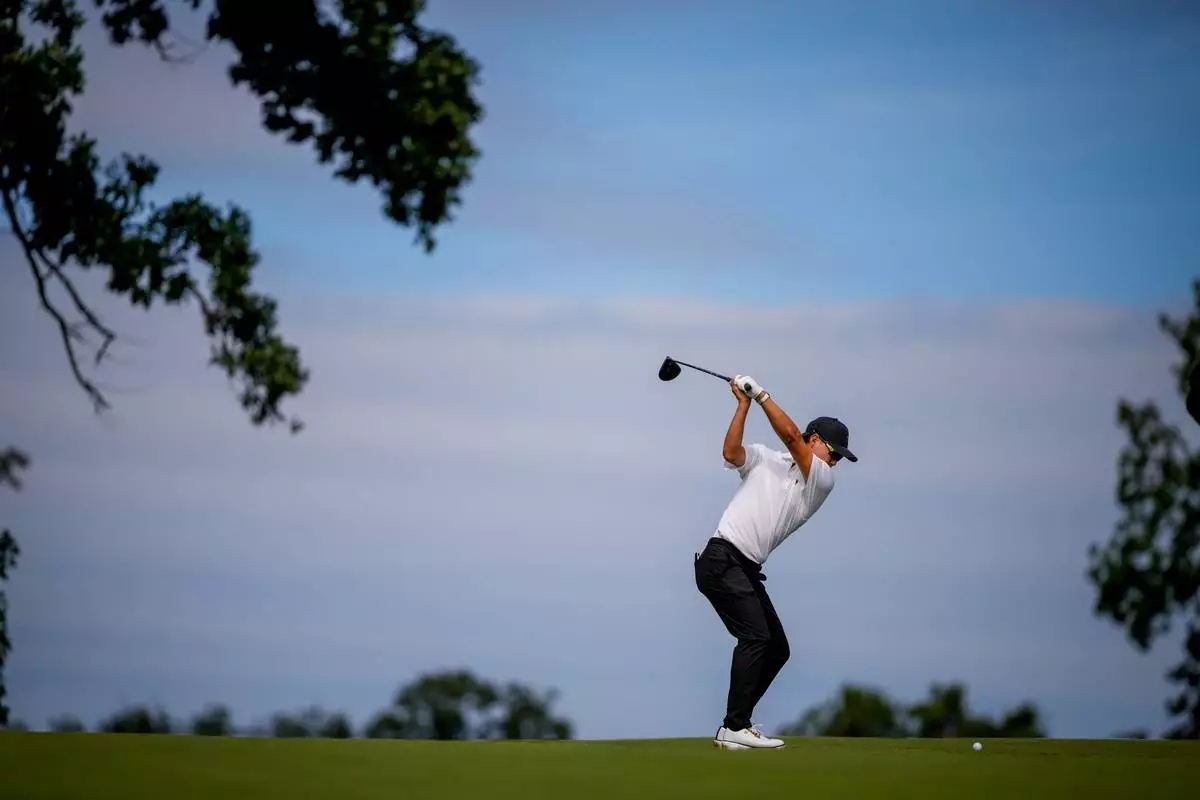
International teams' Min Woo Lee, of Australia, hits from the sixth fairway against the USA team during the first round four-ball match at the Presidents Cup golf tournament at Medinah Country Club, Thursday, Sept. 24, 2026, in Medinah, Ill. (AP Photo/Matt Slocum)

International teams' Min Woo Lee, of Australia, hits from the sixth fairway against the USA team during the first round four-ball match at the Presidents Cup golf tournament at Medinah Country Club, Thursday, Sept. 24, 2026, in Medinah, Ill. (AP Photo/Matt Slocum)

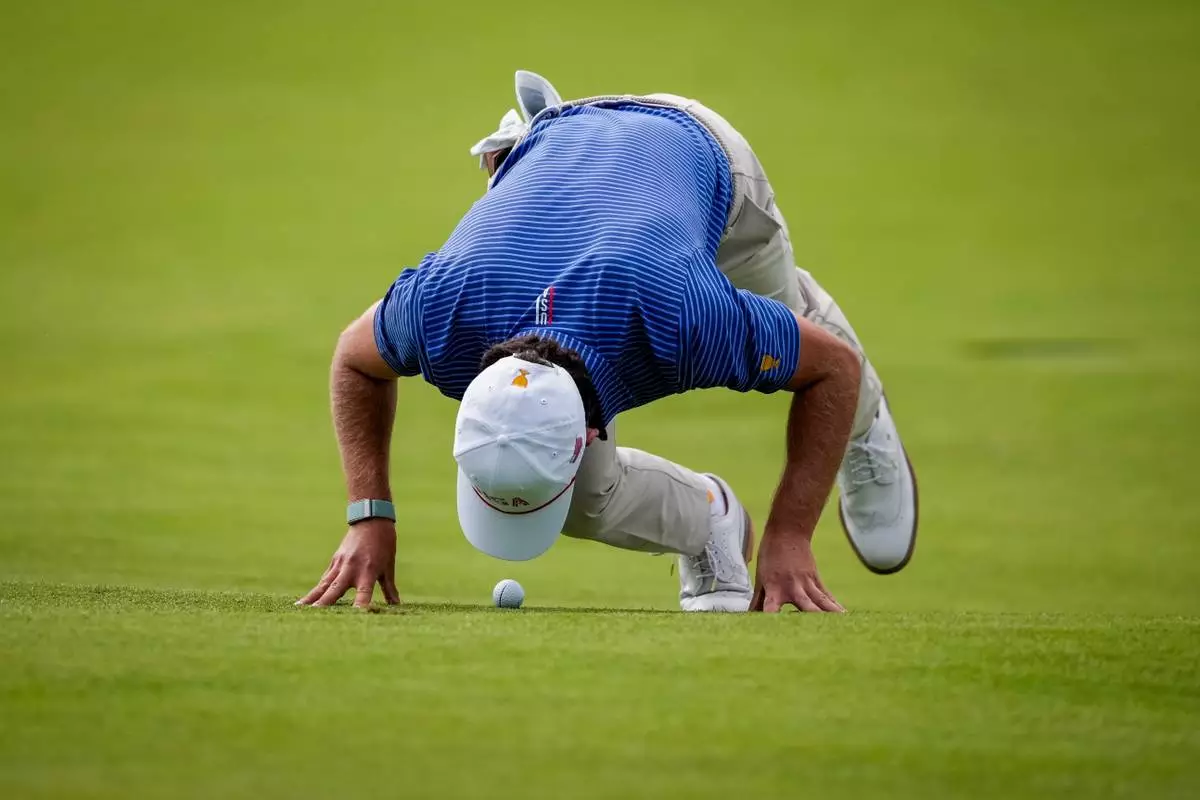
USA teams' Jackson Koivun looks at his ball on the eighth fairway during the first round four-ball match at the Presidents Cup golf tournament against the International team at Medinah Country Club, Thursday, Sept. 24, 2026, in Medinah, Ill. (AP Photo/Matt Slocum)

USA teams' Jackson Koivun looks at his ball on the eighth fairway during the first round four-ball match at the Presidents Cup golf tournament against the International team at Medinah Country Club, Thursday, Sept. 24, 2026, in Medinah, Ill. (AP Photo/Matt Slocum)

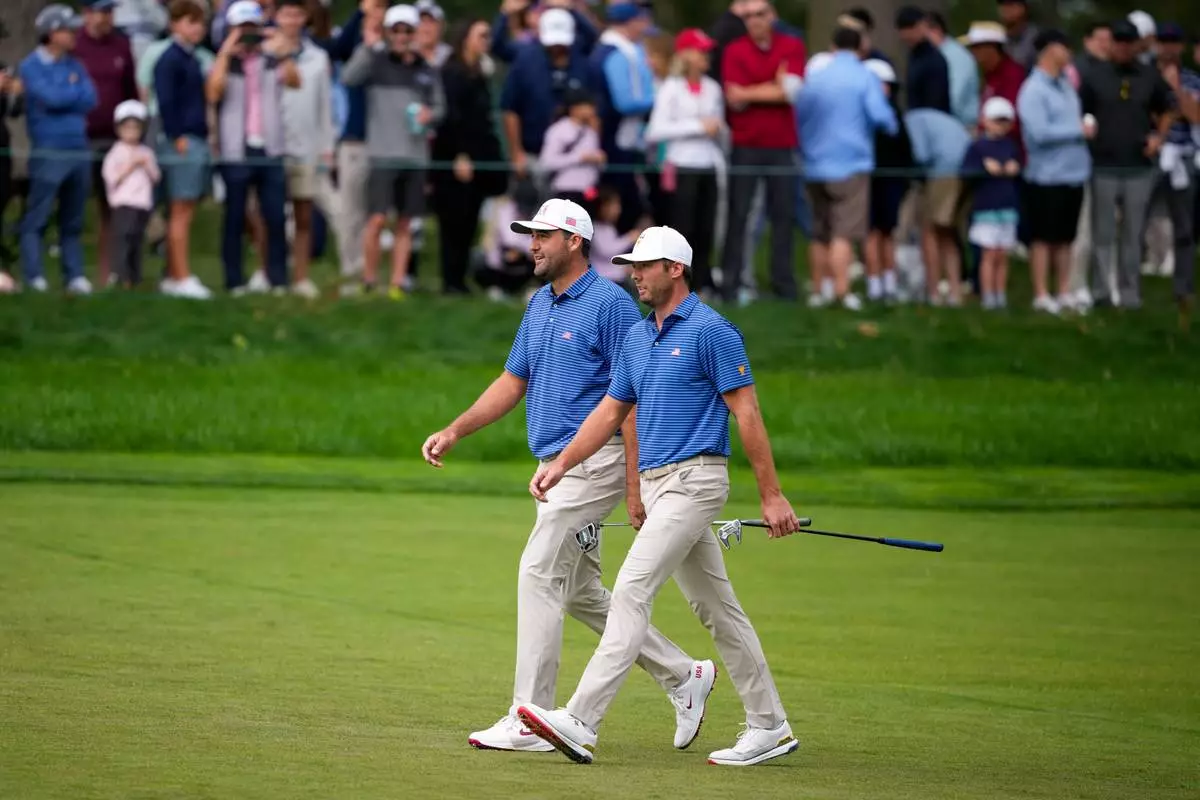
USA teams' Scottie Scheffler and Sam Burns, right, walk up the first fairway during the first round four-ball match at the Presidents Cup golf tournament against the International team at Medinah Country Club, Thursday, Sept. 24, 2026, in Medinah, Ill. (AP Photo/Matt Slocum)

USA teams' Scottie Scheffler and Sam Burns, right, walk up the first fairway during the first round four-ball match at the Presidents Cup golf tournament against the International team at Medinah Country Club, Thursday, Sept. 24, 2026, in Medinah, Ill. (AP Photo/Matt Slocum)

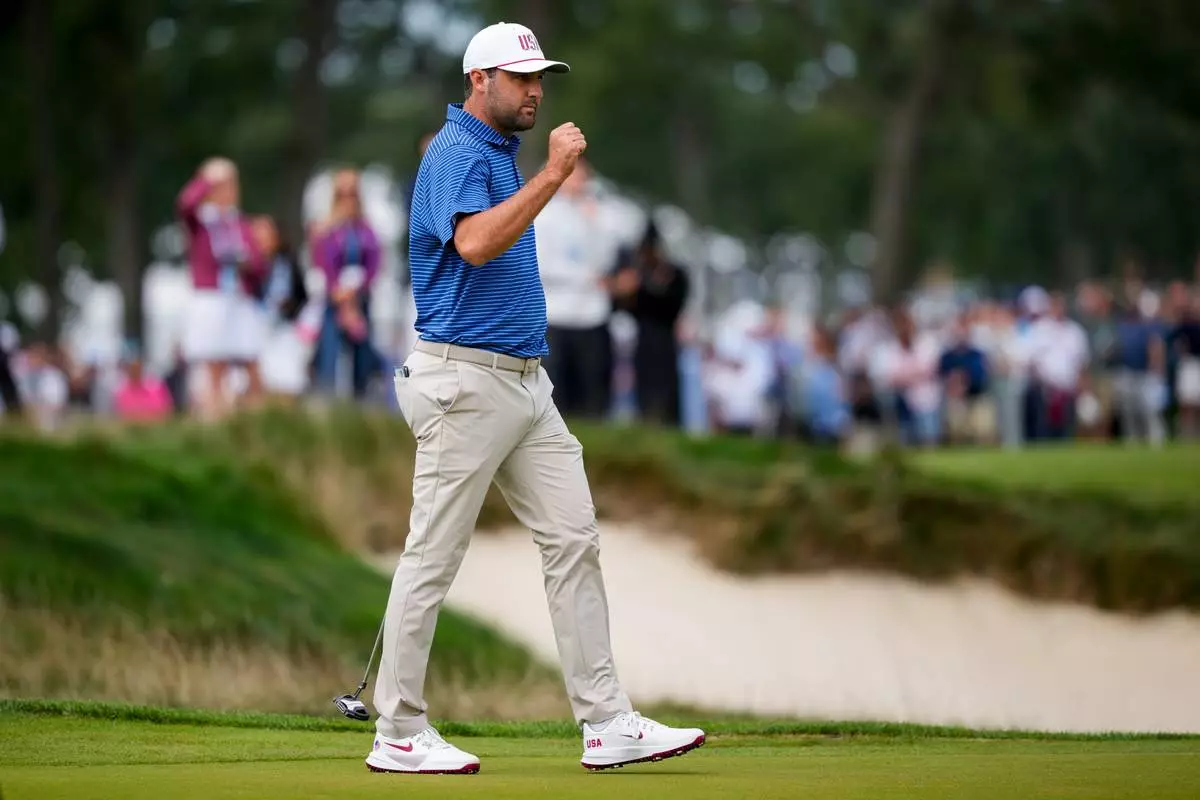
USA teams' Scottie Scheffler reacts to making his birdie putt on the first hole against the International teams during the first round four-ball match at the Presidents Cup golf tournament at Medinah Country Club, Thursday, Sept. 24, 2026, in Medinah, Ill. (AP Photo/Matt Slocum)

USA teams' Scottie Scheffler reacts to making his birdie putt on the first hole against the International teams during the first round four-ball match at the Presidents Cup golf tournament at Medinah Country Club, Thursday, Sept. 24, 2026, in Medinah, Ill. (AP Photo/Matt Slocum)

Recommended Articles