WOBURN, Mass.--(BUSINESS WIRE)--Sep 28, 2026--
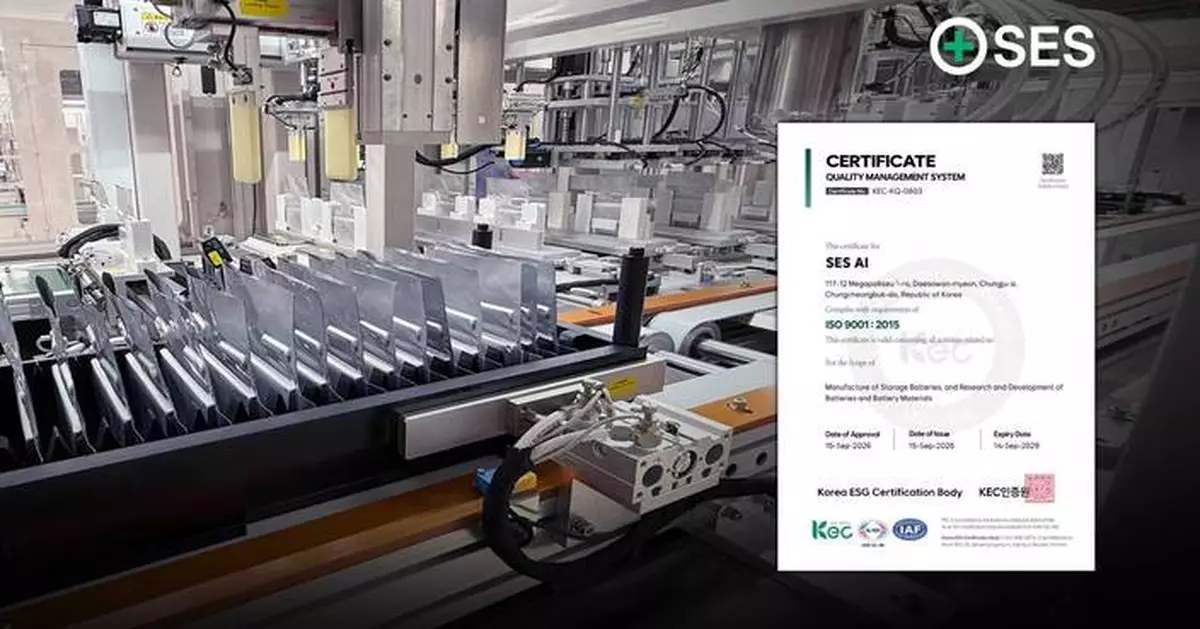
SES AI Corporation (“SES AI”) (NYSE: SES), a global leader in the development and manufacturing of AI-enhanced high-performance Li-Metal and Li-ion batteries, today announced that its battery manufacturing facility in Chungju, South Korea has achieved ISO 9001:2015 certification for its quality management system. The certification was issued by the Korea ESG Certification Body following an independent assessment of the facility’s quality management processes. SES AI also announced that recent changes by the South Korean government to export control standards on energy density for secondary batteries provide significant competitive advantages for the export of SES AI NDAA-compliant pouch cells.
This press release features multimedia. View the full release here: https://www.businesswire.com/news/home/20260928088102/en/
“Achieving ISO 9001:2015 certification is an important milestone as we scale our drone battery business,” said Qichao Hu, Founder and CEO of SES AI. “Drone customers need not only high energy and power density, but also manufacturing quality, traceability, consistency and a dependable supply chain. Our Chungju facility brings these capabilities together and strengthens our ability to supply NDAA-compliant pouch cells manufactured in Korea to customers in the United States and other markets.”
SES AI has been expanding its Chungju manufacturing operation in response to growing demand for high-performance batteries for drones and other advanced mobility applications. The Company has recently completed the scale up to an annual production capacity of approximately one million Li-Metal and Li-ion pouch cells, representing a significant expansion of SES AI’s manufacturing capability for drone and other high-performance battery applications. The Chungju facility manufactures high-energy and high-power density Li-Metal and Li-ion pouch cells for drone applications, including NDAA-compliant cells designed to serve customers requiring secure and dependable battery supply chains.
Earlier this month, the South Korean government raised export control energy density threshold for secondary batteries to 500Wh/kg, while the majority of other countries continue to use the old 350Wh/kg threshold, making trading logistics and compliance even more favorable for Korea-produced cells. Additional comments from SES AI on this recent announcement and its array of high-energy and high-power density pouch cells can be found on its LinkedIn page.
“Battery manufacturing for drones is rapidly moving from small-volume specialty production toward a scaled industrial supply chain,” Hu added. “With ISO 9001 certification, NDAA-compliant sourcing, easier export compliance, manufacturing in Korea and our expansion toward approximately one million cells of annual production capacity, we are building the foundation to serve growing demand from the global drone industry.”
SES AI’s drone cells combine high energy density and high-power density with the Company’s battery material, cell engineering and manufacturing capabilities. The Company is developing both Li-Metal and advanced Li-ion pouch cells for demanding drone missions where flight time, payload, power and battery weight are critical performance requirements.
The scope of the ISO 9001:2015 certification SES AI received is “manufacture of storage batteries, and research and development of batteries and battery materials.” The certification further strengthens the manufacturing infrastructure supporting this expansion and establishes a standardized quality management framework across processes including incoming material control, cell manufacturing, inspection, testing, traceability, corrective actions and continuous improvement.
ISO 9001:2015 is an internationally recognized quality management standard focused on consistent processes, product quality, customer requirements, risk management and continuous improvement. The certification followed an independent audit by the Korea ESG Certification Body covering the manufacture of storage batteries and the research and development of batteries and battery materials.
About SES AI:
SES AI Corp. (NYSE: SES) is powering the future of global electric transportation on land and in the air with the world’s most advanced Li-Metal batteries. SES AI is the first battery company in the world to accelerate its pace of innovation by utilizing superintelligent AI across the spectrum of its business, from research and development; materials sourcing; cell design; engineering and manufacturing; to battery health and safety monitoring. Founded in 2012, SES AI is an Li-Metal battery developer and manufacturer headquartered in Boston and with operations in Singapore, Shanghai, and Seoul. Learn more at SES.AI.
SES AI may use its website as a distribution channel of material company information. Financial and other important information regarding SES AI is routinely posted on and accessible through the Company’s website at www.ses.ai. Accordingly, investors should monitor this channel, in addition to following SES AI’s press releases, Securities and Exchange Commission filings and public conference calls and webcasts.
Forward-Looking Statements
This press release contains forward-looking statements within the meaning of Section 27A of the Securities Act of 1933, as amended, and Section 21E of the Securities Exchange Act of 1934, as amended, about us and our industry that involve substantial risks and uncertainties. Forward-looking statements generally relate to future events or our future financial or operating performance. In some cases, you can identify forward-looking statements because they contain words such as “will,” “goal,” “prioritize,” “plan,” “target,” “expect,” “focus,” “look forward,” “opportunity,” “believe,” “estimate,” “continue,” “anticipate,” “project” and “pursue” or the negative of these terms or similar expressions.
These statements are based on the beliefs and assumptions of the management of the Company. You should not place undue reliance on these forward-looking statements. Although the Company believes that its plans, intentions and expectations reflected in or suggested by these forward-looking statements are reasonable, it cannot provide assurance that it will achieve or realize these plans, intentions or expectations. Should one or more of a number of known and unknown risks and uncertainties materialize, or should any of our assumptions prove incorrect, our actual results or performance may be materially different from those expressed or implied by these forward-looking statements. Some factors that could cause actual results to differ include, but are not limited to, risks related to the development and commercialization of SES AI’s battery technologies; customer demand for drone batteries; the Company’s ability to increase and maintain manufacturing capacity and quality; availability and qualification of raw materials, components and suppliers; compliance with applicable sourcing and regulatory requirements; supply-chain disruptions; competition; and other risks described in SES AI’s filings with the Securities and Exchange Commission, including the Company’s most recent Annual Report on Form 10-K and Quarterly Reports on Form 10-Q. Forward-looking statements are based on current expectations and assumptions and are subject to risks and uncertainties that could cause actual results to differ materially from those expressed or implied.
Forward-looking statements speak only as of the date of this release and subsequent events may cause these expectations to change. SES AI disclaims any obligation to update or alter such forward-looking statements, whether as a result of new information, future events or otherwise, except as required by law.
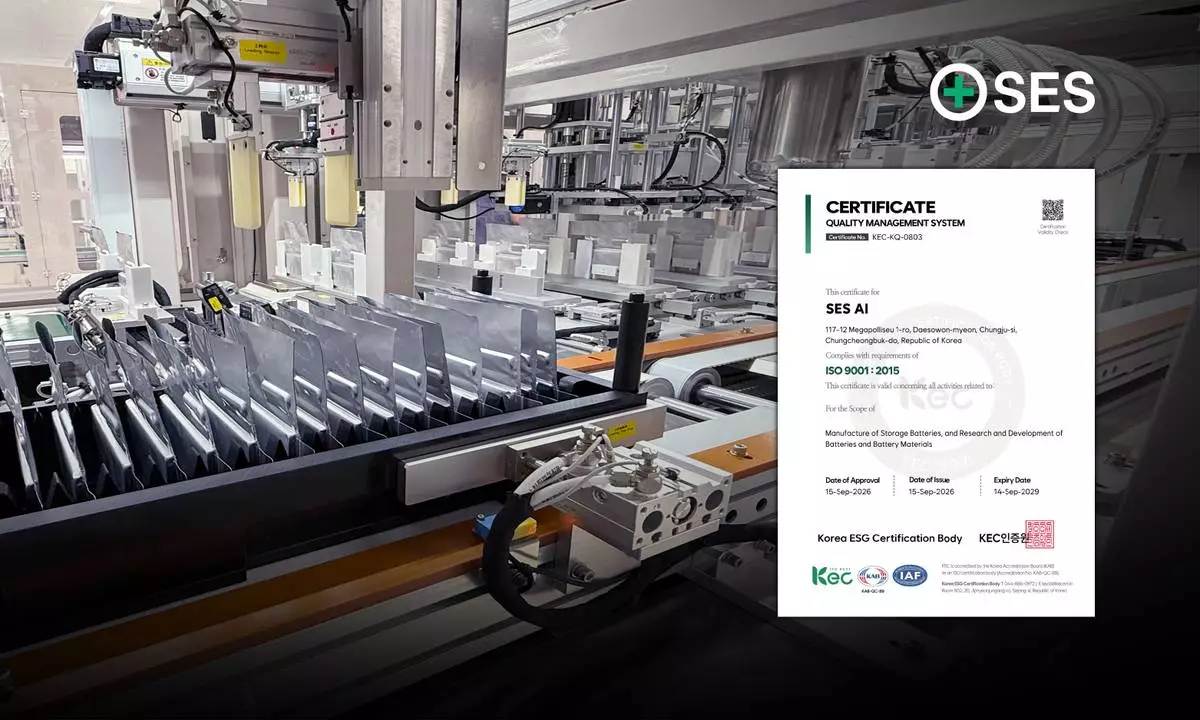
SES AI’s Chungju Battery Facility Achieves ISO 9001:2015 Certification for Production of NDAA-Compliant Drone Cells