Preparations are in smooth progress for the APEC CEO Summit 2026, with the United States emerging as the economy with the largest number of companies signing up for the event, a spokeswoman for the China Council for the Promotion of International Trade (CCPIT) said Tuesday.
The summit is scheduled to take place on Nov 17-18 in Shenzhen, south China's Guangdong province, on the sidelines of the 33rd APEC Economic Leaders' Meeting.
"Under the theme 'promoting prosperity together for a win-win future,' representatives from the political and business communities of APEC economies will be invited to have in-depth exchanges on topics such as the building of the Free Trade Area of the Asia-Pacific, artificial intelligence, and the development of the Guangdong-Hong Kong-Macao Greater Bay Area," CCPIT spokeswoman Wang Wenshuai told a press conference in Beijing.
A large number of U.S. Fortune 500 companies and well-known firms, including Amazon, Walmart, Apple, Google, ExxonMobil, and Microsoft, have submitted applications to attend, spanning industries such as semiconductors, artificial intelligence, biopharmaceuticals, energy, finance, transportation and logistics, chemicals, aerospace, manufacturing, and consumer retail.
Wang said the broad participation reflects the importance the U.S. business community attaches to Asia-Pacific cooperation and underscores the closely interconnected industrial and supply chains between China and the United States.
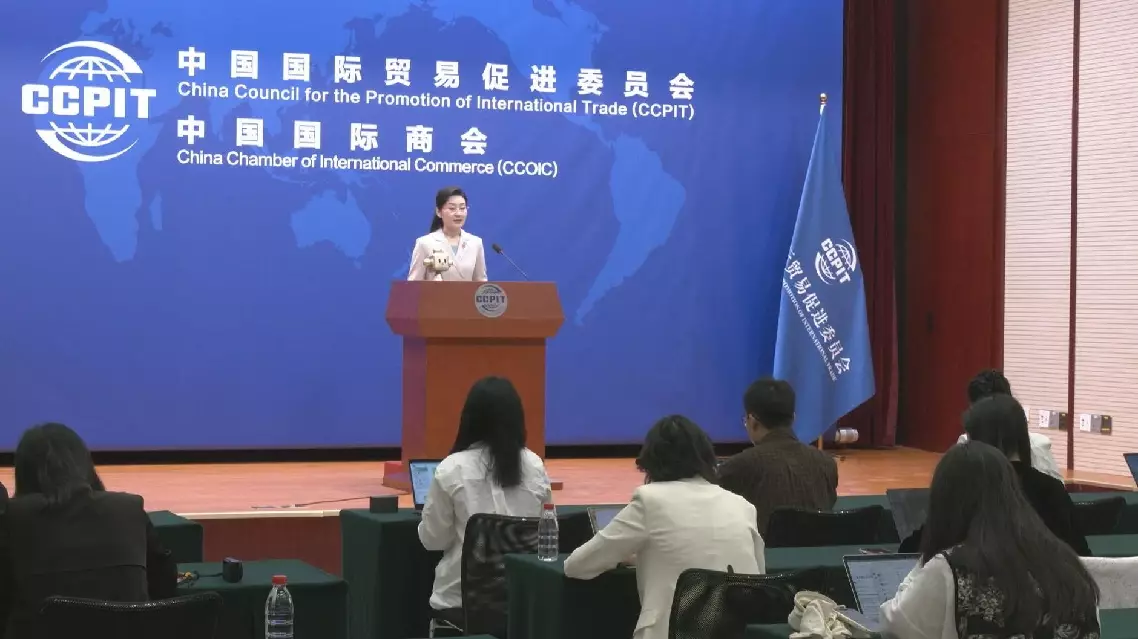
Preparations for APEC CEO Summit 2026 progressing smoothly: CCPIT
The scale of China's core artificial intelligence (AI) industry reached a record high of more than 1.2 trillion yuan (about 179 billion U.S. dollars) in 2025, as the technology is driving transformative changes across traditional sectors, said an industry report released on Tuesday.
Published by the China Internet Network Information Center, the Report on the Development of Generative AI Applications (2026) showed that over the past year, the industry saw rapid growth in computing power, foundational models and talent pool, becoming a crucial driver for cultivating innovation-driven new quality productive forces and building a modern industrial system.
The report also showed that as of June this year, China's intelligent computing power scale reached 2,185 EFLOPS, marking a year-on-year surge of 177 percent. The country's first homegrown 100,000-card AI supercluster has been officially commissioned, with all core software and hardware fully under independent domestic control.
EFLOPS, or ExaFLOPS, is a unit of computing performance, with each unit representing 1 quintillion floating-point operations per second.
As AI applications continue to expand, AI technology has penetrated deeply into sectors such as steel, non-ferrous metals, energy and communications, playing crucial roles in product research and development, quality inspection and customer service, according to the report.
"The evolution from large language models to AI agents marks a new stage in artificial intelligence development. We can see that the focus of AI development is rapidly shifting from mere technological iteration to generating real-world value. AI agents are stepping out of the 'dialogue boxes' on computer screens and entering laboratories, production lines, offices and households. They are becoming deeply embedded in entire business processes such as research, design and manufacturing, which will further drive a systemic transformation in production organization and service supply models," said Wang Peng, director of the China Internet Network Information Center.
The report noted that as of June, there were 10,740 AI-related enterprises in China. Looking ahead, the report projects that AI will emerge as a new growth pole for China's economy, generating many new professions and services.
"In the long run, AI will unlock even greater possibilities and opportunities for us. We need to actively embrace AI to reshape our professional capabilities, using it as a lever to amplify our advantages and expand our boundaries. It is essential to master the literacy required to coexist and co-develop with AI," said Chao Lemen, deputy director of the research center for intelligent information analysis at the Renmin University of China in Beijing.

AI transforms traditional sectors as core industry value hits record high: report