LEMONT, Ill.--(BUSINESS WIRE)--Sep 29, 2026--
When a nuclear power plant shuts down, the heat from the reactor doesn’t disappear right away. The fuel continues to give off what scientists call decay heat. In the event of an unplanned shutdown or accident scenario, the heat must be removed fully, safely and without fail.
This press release features multimedia. View the full release here: https://www.businesswire.com/news/home/20260929102190/en/
Researchers at the U.S. Department of Energy’s Argonne National Laboratory study ways to remove decay heat without pumps or active controls. They recently looked more closely at how certain systems behave when the amount of decay heat changes over time, just as it does in the real world.
One concept, called the Reactor Cavity Cooling System (RCCS), is being considered for several advanced nuclear reactor designs. Argonne’s Natural Convection Shutdown Heat Removal Test Facility (NSTF) is the largest experimental facility of its kind built to study how such systems work at realistic size and conditions.
The RCCS concept uses passive safety principles – relying on natural phenomena like gravity and buoyancy instead of mechanical pumps — to move water through metal tubes that run around the outside of a reactor vessel. When the reactor shuts down, decay heat travels from the vessel walls into these tubes. Warmer water rises, cooler water falls, and the loop carries heat away to a large storage tank at a higher elevation.
Because the water can eventually start to boil and form steam, engineers must understand not only how much decay heat the system can remove, but also how it behaves when liquid water and steam coexist.
Using the NSTF’s 59-foot-tall loop, the team ran controlled tests at power levels scaled based on the range of typical decay heat levels in a full‑size reactor. They then changed the height of the main water tank inlet, which can change across different designs. The inlet’s height affects how much water is available and how fluid in the loop circulates and flows.
One key effect they observed was a phenomenon called flashing. Flashing happens when water in the lower portions of the loop rises in elevation and reaches a critical point where it turns suddenly into steam, even without extra heat. These bursts of steam – flashing – can affect surges in the flow of water and steam, reducing cooling efficiency and placing extra stress on reactor components..
They found that decay heat at lower power levels slowed the spread of boiling and flashing from NSTF’s tank into its chimney.
The height of the tank inlet also mattered. They identified a clear boundary where metrics changed and concluded that mid-level inlets contributed to more stable operating conditions in certain scenarios.
“These findings have practical value for companies designing next‑generation reactors,” said Argonne nuclear engineer Qiuping Lu.
This research was supported by the U.S. Department of Energy Office of Nuclear Energy’s Advanced Reactor Technologies program.
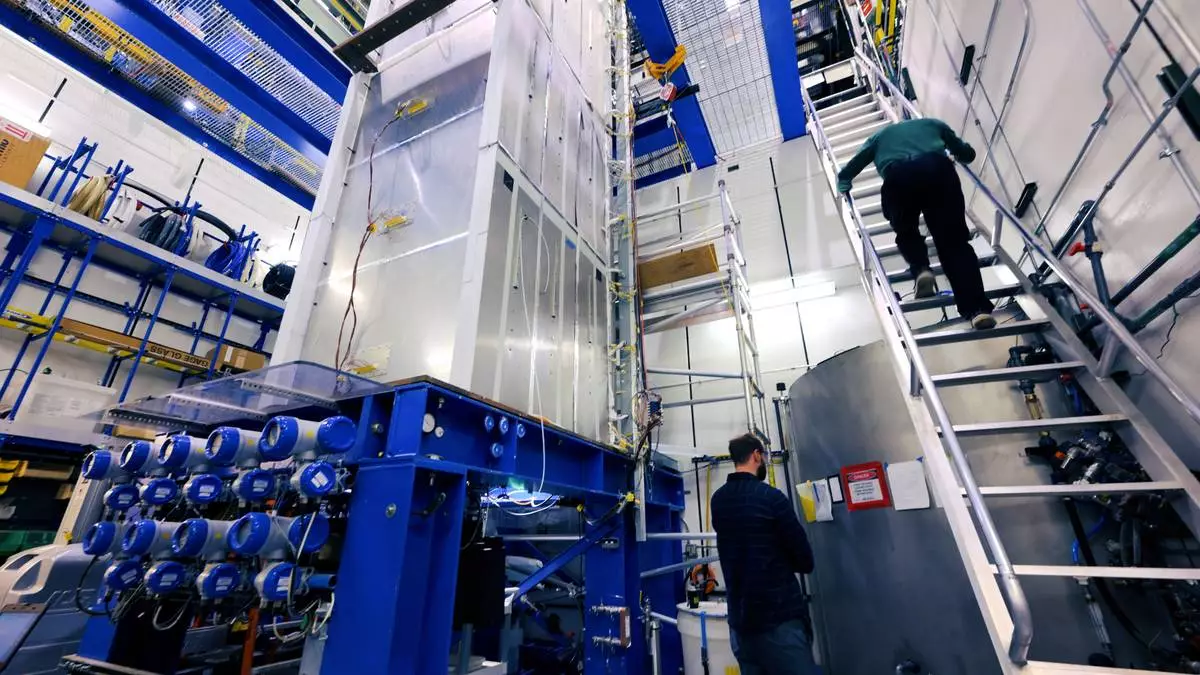
Argonne’s multi-story NSTF allows for study of steam and water flow in nuclear reactor designs given changes in power, pressure, the height of water inlets and more. (Image by Argonne National Laboratory.)
MIAMI (AP) — A 77-year-old Florida man convicted of beating a woman to death with a hammer is scheduled Tuesday to become the 16th person executed this year in the nation's busiest death chamber.
Curtis Wilkie Beasley was sentenced to death after being convicted of first-degree murder, robbery and grand theft auto in a 1995 attack on Carolyn Monfort. The Florida Supreme Court last week rejected appeals that executing a man his age who is suffering from cognitive decline would amount to cruel and unusual punishment.
Beasley, who would become Florida's seventh prisoner over the age of 70 to be executed this year, is set to receive a three-drug injection at the state prison starting at 6 p.m.
It was one of two executions scheduled this week in the U.S. Tennessee plans to execute a woman for the first time in 200 years on Wednesday by administering a lethal injection to Christa Pike, 50, who was convicted of killing a classmate in a jealous rage when they were both teens.
Beasley awoke at 5 a.m. Tuesday and remained compliant while awaiting execution, Florida Department of Corrections spokesman Jordan Kirkland said at a news conference. The official said Beasley had grilled cheese sandwiches and ice cream for a last meal and met with three visitors and a spiritual adviser.
Earlier Tuesday afternoon, the U.S. Supreme Court denied the inmate's last appeal without comment.
According to court records, Beasley had been staying at Monfort’s Dundee home, south of Orlando, in August 1995 while he was pressure washing and painting nearby apartments owned by her son-in-law. Monfort's daughter went to her home after being unable to reach her for two days and found her body in a blood-splattered laundry room.
Monfort suffered multiple blunt-force trauma injuries to the head, and a bloody hammer head was found wrapped in a towel nearby, according to investigators.
Authorities began searching for Beasley after a witness reported seeing him driving what turned out to be Monfort's car. Investigators determined Beasley had traveled to Miami and later relocated to Alabama, where he was arrested while working under a fake name for an electrical company, officials said.
Beasley was convicted of murder and sentenced to death in 1998.
Beasley would be the nation’s 29th execution this year, most of which have taken place in Florida.
The state is getting closer to last year's 19 executions, which was a record in Florida since the death penalty was reinstated in 1976. In July, Florida executed two prisoners in one day, the first state in nearly a decade to do so.
Two more are scheduled for this year, but Republican Gov. Ron DeSantis has temporarily paused the next one.
William Lee Thompson, 74, is scheduled to be executed Oct. 13 for raping and fatally beating a woman at a Florida motel in 1976. After a doctor this month determined Thompson might be suffering from dementia, DeSantis ordered a panel of three psychiatrists to examine him Thursday to determine if he is competent to be executed.
DeSantis, who leaves office in January, issued similar stays in 2023 and 2025 but both executions proceeded following evaluations.
William Reaves, 77, has an Oct. 20 execution date. He was convicted of fatally shooting a deputy outside a convenience store in 1986.
All Florida executions are carried out via lethal injection of a sedative, a paralytic and a drug that stops the heart, according to the Department of Corrections.
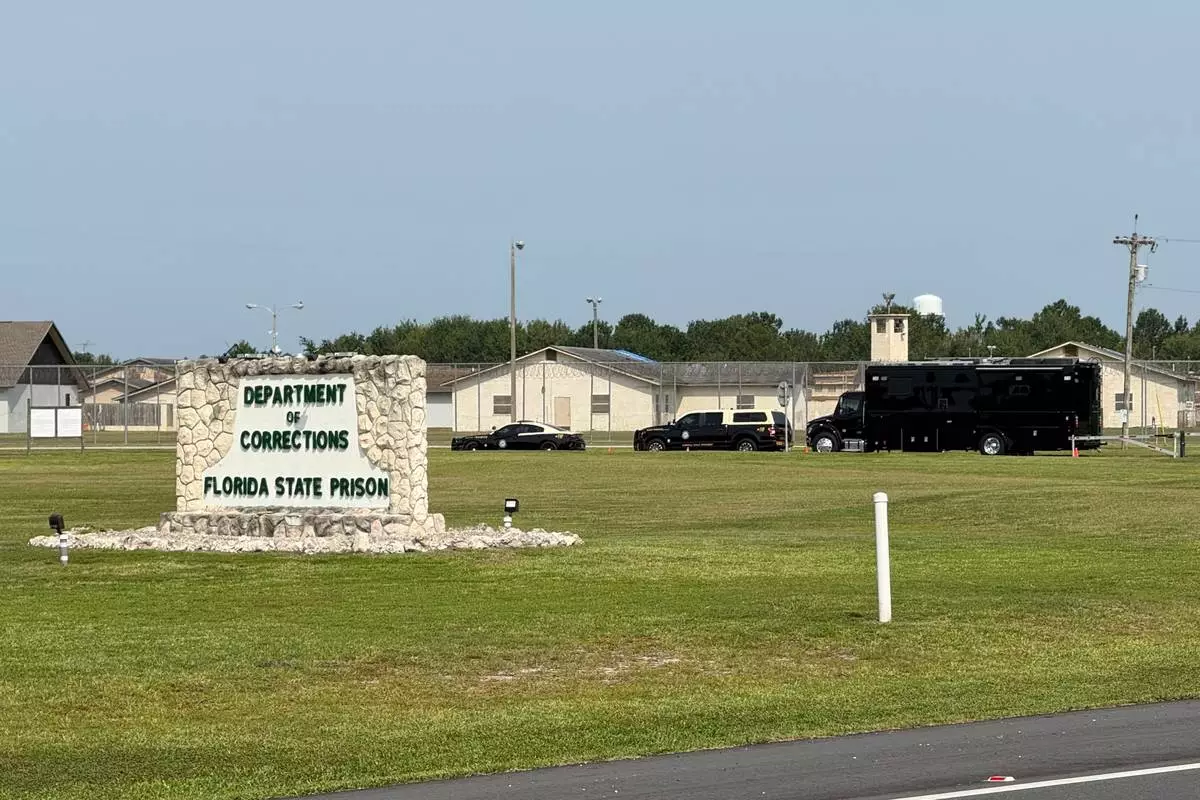
FILE - Law enforcement vehicles sit parked outside the Florida state prison in Starke, Fla., on Tuesday, July 28, 2026. (AP Photo/David Fischer, file)