DETROIT (AP) — A group of environmental organizations sued the Trump administration on Friday over its recent relaxation of key vehicle fuel economy rules, a decision that the group says will make vehicles less efficient, contribute to more pollution and increase gas consumption.
On Monday, the Trump administration lowered Corporate Average Fuel Economy, or CAFE, standards that set out how far new vehicles need to travel on a gallon of gasoline. The announcement was made as the Trump administration negotiated with Iran over reopening the Strait of Hormuz.
About a fifth of the world's oil passes through the strait on a typical day, and the fight over its control has sent energy prices soaring across the globe.
The environmental groups filed the petition for review Friday in the U.S. Court of Appeals against Transportation Secretary Sean Duffy and Jonathan Morrison, the administrator of the National Highway Traffic Safety Administration, which sets the rules.
“We’re taking the Trump administration to court for this reckless rollback that prioritizes Big Oil and automaker profits over American families,” Katherine Garcia, director of Sierra Club’s Clean Transportation for All program, said in a statement. “It is unlawful for Trump to turn back the clock on fuel-efficient cars, forcing drivers to waste more money on gas and communities to breathe toxic air.”
The Center for Biological Diversity, the Conservation Law Foundation, the Environmental Defense Fund and Public Citizen, along with the Sierra Club, filed the suit.
The Transportation Department and NHTSA earlier this week lowered the standards to an industry fleetwide average of roughly 34.9 miles per gallon for passenger cars and light trucks in the 2031 model year, down from a projected 50.4 miles per gallon under rules set by the Biden administration.
The administration said the change would provide Americans more vehicle choice and encourage consumers to buy newer, safer vehicles. Experts say reducing fuel economy requirements in vehicles does not necessarily lower their cost, nor would it automatically translate to new vehicle sales.
Duffy said the new rule also cuts the “illegal mandate that forced automakers to produce more expensive electric vehicles that American families didn’t want.”
There has never been a mandate that manufacturers sell EVs or Americans buy them; the rules and other cleaner vehicle standards incentivized automakers to sell a mix of electric, hybrid electric and increasingly-efficient gasoline-powered vehicles.
When reached for comment, a DOT spokesperson referred to statements made by Duffy: "This administration understands the freedom of every American family starts with affordable cars. That’s why our new standards will make that dream more achievable by letting auto manufacturers produce the cars that fit families’ needs at a lower price.”
Auto companies and industry groups broadly welcomed Monday's change, saying the rules under the Biden administration were too stringent and did not benefit consumers.
But environmental organizations decried the changes.
“With gas prices at historic highs, Trump picked the worst possible time to roll back federal mileage standards,” David Pettit, an attorney at the Center for Biological Diversity’s Climate Law Institute, said in a statement. “Oil companies will profit from less efficient cars, but drivers will take a hit to their wallets and our kids will breathe dirtier air. We’ll all pay the price for more tailpipe pollutants spewing everywhere from playgrounds to wild places. We’re asking the courts to put a stop to this callous giveaway to Big Oil and Big Auto.”
Gas prices have hovered around $4.50 and diesel has hit unprecedented heights in recent weeks, according to AAA.
The DOT said Monday that the rule would cut yearly oil consumption in 2050 by about 1.3 billion barrels as compared with yearly oil consumption in 2024, but NHTSA had estimated the 2024 standards would have saved 14 billion gallons of gasoline from being burned by that year.
Fuel economy requirements have been in place since the 1970s energy crisis, and over time, have led to improved average efficiency in vehicles.
President Donald Trump has made a number of moves to undercut cleaner vehicles in the U.S. These include eliminating electric vehicle tax credits; scrapping vehicle emissions standards; repealing the fines for automakers who don’t meet mileage rules; and attempting to block the nation’s EV charging buildout.
Alexa St. John is an Associated Press climate reporter. Follow her on X: @alexa_stjohn. Reach her at ast.john@ap.org.
Read more of AP’s climate coverage.
The Associated Press’ climate and environmental coverage receives financial support from multiple private foundations. AP is solely responsible for all content. Find AP’s standards for working with philanthropies, a list of supporters and funded coverage areas at AP.org.
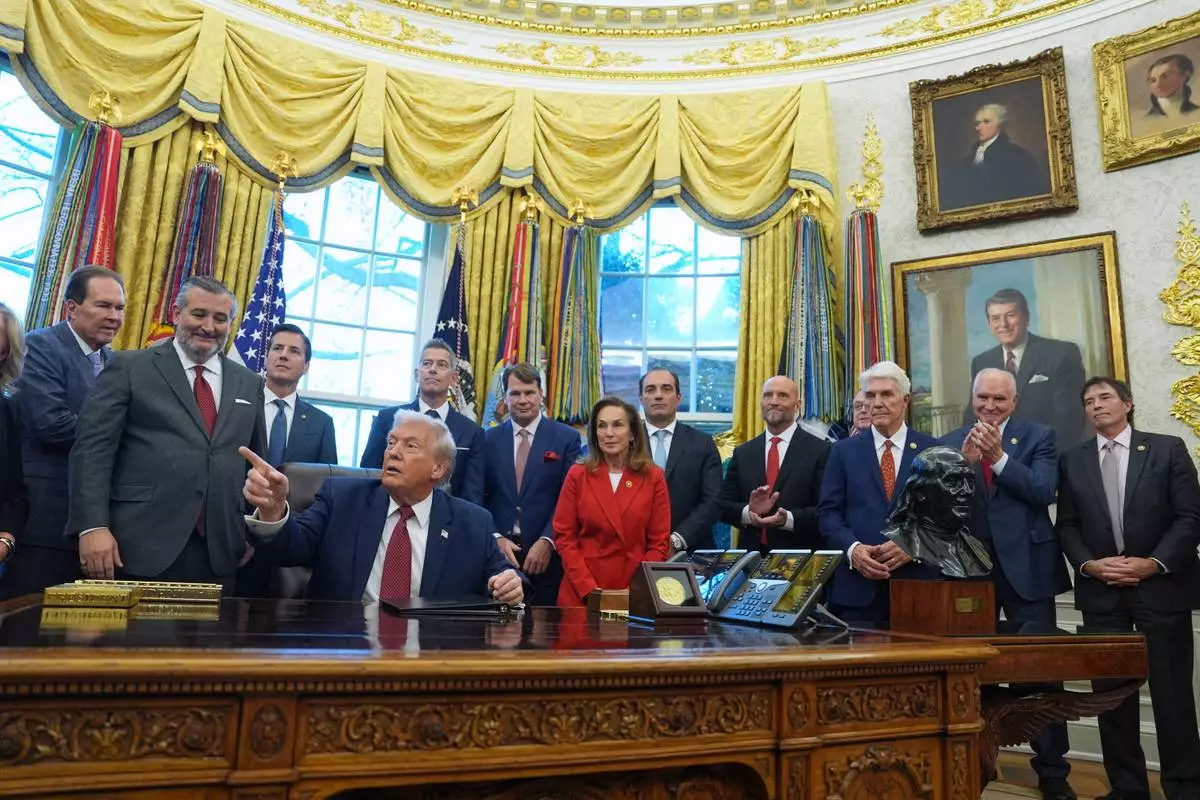
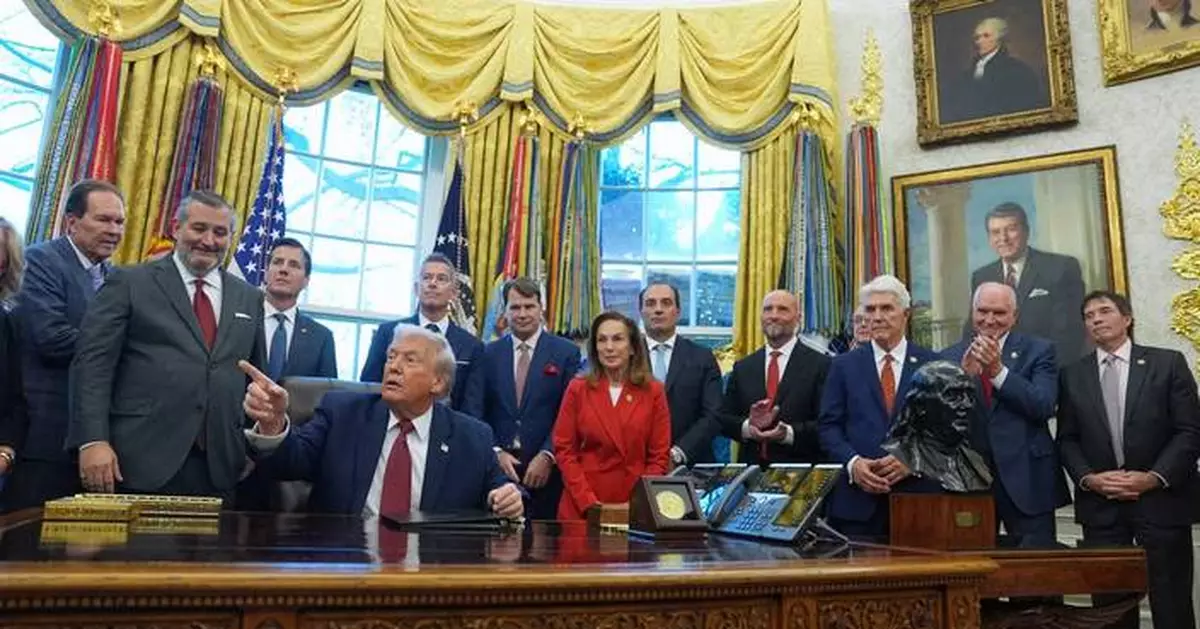
FILE - President Donald Trump speaks during an event on fuel economy standards in the Oval Office of the White House, Dec. 3, 2025, in Washington. (AP Photo/Evan Vucci, File)
The Indian airline captain who helped thwart an apparent attempt to crash a FlyDubai flight said in a live video call that he knew he had to get back on his feet to save passengers after being stabbed by his co-pilot.
Meanwhile, a Palestinian citizen of Israel who was running in Israel’s upcoming election is withdrawing his candidacy following comments about Hamas’ Oct. 7 attack on Israel.
Here is the latest news from the Middle East on Friday. Full coverage is available here.
The FlyDubai captain told Indian Prime Minister Narendra Modi that he knew he had to get back on his feet to save everyone on board, after he was stabbed by his co-pilot and the aircraft plunged into a steep descent.
“I had so many wounds. I had fallen down,” Capt. Smit Machchhar said from a hospital in Abu Dhabi. “I was fighting for my life. At one point I realized that if I didn’t get up … then passengers would lose their lives.”
Machchhar was seriously injured in Wednesday’s attack but managed to open the cockpit door, allowing passengers to enter and restrain the attacker as the Boeing 737 descended sharply, witnesses and Israeli authorities said.
The flight from Dubai to Tel Aviv, with 182 people on board, was diverted to Tabuk in northwestern Saudi Arabia for an emergency landing.
Israeli Prime Minister Benjamin Netanyahu said the attacker, an Omani national, was arrested in Saudi Arabia. His motive for the attack was not immediately clear.
Israel was set to begin repatriation flights to bring back passengers stranded in the United Arab Emirates after commercial travel between the two countries was suspended following the attack.
— More coverage on the attempt to crash the plane is available here.
In the Strait of Hormuz, a tanker was struck by an “unknown projectile” while transiting outbound through the waterway, the British military said Friday, adding that the attack caused a “small fire and blackout onboard.” There were no reported casualties, the United Kingdom Maritime Trade Operations Center (UKMTO) said. The fire was extinguished and the tanker continued its transit.
UKMTO did not identify the tanker and there was no immediate claim of responsibility for the attack. Four tankers have recently been hit by projectiles in the critical waterway, bringing the total to five with Friday’s incident, UKMTO said.
Overall ship traffic remains below prewar levels in the Strait of Hormuz, as do shipments of energy products, even though Iran has lost its near-complete chokehold over the crucial waterway thanks to the U.S. Navy's efforts to shepherd oil tankers through the strait. That, along with various pipelines, has allowed Gulf countries to restore oil exports to nearly prewar levels.
Three Israeli strikes in Gaza City and central Gaza killed three people and wounded at least one other on Friday, according to health officials at Gaza’s hospitals.
Two strikes in Gaza City killed one person each, while another strike in central Gaza killed a third, officials said.
Israel’s military acknowledged carrying out the strikes, saying that it was hitting militants in those areas, without elaborating.
In Yemen, intense fighting engulfed a residential area in Taiz City as clashes between the Iran-backed Houthis and Saudi-backed government forces raised concerns over a worsening humanitarian situation.
The World Food Program warned that renewed fighting in Yemen is worsening an already dire humanitarian situation in a country suffering from severe hunger.
WFP director Matthew Hollingworth said that almost three out of four households are unable to meet their basic food needs.
Shelling Friday by the Houthis on the residential neighborhood of Wadi al-Qadi in Taiz City injured several people, according to an Associated Press reporter in the city.
Separately, Saudi Arabia said Friday that it intercepted three ballistic missiles, launched by the Houthis, over the city of Khamis Mushait. The statement, by Saudi spokesman Gen. Turki al-Maliki, did not specify when the attacks occurred or report any immediate damage.
In Israel, the chairman of the left-wing Balad party said he would withdraw from Israel’s upcoming election after the country’s Supreme Court president said a majority of justices were prepared to uphold his disqualification.
Sami Abou Shehadeh’s candidacy was challenged over an editorial he wrote in the newspaper Al-Araby al-Jadeed the day after Hamas’ Oct. 7 attack on Israel. The article did not condemn Hamas and argued that it was surprising violence hadn’t erupted earlier given conditions in Gaza.
In a subsequent article, Abou Shehadeh, a former member of Israel’s Knesset, called Hamas’ attack both unacceptable and a crime. He said he hadn’t known the scale of the violence when he wrote the first article.
The court weighed whether his remarks violated an Israeli law barring candidates who reject Israel’s existence, incite racism or support armed struggle against Israel. His lawyers said that barring him would reinterpret the law and create a new threshold.
About 20% of Israel's citizens are of Palestinian descent.
Israeli soldiers have barred Palestinian farmers and activists from harvesting olives in the northern West Bank, according to video footage obtained by The Associated Press.
The footage showed soldiers firing shots in the air and tear gas toward the Palestinian farmers and activists, while settlers were also seen in the area.
Israel's military said troops were deployed following reports of a confrontation, which was dispersed. It added that a security official at the scene fired shots into the air earlier, without elaborating. The military said no one was injured.
The olive harvest season in the West Bank is usually marred by tensions between Palestinian farmers and settlers. Israel has imposed new rules this year, prohibiting Palestinians from harvesting in what’s known as Area C, which is under Israeli security control and encompasses the majority of the territory’s agricultural lands.
This report will be updated throughout the day as new developments emerge.

This screengrab from Narendra Modi YouTube Channel shows Indian Prime Minister Narendra Modi speaking with FlyDubai pilot Capt. Smit Machchhar on Friday, Oct. 2, 2026. (Narendra Modi YouTube Channel via AP )