Arizona State has asked a former chief justice of the Arizona Supreme Court to lead an independent review of the collapse of hockey player Matthew Mayich during an outdoor workout in August.
Scott Bales will review Arizona State’s findings and information provided by attorneys for the Mayich family, attorneys for members of the hockey team and law enforcement, James Rund, ASU senior vice president of educational outreach and student services, said in a memo Friday to university President Michael Crow.
The 21-year-old Mayich collapsed during a workout on the first day the NCAA allows official activities. He suffered from exertional heat stroke that reduced flow of oxygen to his brain and is unlikely to recover, according to family attorney Rob Carey.
Rund said Bales will be tasked with making recommendations on multiple topics surrounding the planning, approval, staffing, policies and procedures for outdoor athletic activities. He will also review the use of outside consultants in strength and conditioning practices.
Bales was on the Arizona Supreme Court from 2005 to 2019, serving the last five years as its chief justice. The school has requested that his review be completed by early December.
The Mayich family was pleased the university brought in Bales, but not with the scope of his review.
In a statement made through Carey, the Mayich family said Bales should be looking into why the workout was allowed and why it wasn't stopped when players were in visible distress with no water or rest. They also want to know which school, conference and NCAA rules were broken.
“Justice Bales is a respected choice and he will do an excellent job. But ASU hired him to review policies that may help prevent a tragedy like this in the future. That’s not what’s needed right now,” the statement said. “What is necessary, and what the Mayich family has asked for and deserves, is an investigation of what went wrong on that field and who is responsible. Justice Bales has not been asked to answer those fundamental questions.”
The Mayich family pointed to the death of Maryland football player Jordan McNair after he collapsed during a workout in 2018. The school hired outside investigators and reported to the Maryland Board of Regents, which released the findings publicly.
The family called for Bales to report to the Arizona Board of Regents and “not to the office whose own review has missed too much.”
“There are firms that specialize in exactly this work. Some reconstruct exertional heat stroke cases and evaluate emergency preparedness,” the statement said. “Others investigate institutional and personnel failures. ASU should expand Justice Bales’ mandate to cover the questions that matter and let him bring in the expertise he needs. Otherwise, it should appoint a second independent investigator to examine what ASU’s employees did and failed to do, and the conduct of whomever they allowed to run the workout that left Matthew Mayich in a hospital bed fighting for his life.”
Arizona State’s preliminary report on its investigation said the hockey coaching staff requested permission for Timothy Ziesel, a former Green Beret, to speak with the team during a three-day team-building event. The coaching staff did not “submit a plan of training activities for review by ASU’s strength and conditioning coaches prior to the event,” the report said.
Arizona State placed hockey coach Greg Powers on administrative leave Wednesday as the investigation continues. Powers will not join the team for its season opener at Lindenwood on Friday.
“Our focus continues to be on Matthew and his family, and on our student-athletes to make sure they have the support they need during this time and as the season begins,” ASU athletic director Graham Rossini said in a statement after Powers was placed on leave. “We have continued to collect as much information as possible. After thorough and careful deliberation, I believe this is the best move to provide stability for the hockey program.”
Seven players sent a letter to Crow earlier this week urging the school to place the coaches involved in the workout on administrative leave until an independent investigation is conducted.
The players sent the letter anonymously through an attorney, fearing retribution from the coaching staff. They said several other players didn’t join in sending the letter out of fear of retribution.
Mayich’s parents, John and Christina Mayich, issued a statement on Tuesday agreeing with the players that the coaching staff should be placed on leave.
AP Sports Writer John Marshall contributed to this report.
See AP’s full college sports coverage here

FILE - Members of the Arizona State University hockey team skate on the ice at the new Mullett Arena, Oct. 24, 2022, in Tempe, Ariz. (AP Photo/Ross D. Franklin, File)
A woman who says she was gang-raped at a Cornell University fraternity told the school's investigators last year that she “felt like bait” as the attackers were “like lions around me,” according to records from the school’s disciplinary investigation.
The documents, reviewed Friday by The Associated Press, include excerpts of interviews Cornell's investigators did with the woman and the men she accused and shed more light on the university's handling of the case.
While heavily redacted, the records offer a fuller but sometimes conflicting timeline of events and a glimpse at how the men responded to the allegations. Some disputed the woman’s account and said they weren’t involved in any assault.
The woman, identified in court papers only as Jane Doe, sued Cornell and seven former students last month, alleging she was given ketamine and repeatedly assaulted at a fraternity house in October 2024.
She went to campus police three weeks after the encounter and gave a detailed account of what happened, but the local district attorney decided not to file criminal charges or push for more investigation after reviewing a police summary of her interview.
Only the school’s investigation, under the federal Title IX law, persisted, with a goal of deciding discipline for the students involved.
This week, a lawyer for one of the accused men filed documents from the school’s investigation in a lawsuit that seeks to overturn the university’s punishment and remove it from his academic record. They include a 99-page report on a campus hearing panel’s disciplinary findings and a summary of events submitted by the university's lawyers.
Though only a fraction of the thousands of pages amassed in the investigation, the records show the breadth of the university’s inquiry — including 50 interviews with 32 witnesses and 12 days of hearings.
Late Thursday, Gov. Kathy Hochul appointed Attorney General Letitia James as a special prosecutor to lead a renewed criminal investigation, saying she had lost faith in Tompkins County District Attorney Matthew Van Houten.
According to the Title IX documents filed in court, which are only a portion of the entire investigation, the woman and several of the men gave investigators similar accounts of drug use and sexual activity that took place at the Chi Phi fraternity house — but differed sharply in how much of it was consensual.
The woman had been invited there by a fraternity member for whom she had long held strong romantic feelings and sexual interest, according to the disciplinary panel’s findings. The panel found that she initially consented to sex with that man and one of his friends, though she later alleged in her lawsuit that she had been pressured into taking ketamine, marijuana and alcohol and was too intoxicated to consent.
Then other men began showing up in the room, some drawn by a message one of the fraternity brothers sent to a Snapchat group at 1:42 a.m. using a vulgar term to advertise that a woman's body was freely available. Later, another person in the chat asked if the “shop” was still open.
The woman told investigators that her intoxication had rendered her partly defenseless. She said she remembered smoking marijuana and said she knew she took ketamine, her first time doing so, but didn’t have an independent memory of it. The drug, she said, left her in a state of “vague consciousness."
“You look like an operating human being," she told school investigators at a hearing in May of 2025. "You don’t look dead or asleep necessarily. So, lights are on, but nobody’s home. Your brain is not functioning at its proper level.”
She said some of the men inhaled drugs off her unclothed body.
“I felt like bait. I felt like lions around me. It just was a totally debilitating place to be in," she told investigators.
One of the men the woman accused of snorting drugs off her body — but not participating in other elements of the assault — denied her account.
He told investigators he was in the room for no more than five minutes, and didn’t go there for sex.
“That was not our intentions at all. We were just checking out to see if everything” was OK, he said.
He insisted that he did not see the woman naked at any time — she was under bed coverings, he said — and did not partake in drug use. He said he sat on a couch and chatted for a few minutes, then left after the woman and another man there both indicated they were all right.
A Cornell disciplinary panel later cleared him of sexual assault or exploitation allegations, but found him responsible for attempted sexual exploitation because it didn't believe his claim to have gone to the room for altruistic reasons.
The fraternity member, who is challenging Cornell’s disciplinary process in court, also posted in the Snapchat conversation, saying what was happening in the room was not a joke, adding: “Firsthand pov not a bit.” The student later told investigators he did not remember sending the message, according to Cornell’s account.
In her lawsuit, Jane Doe accused two of the other men who entered the room of performing sex acts on her without her consent, while she was partially incapacitated. She accused another man of kissing her without her consent. According to the Title IX documents, Jane Doe told investigators two other men stood at the foot of the bed acting “more like voyeurs than anything."
The lawsuit seeks to hold all seven men liable for rape. She is asking for unspecified damages.
Cornell hasn’t detailed the results of its investigation, but said it resulted in some students being expelled.
The man who filed the lawsuit challenging his punishment was allowed to stay at Cornell, but he was ordered to stay away from the woman, take a class on sexual harassment and bystander intervention, and write a paper reflecting on the circumstances for which he was found responsible and include a proposal to train other students on preventing sexual harassment.
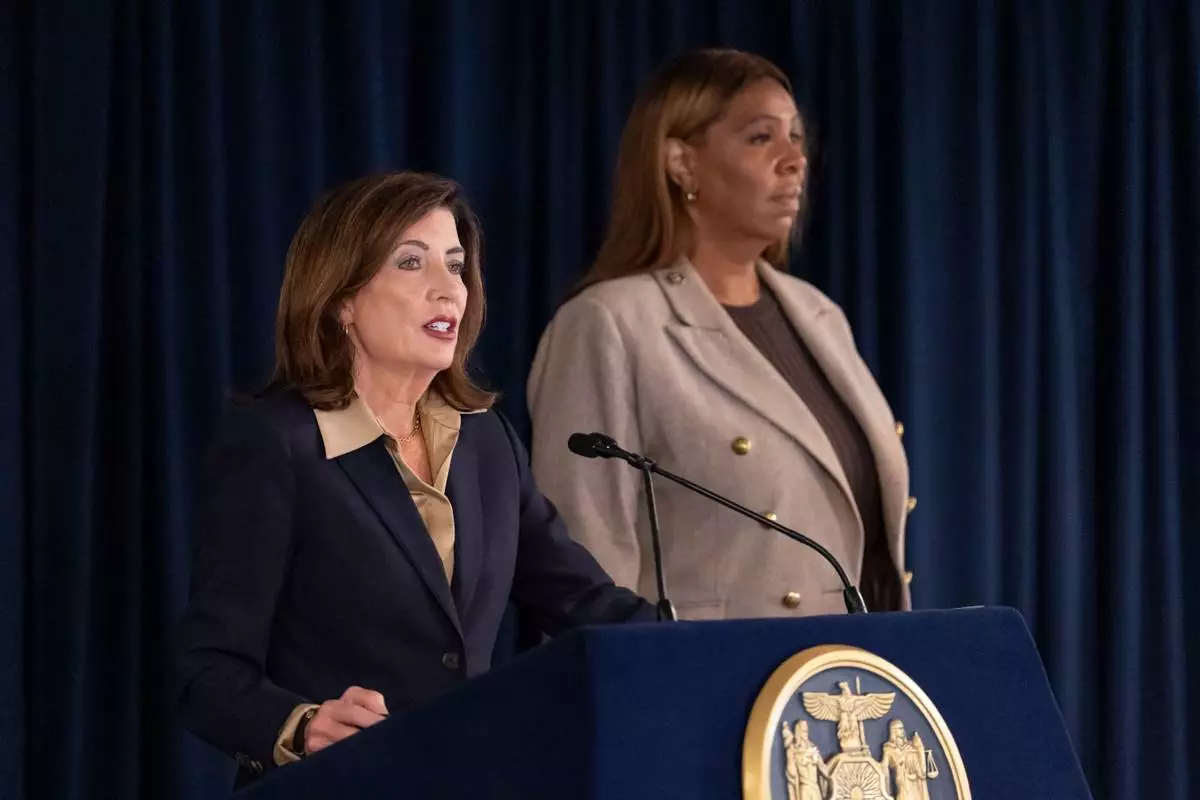
New York Governor Kathy Hochul speaks during a news conference with New York Attorney General Letitia James, Friday, Oct. 2, 2026, in New York. (AP Photo/Yuki Iwamura)
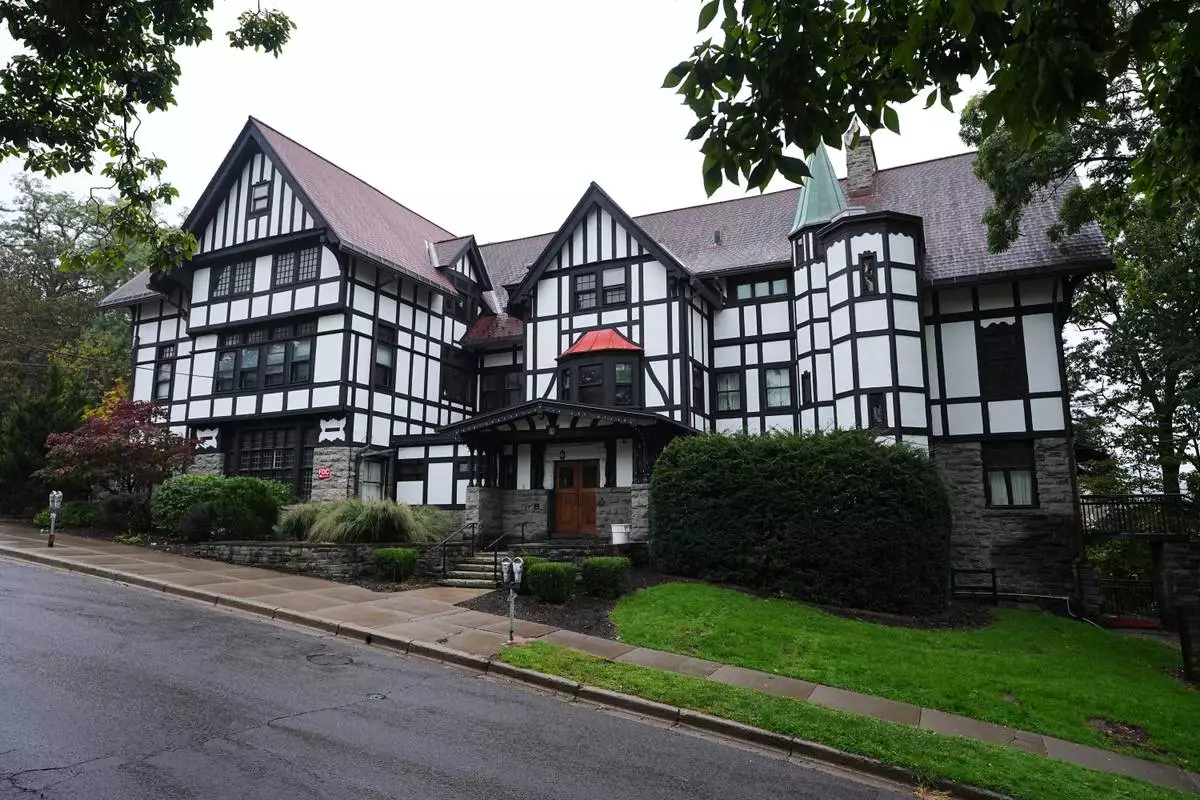
Shown is the the Chi Phi fraternity house at Cornell University in Ithaca, N.Y., Thursday, Oct. 1, 2026. (AP Photo/Matt Rourke)