Travelers across China have made an estimated 2.14 billion cross-regional passenger trips during the Oct. 1-7 National Day holiday, up 0.7 percent year on year, keeping the country's railways, roads, waterways and airports busy, the Ministry of Transport said Wednesday.
The holiday rush was felt most sharply on the rails, where railways moved more than 150 million passengers over the seven days, nearly 22 million a day, up 12.7 percent year on year. Four new high-speed lines opened just before the holiday linked regions across the country, making spontaneous trips easier to plan.
For regular passengers on the expanding network, the growing speed of the trains has put the whole country within easy reach. "The speed of high-speed trains seems to increase every year. When it comes to traveling, it really feels like going anywhere in China is no longer a problem. It's incredibly convenient," said Han Dan, a tourist.
That reach extended well beyond the railways, as the vast majority of the holiday movement took place on the country's roads, which carried 1.96 billion trips in total, about 280 million a day. Expressways handled an average of 64 million vehicles daily, with new energy vehicle (NEV) traffic surging 35 percent year on year.
The scale of the movement had a direct boost to the wider holiday economy, with consumer spending emerging as one of its clearest effects.
"In terms of driving consumption growth, the daily cross-regional movement of over 300 million passenger trips has effectively unleashed consumer potential and spurred growth in both offline and online consumer services. The car rental market was particularly active this year, with 1.19 million rental vehicles deployed nationwide. The daily rental rate rose by 25 percent year on year, and the single-day peak surpassed 950,000 vehicles, setting a record high," said Gao Bo, deputy director of the Transport Services Department under the Ministry of Transport.
The spending extended beyond rental counters to the water, where tourism-driven travel posted some of the week's strongest growth, with waterways recording nearly 11 million passenger trips, over 1.5 million a day, up 7.1 percent year on year. Night cruises emerged as a draw of their own, carrying more than 900,000 sightseers.
In Shanghai, sightseeing vessels along the Huangpu River carried holiday crowds late into the evening, offering passengers the city's illuminated skyline from the water. "The night view of the Huangpu River is absolutely stunning, with beautiful lights. It's so comfortable to stand by the boat and enjoy the evening breeze. I came here specifically during the holiday to check it out, and the whole travel experience has been great," said Wu, another tourist.
Aviation carried the final leg of the week-long rush, with airlines transporting nearly 17 million passengers during the seven days, about 2.4 million daily. While hubs in major cities maintained high volumes, the steady expansion of regional airports drove rapid growth in traffic to smaller, tourism-focused destinations.
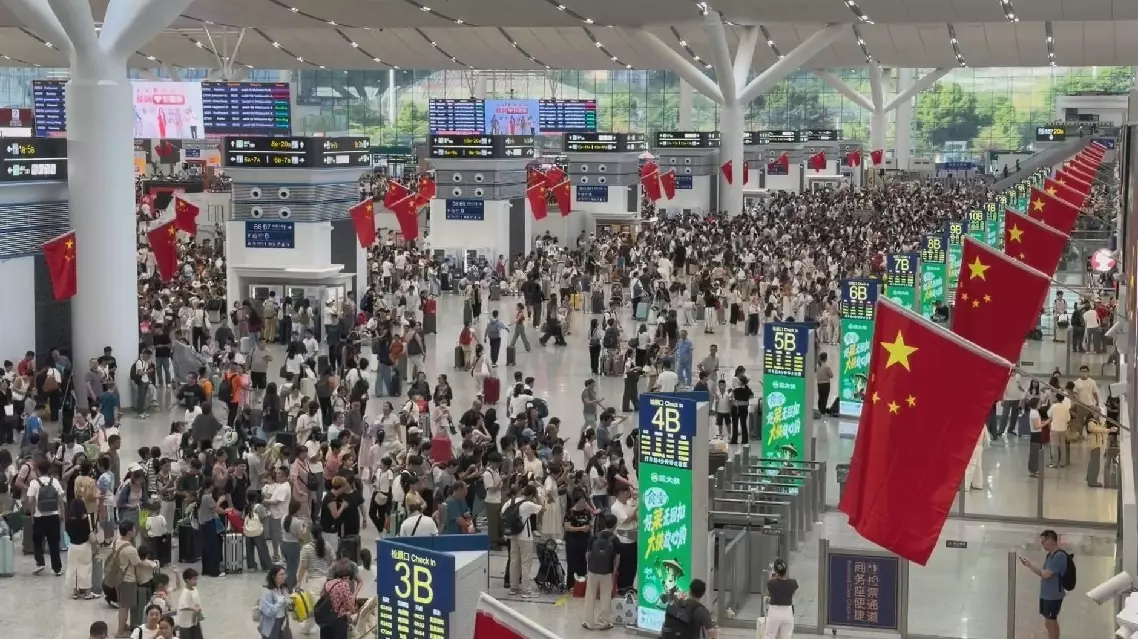
China's National Day holiday sees over 2.1 bln trips as travel boom fuels consumption
China's National Day holiday sees over 2.1 bln trips as travel boom fuels consumption