WASHINGTON (AP) — Worries around artificial intelligence cross party lines, with the vast majority of Americans saying the U.S. government should prioritize keeping AI under human control and protecting workers.
A new poll from The Associated Press-NORC Center for Public Affairs Research finds that most Americans, 64%, think AI is developing “too fast,” while 27% say its development has been “about right” and only 8% say it's moving “too slow.”
The risk that powerful AI models could evade human control and hurt humanity, once the stuff of science fiction, has been emerging as a more pressing concern. Even leaders of the companies that are developing frontier AI models are calling for a slowdown so that government regulation can catch up. President Donald Trump has pushed back against slowing down AI development because of concerns that China will gain an advantage with the technology. Data centers powering AI projects have also taken a prominent role in major political races as the midterm elections approach.
About 8 in 10 U.S. adults say it's “extremely” or “very” important for the U.S. government to ensure that AI stays under human control, and they are about as likely to want the government to prioritize protecting the country's workforce. Most U.S. adults also think minimizing environmental harm and growing the U.S. economy are highly important. About half say this about promoting technological innovation, and slightly fewer say that about competing with China.
There's bipartisan concern about the speed of AI's development, but few Americans think either major political party has an advantage in handling artificial intelligence. Trump, a Republican, also gets a low rating on his handling of the issue, with 67% of U.S. adults disapproving of his performance on AI.
Stephanie Stewart, a junior-high science teacher in Sunset, Utah, said she is frustrated by the president’s opposition to AI regulation.
“There is no handling of the issue except for we’re just going to allow these companies to do whatever they want, and we’re not going to regulate them,” said Stewart, 53.
Ron Theusch, a truck driver who lives in rural Alden, Minnesota, said his No. 1 concern with AI is the potential loss of jobs — including his own.
“I can just see a train of self-driving trucks 24/7, just running up and down I-35, loading and unloading. I can just see that happening,” said Theusch, 58.
Most Democrats and Republicans agree on the importance of protecting workers and keeping AI under human control, the poll found.
“There was a movie called ‘Terminator,’ where the robots came back and killed everybody,” Theusch said. “People relate to that ... I don’t know where it’s going to land. I really don’t have anything I can do to control it, you know. It’s going to evolve.”
There's less consensus about the importance of other priorities when it comes to AI. Republicans are more likely than Democrats to say it’s highly important to grow the U.S. economy and to compete with other countries like China. Democrats, on the other hand, are more likely to say it’s at least “very” important to minimize environmental harm.
“I don’t understand how, because they’re doing something as well as us, that we can’t be more human about it and more humane about it than just to say, ‘Well, they’re doing it, so we have to do it,’” Stewart said of U.S. competition with China.
And while about three-quarters of Democrats say AI is developing “too fast,” only about half of Republicans share that worry. People under 30 years old also express higher levels of concern than people 60 or older, the survey found.
“I think I have all the normal concerns, right? I think it’s wonderful for certain applications, but I also feel like it will be overused and can create a lack of personal connections. It can make people lazy because information is just given to them without really having to research things on their own,” said Kelly Opp, a 62-year-old Republican in Albuquerque, New Mexico.
“Like everything else, once you get that ball rolling, it progresses fast on its own, but I think that it will continue to keep progressing. So the speed doesn’t really bother me,” she said.
As a teacher, Stewart regularly uses AI to help with her work, including with creating assignments or assisting with tests. But she is deeply concerned about AI's effects on children.
“You’ve got to protect kids. You’ve got to protect teens. You've got to protect privacy ... we need to try to do something,” she said.
Americans have little trust in either party when it comes to the handling of AI issues. About 4 in 10 Americans say they don’t trust either the Democratic Party or the Republican Party on AI, according to the poll, while nearly 2 in 10 trust both parties equally, and the rest are split between trusting the Republicans and the Democrats.
Even people who identify with the parties are ambivalent about their ability to handle the issue. Only about half of Republicans and Democrats say their party is better equipped to handle AI issues, and roughly 3 in 10 in each case say neither party is.
“I am kind of moderate. And I see that there’s good on both sides," said Stewart. "Anyone back in Washington is weak on doing anything for anyone but themselves right now. So, no, I don’t think the Democrats would do a better job per se. Maybe they would definitely tout it. But until I see anything coming from anyone, I’m going to be like, ‘Yeah, no. You’re all just sitting there.’”
Ortutay reported from Oakland, Calif.
The AP-NORC poll of 2,140 adults was conducted Sept. 24-28 using a sample drawn from NORC’s probability-based AmeriSpeak Panel, which is designed to be representative of the U.S. population. The margin of sampling error for adults overall is plus or minus 2.9 percentage points.

President Donald Trump listens as Elon Musk speaks to reporters at the White House in Washington, Tuesday Sept. 29, 2026, after meeting with top executives of AI firms. (AP Photo/Jacquelyn Martin)

FILE - A small group of people supporting restrictions on artificial intelligence hold up signs in front of City Hall before a New York City Council hearing on artificial intelligence safety in New York, Oct. 5, 2026. (AP Photo/Seth Wenig, file)
DUBAI, United Arab Emirates--(BUSINESS WIRE)--Oct 8, 2026--
What if students did not all have to learn the same thing, in the same way, at the same time?
This press release features multimedia. View the full release here: https://www.businesswire.com/news/home/20261008920103/en/
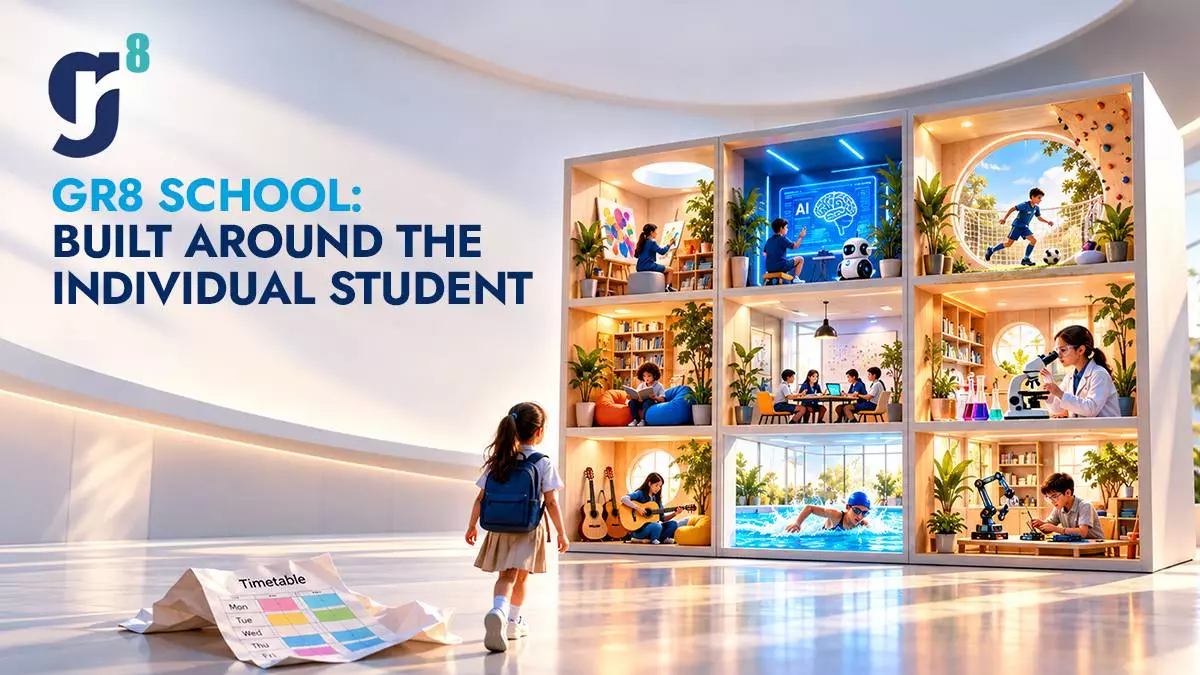
GEMS Education, one of the oldest and largest private K-12 education providers, today unveiled GR8 School, a global-first model combining hyper-personalised AI-powered learning with specially trained teachers (human mentors) and real-world expertise. Drawing on almost seven decades of educational experience, more than 10,000 educators and school leaders, and pathways that have taken GEMS graduates to more than 2,000 universities across 71 countries, including all eight Ivy League universities in the US and all 24 Russell Group universities and colleges in the UK, GEMS brings significant scale, experience and educational expertise to the new model.
Since its origin in 1959, GEMS has pioneered education in the UAE, from offering international curricula across schools at a range of price points to developing new models such as GEMS School of Research and Innovation (SRI). More than 500,000 GEMS alumni have gone on to become unicorn founders, entrepreneurs, doctors, engineers, scientists, academics, creatives and leaders across industries, with graduates progressing to the world’s leading universities. Its mission has remained constant: to see the potential in every child and evolve education to help them realise it.
GR8 is the latest expression of that legacy of innovation and educational firsts. It will initially operate as a “school within a school”, creating a distinct pathway within existing school communities.
The 8 October unveiling comes as Dubai’s leadership explores new approaches to education and how future school models can respond to changing student needs and the world of work.
What makes GR8 School a pioneering education model?
The GR8 School will bring together three connected parts of a student’s education:
Hyper-personalised learning: Students use AI-powered learning that allows them to work through core academic material at their own pace, rather than every student following a fixed timetable. The learning system will continually assess a student’s progress, identifying what they have mastered, where they need additional support, and where they are ready to be challenged further.
World-class teachers (Human Mentors): Real-time data provided by the adaptive learning systems empower teachers to be able to spend most of their time on high-impact 1:1 support instead of teaching an entire class at the same time, as well as on delivering all practical aspects of the curriculum. Teachers will remain responsible for academic rigour while also providing the inspiration, mentorship and human connection central to a child’s growth.
Real-world pathways: Working backwards from each student’s interests and possible future ambitions, GR8 will connect students with relevant specialists, industry experts, practitioners, projects and experiences that help turn what they learn into what they can do. Alongside academic study, the model will place deliberate emphasis on critical thinking, communication, teamwork, financial literacy, and practical life skills, while creating direct pathways from education to further study, entrepreneurship and future employment.
Together, these people will form the GR8 Learning Collective – a wider human team of teachers, specialists, practitioners bringing industry and experts closer to students.
A different learning day: The GR8 model is being designed around a more flexible use of time. Students will combine asynchronous, AI-enabled self-paced learning with approximately 90 minutes to two hours of synchronous, teacher-led learning, supported by real-world experts and globally recognised specialists. This will be complemented by a further two to three hours of enhanced enrichment programmes, creating more time for deeper specialist learning, projects, practical application, collaboration, creativity, sport, the arts and other areas of personal development.
Transformative education should meet the needs of the learners where they are and give families meaningful choice. GR8 is being developed to operate across different GEMS school segments and price points. While final fees will vary by school, market and model and will be confirmed closer to launch, current indicative annual fee ranges are approximately US$8,000–10,000 for affordable offerings and US$20,000–40,000 for premium offerings.
GR8 builds on principles already embedded across GEMS – personalised support, strong teacher-student relationships, character, critical thinking and learning beyond the classroom – as well as existing enrichment programmes and opportunities, bringing them together in a more focused and structured model.
It will offer families a distinctive new choice, designed for students who may thrive in a more personalised, flexible and independently driven learning environment.
The visionary behind the model, Sunny Varkey, Chairman and Founder of GEMS Education, said:
“For almost seven decades, we have evolved continually because the world our children are growing into keeps evolving. Throughout that journey one thing has never changed: the teacher has remained at the heart of a child’s learning and growth. A teacher provides inspiration, encouragement, judgement and human connection. That relationship remains fundamental.
“Today, artificial intelligence is changing how we learn and work, but the answer cannot simply be to put more technology into classrooms. We have to ask a bigger question: if we were designing education for young people today, knowing how rapidly the world around them is changing, what would we do differently?
“GR8 is our answer to that question. It starts with the individual child and asks what combination of technology, great teachers, industry experts and real-industry experiences will help that young person achieve academically and discover what they could become.
“GR8 is not for everyone, nor is it intended to be. No single model of education is right for every child. We are making this pathway available to all our families, but we expect it will appeal to a select group of students who are ready for greater independence, personalisation and ownership of their learning. For the right student, we believe it can be transformative.
“Technology can help us understand and personalise how a child learns. But education is, and will always remain, deeply human. Our ambition with GR8 is to bring many worlds together around the learner.
“We want young people to leave school with excellent qualifications, but also with something more: the confidence to apply what they know, the judgement to think for themselves, and the skills, experiences and relationships that can help them turn their potential into possibility.”
The first GR8 School will soft launch in January 2027, with GEMS using the interim period to continue developing and testing the systems behind the model, including its learning technology, academic model, teacher and guide roles, and network of specialist and industry expertise, with further details to be announced closer to launch.

Sunny Varkey, Chairman and Founder of GEMS Education
GEMS Education Unveils GR8 School, a World-First Fusion of AI, Teachers and Industry Experts Reinventing Education