GENEVA (AP) — The World Trade Organization is sharply increasing its forecast for merchandise trade growth worldwide this year, more than doubling its earlier prediction to 3.9% as booming AI investments offset a hit from the war in the Middle East.
The Geneva-based trade body says global trade chugged along at a hearty pace, as supply chains adapted and AI-related spending poured in to provide “a powerful boost to goods trade.”
The revised forecast marks a big jump from an initial WTO forecast in this spring for 1.9% growth for merchandise trade. The figure excludes services trade. The trade body forecast growth next year of 4.1%, up from 2.9% predicted in March.
“The revision reflects evidence that global supply chains adapted to disruptions in energy and fertilizer markets, while strong investment in AI-related infrastructure boosted trade in AI-enabling goods,” WTO said. Trade of oil and gas and fertilizer through the Persian Gulf was shaken after the U.S.-Israeli war against Iran began in February.
WTO said merchandise trade grew 3.5% in the first half of the year, powered by the artificial intelligence market.
“Demand for AI-enabling goods such as semiconductors and servers accounted for 47% of global merchandise trade growth in the first half of 2026, and trade in these products rose by 67% year-on-year, accelerating from the already rapid expansion seen in 2024 and 2025,” WTO said.
Robert Steiger, its chief economist, said WTO teams — like most forecasters — have been “surprised" at the strength of the AI investment boom. They anticipated that strong growth in AI-enabling goods like electronics and computers would moderate over time because of already-high growth last year and “market saturation” eventually.
“This actually has not happened. Trade in AI-enabling goods grew 16% in value terms in 2024. It grew 31% in value terms in 2025, and it grew an astonishing 67% in the first half of 2026,” he told reporters at WTO headquarters.
Liquefied natural gas exports from the Middle East fell by 47% in the first half of the year, while crude oil exports dropped by nearly a quarter, WTO said. But shipments from other suppliers helped limit the decline to roughly 1% for LNG and about 6% for crude.
WTO said it expects global GDP to grow 2.6% this year and 2.9% in 2027, even though it predicted that the Middle East conflict will continue to weigh on trade through higher energy prices and transport route disruptions.

A man checks his cellphone at a waterfront shelter as commercial vessels appear anchored in the Strait of Hormuz off Bandar Abbas, Iran, Monday, Tuesday, Oct, 6, 2026. (Amirhosein Khorgooi/ISNA via AP)
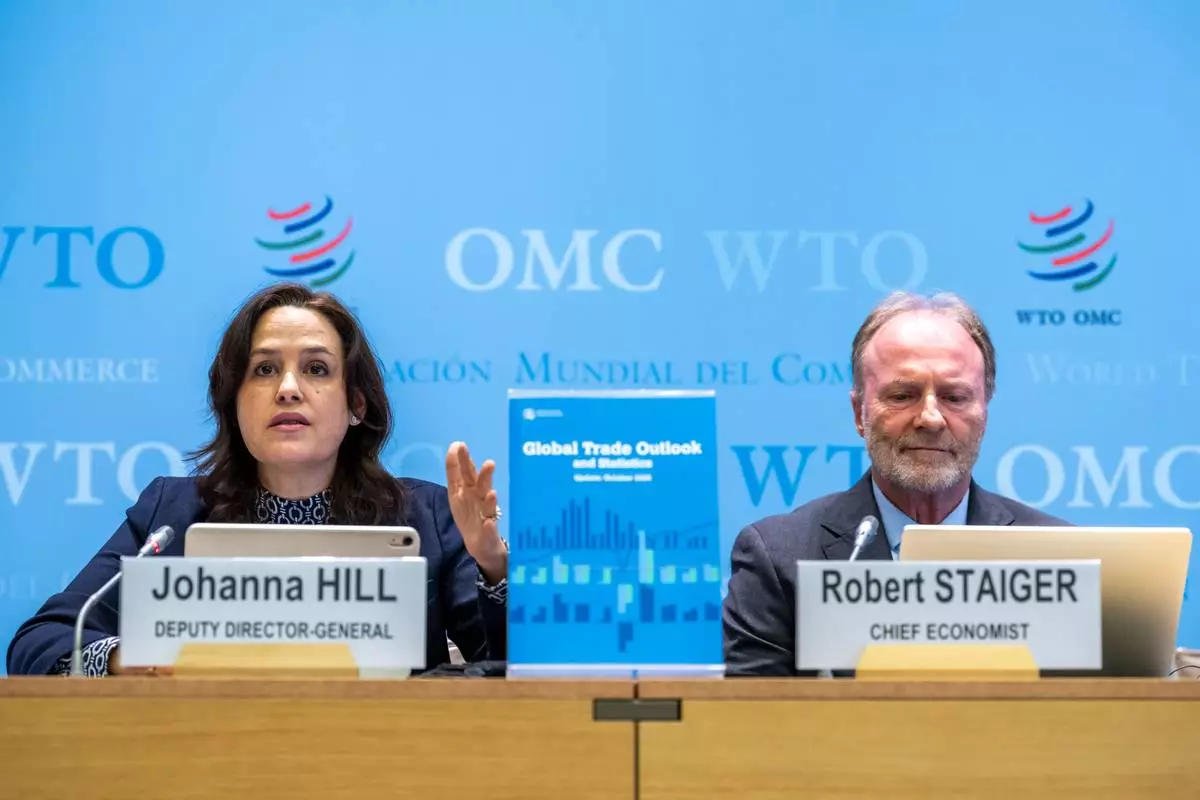
WTO Deputy Director-General Johanna Hill, left, and Robert Staiger, right, Chief Economist of WHO, talk to media about this WTO's "Global Trade Outlook and Statistics" during a press conference at the headquarters of the World Trade Organization (WTO) in Geneva, Switzerland, Thursday, Oct. 8, 2026. (Martial Trezzini/Keystone via AP)
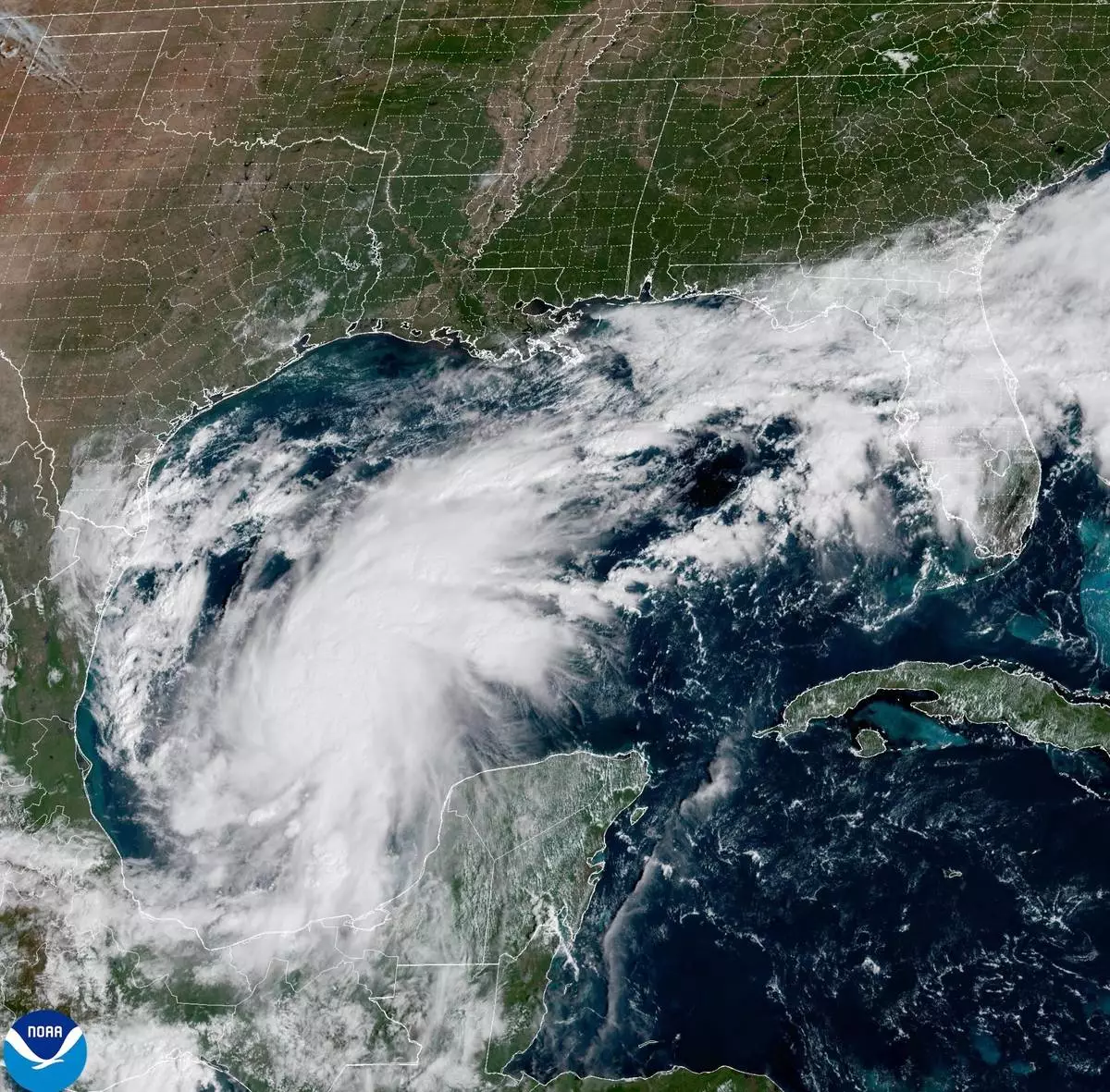
Isaias surged toward the U.S. Gulf Coast on Thursday as the first hurricane of the Atlantic season, prompting mandatory evacuations, school closures and local government shutdowns in parts of Florida.
Isaias was forecast to intensify rapidly and bring strong winds and a life-threatening storm surge to the Florida Panhandle, southern Alabama and southern Mississippi when it makes landfall on the northern Gulf Coast late Friday or early Saturday. Heavy rain with the risk of flooding was possible into the weekend as far inland as the Tennessee Valley.
The hurricane had maximum sustained winds around 80 mph (129 kph) and was moving east-northeast at 9 mph (15 kph) early Thursday morning, the National Hurricane Center in Miami said. It was centered about 385 miles (620 kilometers) south-southwest of the mouth of the Mississippi River.
Coastal communities moved quickly to prepare. Some Gulf oil wells paused production, and at least four Florida school districts canceled classes for later in the week. Okaloosa County announced mandatory evacuations for some coastal areas, and communities closed government offices as of Thursday afternoon. The governors of Florida and Alabama, meanwhile, declared a state of emergency for dozens of counties.
Dauphin Island, a 15-mile-long barrier island off the Alabama coast, encouraged some people to voluntarily evacuate.
“That area is traditionally very vulnerable to storm surge — salt water flooding — and that is also where most of the visitors are," Mayor Jeff Collier said Thursday of the western part of the island.
He said he didn't anticipate substantial damage, “but at the same time, these things are very fickle and a little jog here or there or some last-minute increase in strength, we just have to be prepared for the worst.”
Water from the storm surge and high tide could reach heights of 5 to 7 feet (1.5 to 2 meters) in parts of Alabama and Mississippi, the hurricane center said. Isaias also could dump up to 10 inches (25 centimeters) of rain along parts of the Gulf Coast and spawn tornadoes overnight Friday into Saturday from Alabama to the Florida Panhandle and southwestern Georgia. The hurricane itself is expected to quickly weaken after making landfall.
The National Weather Service told communities from Ocean Springs, Mississippi, to Gulf County, Florida, to prepare for the possibility of “long-duration power outages.”
Isaias developed more than four months into the Atlantic hurricane season and was short by one day of tying a 121-year-old record for the area’s latest-forming hurricane. According to the weather service, the record dates to 1905, when the year’s first Atlantic hurricane formed on Oct. 8.
The Atlantic hurricane season has been unusually quiet this year because of a strong El Niño, which disrupts storm formation over that ocean. Storm activity has been above average in the Pacific, where Tropical Storm Simon formed Wednesday off Mexico.
Isaias is expected to strike a swath of coastline that’s familiar with major hurricanes.
One of the 20th century’s worst storms, Hurricane Camille, killed more than 250 people after hitting land near Waveland, Mississippi, in 1969. Hurricane Katrina in 2005 razed neighborhoods in Mississippi, flooded New Orleans and killed nearly 1,400 people. And Hurricane Michael leveled homes and buildings near Panama City, Florida, in 2018.
Ahead of the storm, oil and gas producers shut down a significant share of offshore production in the Gulf, which accounts for almost 15% of crude pumped annually in the U.S.
As of Wednesday, about 25% of the oil production in the region had been temporarily halted, taking about 511,000 barrels a day off the market, according to the Marine Minerals Administration. It said eight of the Gulf's 371 manned oil platforms had been evacuated.
With oil prices already high, the production cuts are steep enough to affect markets, though other Gulf hurricanes have caused larger disruptions, said Jim Burkhard, global head of crude oil market research for S&P Global Energy. More concerning, he said, is whether Isaias strikes as a powerful storm near refineries.
As it moves inland, Isaias might also disrupt Saturday’s college football showdown between rivals Georgia and Alabama, a game President Donald Trump has planned to attend.
In Gulf Shores, an Alabama community encouraging voluntary evacuations, resident Maranie Adams gathered water and other supplies as her family moved belongings, including a hot tub motor, to higher ground. Her family planned to ride out the storm at home, roughly a half-mile from shore, sheltering indoors alongside their flock of chickens.
“We’re having to get crates to bring them into the house so they don’t blow away,” Adams said. “It’s going to be noisy.”
Alabama Gov. Kay Ivey issued a state of emergency for 40 counties, while Florida Gov. Ron DeSantis declared one for 25 counties in the Panhandle and Big Bend regions. The state also planned to deploy a Miami-based urban search and rescue task force.
In Pensacola, electric utilities were pre-positioning crews to quickly repair any power outages. City officials provided sand for residents to fill sandbags to protect their homes against flooding. And Mayor D.C. Reeves urged people to check on older adult neighbors and others who might need help.
“Obviously no need to panic at this point,” Reeves told a news conference. “This is really about preparation.”
Associated Press reporters Kim Chandler, Russ Bynum, Julie Walker contributed to this report.
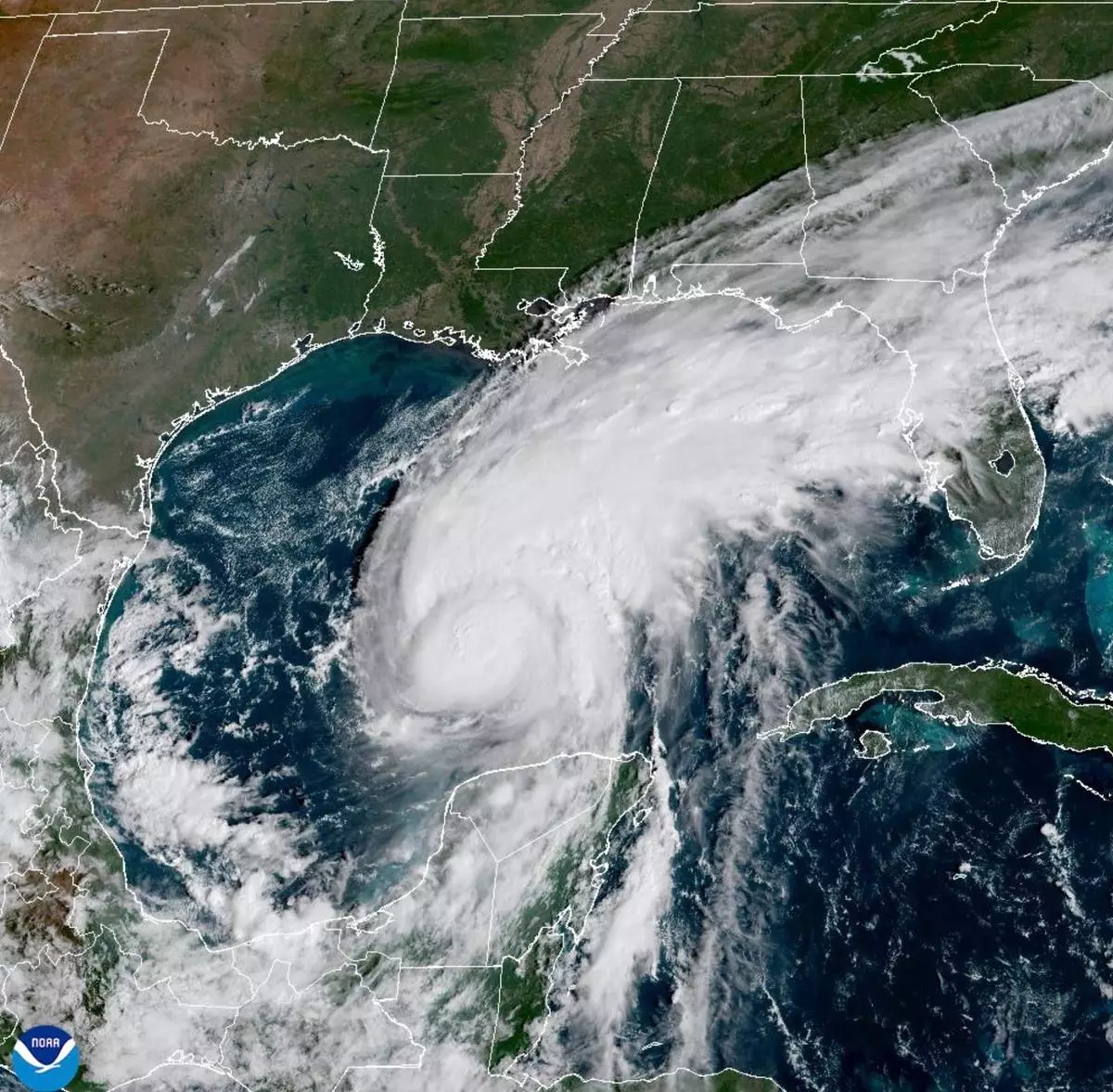
This satellite image from the National Oceanic and Atmospheric Administration shows Hurricane Isaias surging toward the U.S. Gulf Coast on Thursday, Oct. 8, 2026. (National Oceanic and Atmospheric Administration via AP)

Residents pick up sandbags at the James Seals Jr. Parks & Recreation Center as they prepare for Hurricane Isaias expected landfall along the Gulf Coast, Thursday, Oct. 8, 2026, in Mobile, Ala. (AP Photo/Octavio Jones)
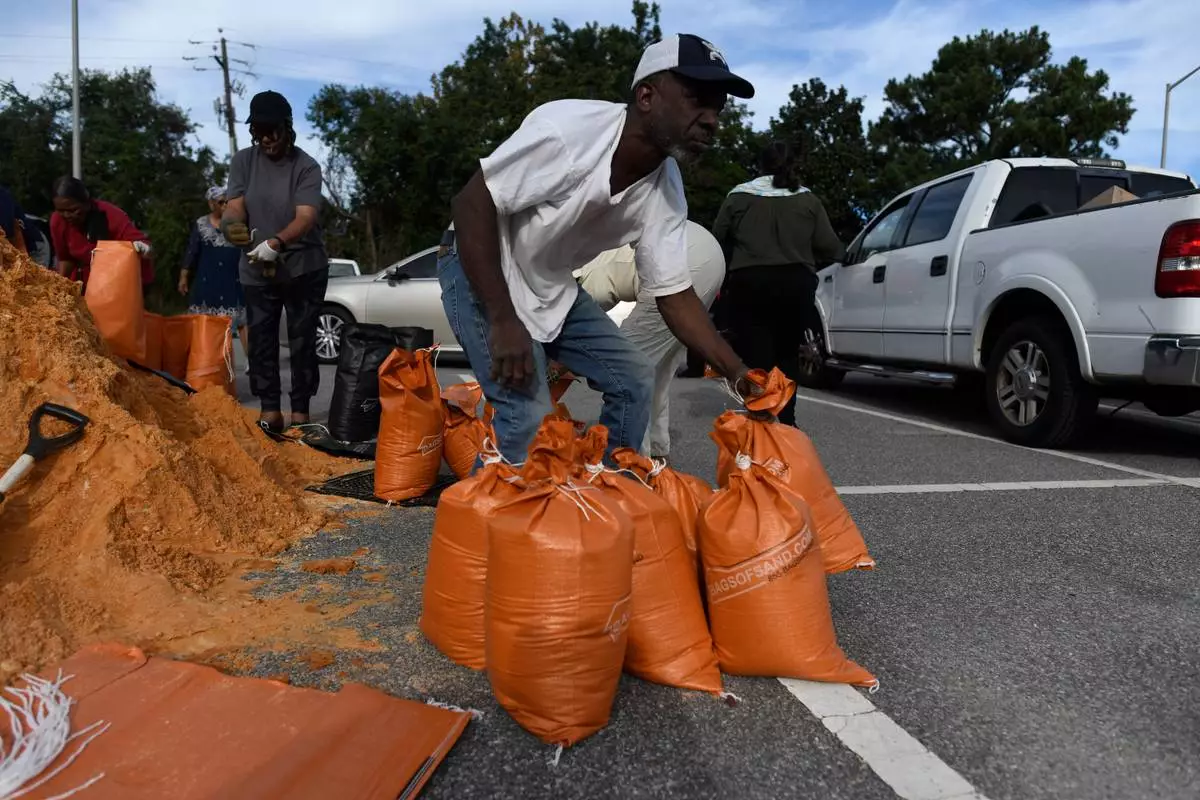
Residents pick up sandbags for storm preparation at the James Seals Jr. Parks & Recreation Center ahead of Hurricane Isaias, expected landfall along the Gulf Coast, Thursday, Oct. 8, 2026, in Mobile, Ala. (AP Photo/Octavio Jones)

Residents pick up sandbags for storm preparation at the James Seals Jr. Parks & Recreation Center ahead of Hurricane Isaias' expected landfall along the Gulf Coast, Thursday, October 8, 2026, in Mobile, Alabama (AP Photo/Octavio Jones)

Residents pick up sandbags at the James Seals Jr. Parks & Recreation Center as they prepare for Hurricane Isaias expected landfall along the Gulf Coast, Thursday, Oct. 8, 2026, in Mobile, Ala. (AP Photo/Octavio Jones)
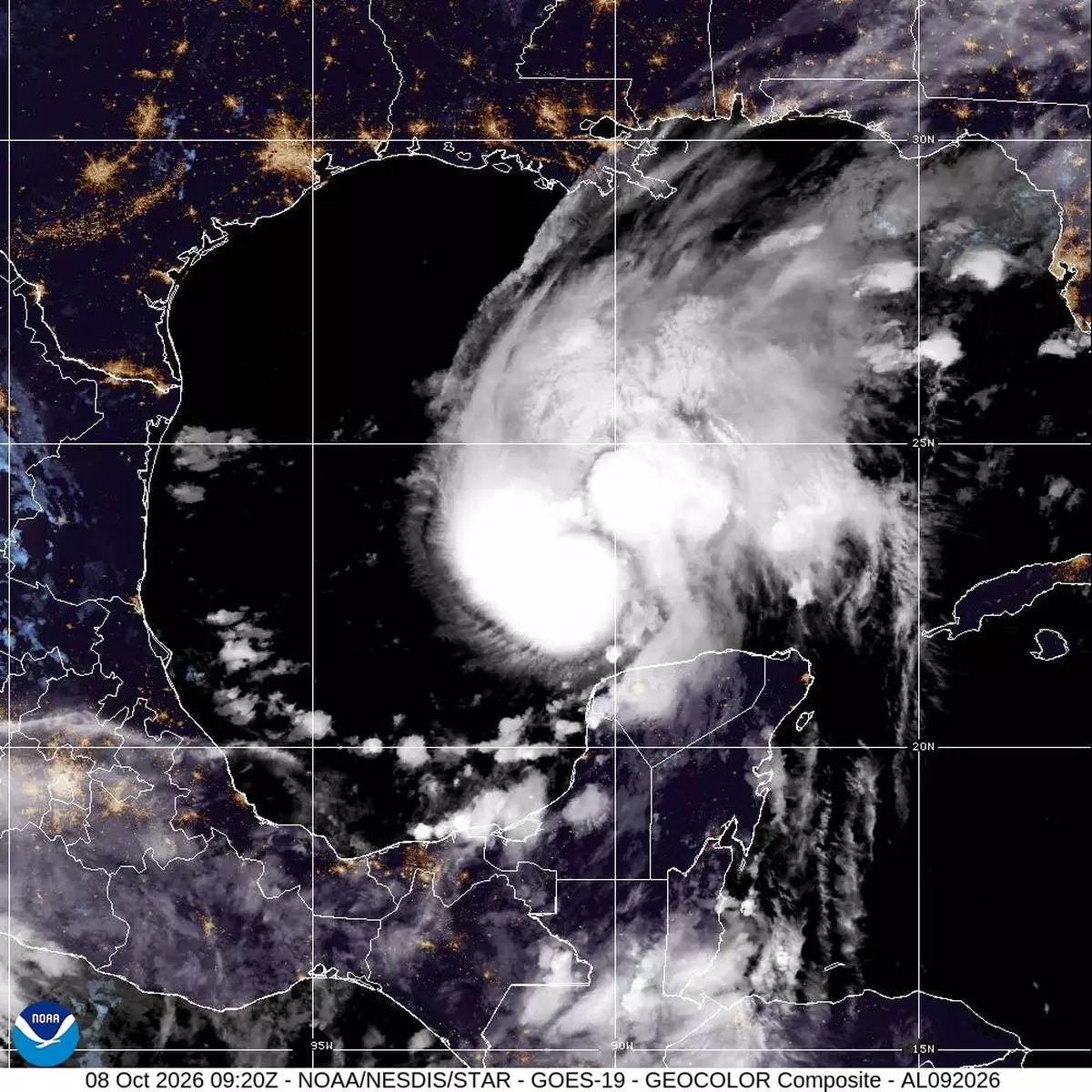
This satellite image from the National Oceanic and Atmospheric Administration shows Hurricane Isaias in the Gulf of Mexico, Thursday, Oct. 8, 2026. (National Oceanic and Atmospheric Administration via AP)
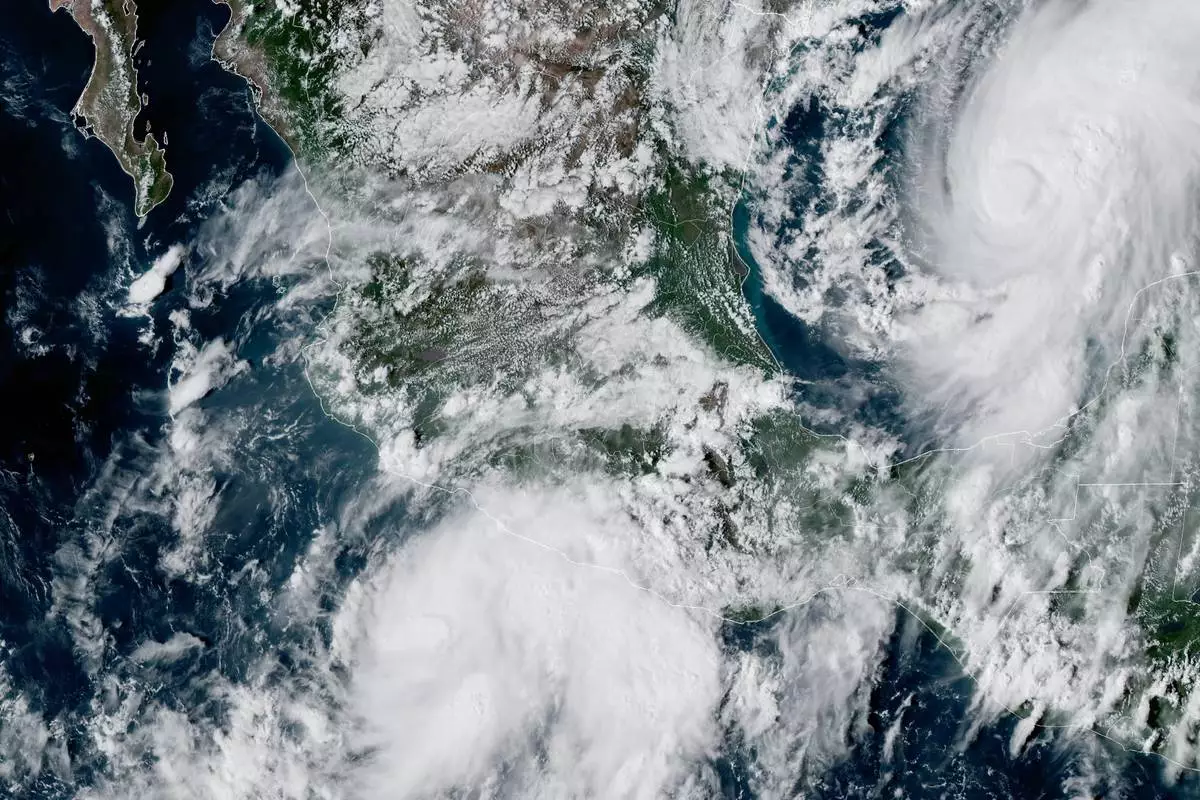
This GOES-19 GeoColor satellite image provided by the National Oceanic and Atmospheric Administration (NOAA) and taken at 4:57 p.m. EDT, Wednesday, Oct. 7, 2026, shows Tropical Storm Simon, bottom center, in the Pacific Ocean, off the southwestern coast of Mexico, and Tropical Storm Isaias, upper right, east of Mexico in the Gulf of Mexico. (NOAA via AP)
This satellite image from the National Oceanic and Atmospheric Administration shows Tropical Storm Isaias off the eastern coast of Mexico on Wednesday, Oct. 7, 2026. (National Oceanic and Atmospheric Administration via AP)