DETROIT--(BUSINESS WIRE)--Oct 8, 2026--
Bloom, the AI-native marketplace for hardware supply chains, today announced an oversubscribed $3.6 million seed round led by SNAK Venture Partners, with participation from Flyover Capital, Mana Ventures, Detroit Venture Partners (DVP), Family VC, Invest Detroit Ventures (IDV), the Michigan Outdoor Innovation Fund (MOIF), TechNexus and Service Provider Capital (SPC).
This press release features multimedia. View the full release here: https://www.businesswire.com/news/home/20261008739048/en/
America is reindustrializing, but the supply chains behind it still run on limited personal networks and slow procurement. When a team building drones, robots or electric vehicles needs a new contract manufacturer, a freight partner cleared to ship lithium batteries, or a service network in a new state, the search can take months. Reshoring and tariff volatility make it harder: more companies need domestic options from a fragmented provider base.
Bloom replaces that search with one marketplace. Hardware companies post a need once. Bloom structures the request, matches it against vetted engineering, manufacturing, logistics and after-sales service providers, and supports quoting, booking and payment. More than 140 hardware companies have used Bloom, completing more than 2,000 successful matches, and every job makes the next match better.
Bloom will use the new capital to:
"I spent years doing this the hard way, moving my prior company's production from China to Detroit," said Justin Kosmides, co-founder and CEO of Bloom. "Hardware companies shouldn't need months and a lucky introduction to find a factory that ships on time. Bloom turns that search into a request, a match to a qualified network and a real booking. This round puts capital behind the marketplace, BloomPay and our agents, so the companies reindustrializing America spend their time on product, not procurement."
"We see Bloom becoming a category-defining marketplace for the hardware industry," said Sonia Nagar, co-founder of SNAK Venture Partners. "Early signs of network effects are already there: most brands buy across more than one service category, and providers call Bloom their most productive source of new business. Hardware supply chains have run on 'do you know a guy' for decades. Bloom is bringing them online."
About Bloom
Bloom is an AI-native B2B marketplace building the supply chain infrastructure for American reindustrialization. It connects hardware companies with vetted manufacturing, logistics and after-sales service providers and runs matching, booking and BloomPay financing on one platform. Founded in 2023 by Justin Kosmides, Chris Nolte and Hitesh Chudasama, Bloom is headquartered at Newlab at Michigan Central in Detroit. Learn more at bloomnetwork.ai.
Media kit:https://www.bloomnetwork.ai/press

Bloom co-founders Justin Kosmides (left), Hitesh Chudasam (center) and Chris Nolte (right). (Bloom)
WASHINGTON (AP) — President Donald Trump said Thursday that he will not order a resumption of military strikes on Iran before the Nov. 3 midterm elections in the United States.
Trump, while stumping for Republicans this week, has hinted that he was confident that an endgame to the war could come in the days before or after the election, while also hinting that he remained open to resuming full-scale military operations against Iran.
For weeks, Trump has been threatening that a post-midterm election escalation in the seven-month-old war remains a viable option, despite his initial promises to Americans of a military campaign that would last a matter of weeks.
But Trump in a social media post on Thursday said the U.S. “will not be attacking Iran at any time prior to the Midterm Elections to be held in the United States on November 3rd.”
Trump added that his team has been “having productive discussions with the Islamic Republic of Iran.”
The U.S. and Iran signed a short-lived interim agreement in June, intended to establish a 60-day ceasefire and framework for a permanent peace deal.
The deal signed by Trump and Iranian President Masoud Pezeshkian collapsed within weeks amid renewed military actions and disputes over control of the Strait of Hormuz, the critical water which one-fifth world's oil flowed through before the war.
Negotiations had appeared at a standstill since Trump late last month publicly rejectedIran’s proposal to reopen the strait within seven days if the U.S. met certain conditions.
Iran, however, said last week they had received a U.S. counterproposal. And Foreign Minister Abbas Araghchi earlier on Thursday said he expected Tehran would offer a formal reply within days.
Trump on Wednesday during a campaign rally in San Antonio, Texas, said that his special envoy, Steve Witkoff, has continued indirect negotiations with Iranian officials.
But at the same time, Trump suggested he had mixed feelings about ending the war at this point.
“I think the deal isn’t really something that I want to do, but they’re willing to offer us anything to stop,” Trump said.
Trump believes that the U.S. is gaining leverage as the U.S. military is having greater success in helping oil tankers traverse the Strait of Hormuz and get Gulf allies’ oil to market, while a Navy blockade is shutting down Iran’s own oil exports.
Iran has lost its near chokehold over oil flows through the vital waterway with U.S. Central Command shepherding oil tankers through the strait at night with their location systems turned off.
That with the help of Gulf pipelines that skirt the strait, has allowed Gulf countries to export oil at nearly prewar levels.
But Iran has ramped up attacks on tankers passing through the strait in recent days. And overall, ship traffic remains well below prewar levels, as are shipments of liquid natural gas and fuel products.
Tanker operators willing to risk running the gauntlet under Central Command’s protection are in some cases charging rates of $1 million a day or more, shipping analysts say.
The situation has become further complicated as Saudi Arabia and Yemen’s government have launched a military campaign aimed at driving Iran-backed Houthi rebels from the Bab el-Mandeb strait, another critical Mideast trade route for oil and other goods. The Houthis, in turn, are targeting Saudi airports and key infrastructure in the kingdom with drone and missile strikes.
Trump's post comes as the military has dispatched more resources to the region. U.S. officials have said a third aircraft carrier, the USS Theodore Roosevelt, and thousands of troops aboard it and accompanying ships could arrive as early as the end of October.
Trump’s announcement was made the same day the USS Abraham Lincoln was due to arrive to its home port in San Diego after a record-long deployment in support of the Iran war. There have been reports of crew stress and poor mental health, as well as supply shortages, including food and hygiene products.
The USS George Washington, which is usually based in Asia, relieved the Lincoln in August. The other aircraft carrier in the Middle East, the USS George H.W. Bush, has been deployed for about six months, but it pulled into Phuket, Thailand, for a port visit several days ago.
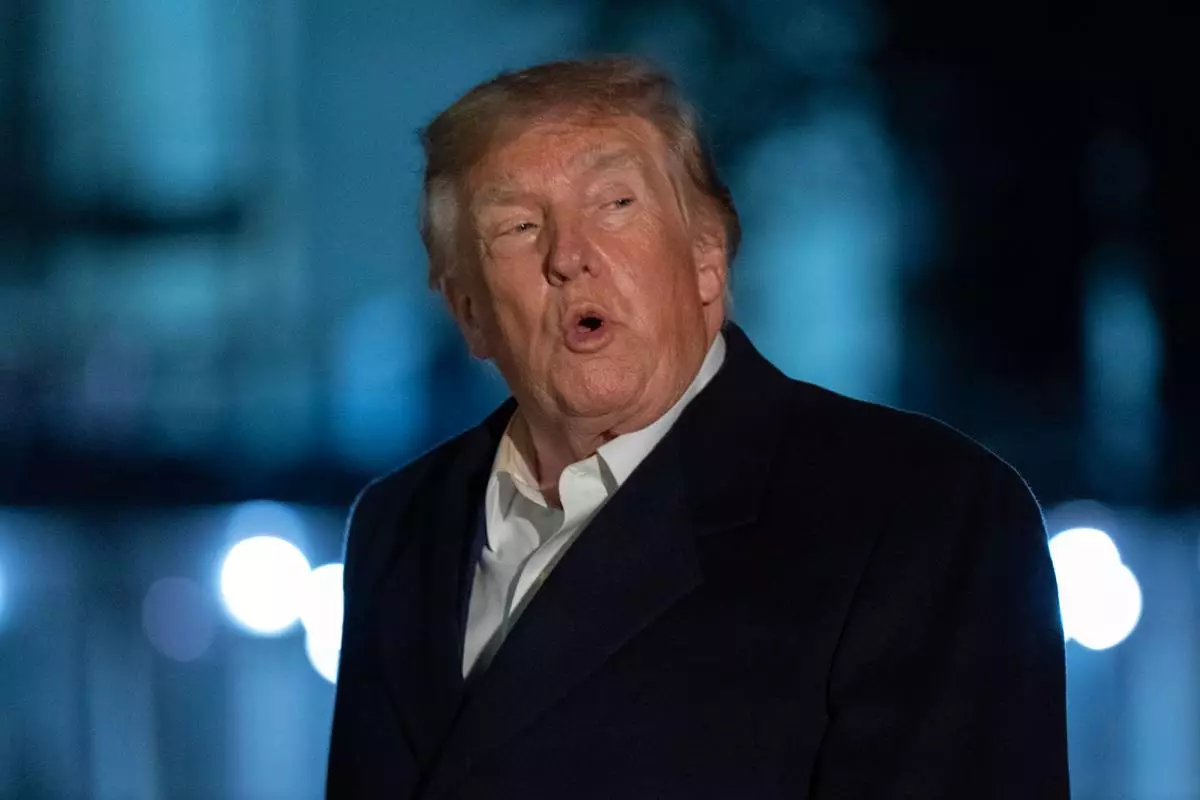
President Donald Trump talks to reporters as he walks on the South Lawn upon his arrival to the White House, Thursday, Oct. 8, 2026, in Washington. (AP Photo/Jose Luis Magana)