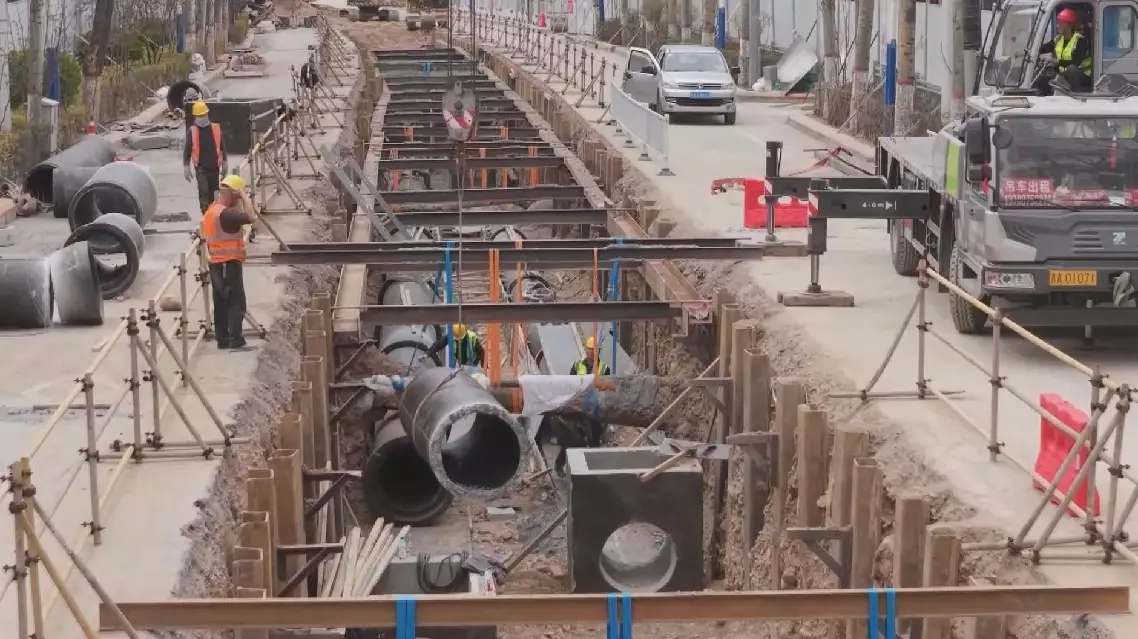
China is stepping up efforts to upgrade its urban infrastructure, targeting roughly 770,000 kilometers of underground pipeline renovations through 2030, according to the Ministry of Housing and Urban-Rural Development.
Set for implementation during the 15th Five-Year Plan period (2026-2030), the initiative targets six key priorities, covering gas pipeline safety, water supply capacity, drainage systems, sewage network upgrades, heating efficiency, and integrated utility tunnels in eligible cities.
To ensure the renovations proceed smoothly, a ministry official emphasized prioritizing urban health checks and strictly enforcing safety controls across all construction phases.
"To effectively implement these tasks, we will fully roll out a 'check-up before renewal' approach. Relying on the results of urban health checks, we will optimize implementation plans and scientifically map out the orderly execution of projects. We must also ensure quality and safety by strictly controlling the planning, design, construction, and acceptance phases, firmly holding the red line of quality and safety," said Xing Haifeng, a senior official of the Urban Construction Department under the Ministry of Housing and Urban-Rural Development.
"We emphasize equal importance on both construction and management. Following the principle of 'whoever owns or operates is responsible,' we will clarify the main entities accountable for the operation and maintenance of various pipelines and establish a routine inspection mechanism. We will also enhance coordination with relevant departments in administrative approvals to form a strong synergy, striving to deliver this livelihood project well," Xing said.
This year, all prefecture-level and county-level cities nationwide are required to conduct comprehensive urban health checks, with key indicators including the renovation rate of old gas networks and the smart monitoring rate of municipal pipelines.
Local authorities are currently speeding up these upgrades. Specifically, efforts will prioritize replacing aging and damaged water distribution networks, upgrading outdated and severely corroded municipal gas pipes, and renewing inefficient heat exchange stations to reduce energy loss and ensure safe operations.
To minimize the inevitable impact of construction on daily commutes, the ministry has urged local authorities to balance project execution with public convenience. Localities are encouraged to adopt new technologies to minimize road excavation, shorten construction cycles, and reduce facility damage.
The ministry also stressed the need to optimize scheduling by implementing centralized block-by-block construction and synchronizing multi-pipeline operations to avoid repeated roadwork.
China to renovate 770,000 km of urban pipelines under 15th Five-Year Plan