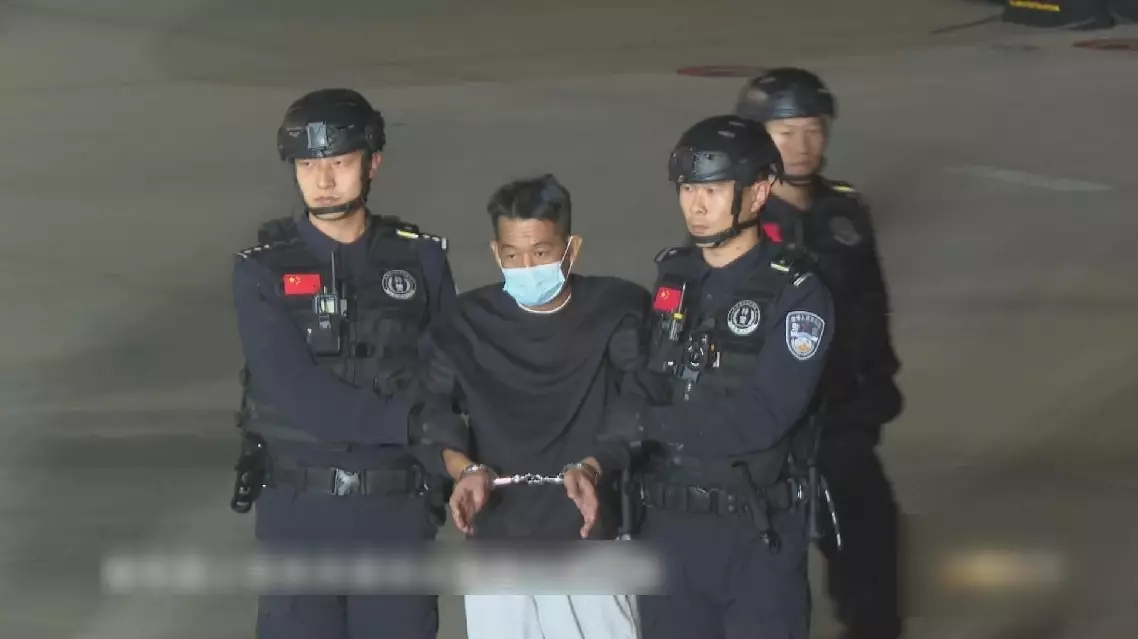
Law enforcement authorities from China, Myanmar and Thailand have conducted continuous joint crackdowns on transnational crime, facilitating the extradition of cross-border online gambling and fraud criminal She Zhijiang back to China.
Since September 2017, She had used his properties in Myanmar as the base to lure Chinese citizens to engage in online gambling via over 200 internet platforms operated by his gang. A total of 330,000 people in China were involved in illegal gambling activities, with the amount of money involved exceeding 2.7 billion yuan (about 380 million U.S. dollars), according to China's Ministry of Public Security.
Investigations launched by the Chinese police also found that She had harbored 248 telecom fraud groups to carry out fraud schemes targeting Chinese citizens, resulting in extremely heavy losses, the ministry said. As She had been at large overseas, the Chinese police applied to the International Criminal Police Organization to issue a Red Notice for a global manhunt. Thai police arrested She in Bangkok, capital of Thailand, in August 2022. His arrest was followed by extradition proceedings.
In May 2023, the Criminal Court of Bangkok made a first-instance judgment, agreeing to extradite She back to China. However, he filed an appeal, attempting to evade trial upon returning to China.
As a single set of evidence is not sufficient to facilitate the extradition process, the related authorities of China, Myanmar and Thailand exchanged their intelligence and evidence to facilitate the process.
On March 3, 2025, a ministerial-level coordination meeting on jointly combating transnational telecommunications and online fraud crimes among China, Myanmar and Thailand was held in Bangkok. The three parties reached a preliminary consensus on key issues such as intelligence sharing, joint case handling and suspect transfer.
The second ministerial-level meeting of the three countries held in July of the same year clearly identified Myawaddy, Myanmar and other regions as key targets for joint strikes.
As a result, a total of 5,400 suspects involved in fraud have been escorted back to China in batches from Myawaddy. After several rounds of trials, the court in Thailand made a final ruling on Nov 10, 2025 to reject She's appeal requests and uphold the first-instance judgment.
She was finally extradited back to Nanjing, capital of east China's Jiangsu Province, from Thailand on Nov 12, 2025.
A senior police officer told media that She's successful extradition demonstrates the firm resolve of these public security organs in cracking down on crime.
China-Myanmar-Thailand judicial collaboration facilitates extradition of online gambling, fraud criminal