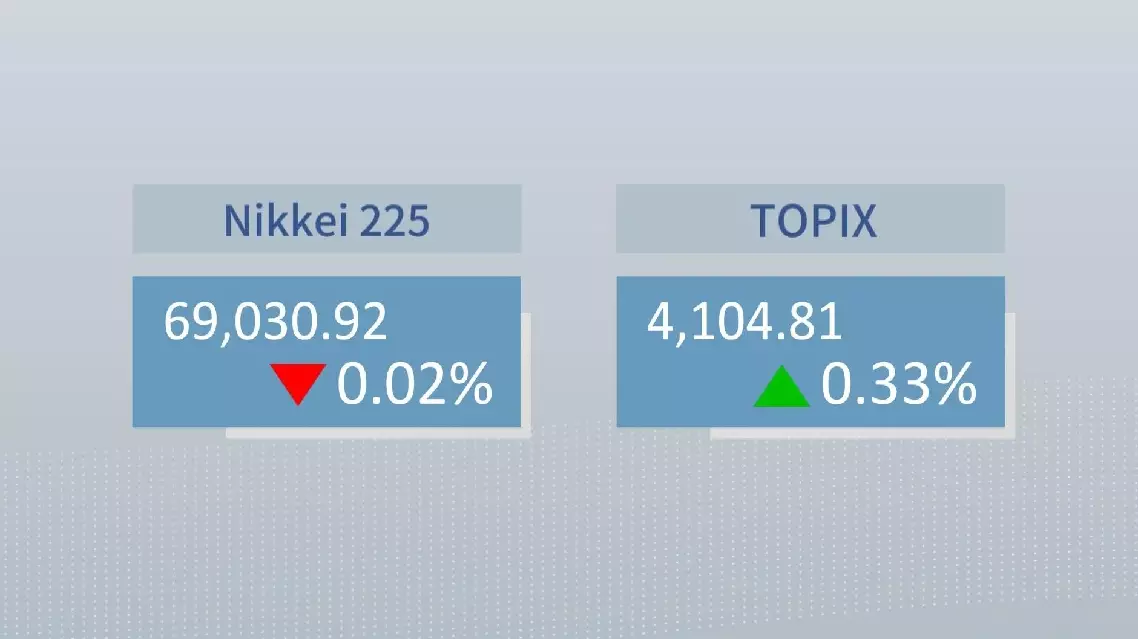
Tokyo stocks ended mixed Friday, as losses in technology shares weighed on the benchmark Nikkei index amid concerns over the outlook for artificial intelligence-related businesses.
The 225-issue Nikkei Stock Average ended down 11.19 points, or 0.02 percent, from Thursday at 69,030.92.
The broader Topix index, meanwhile, finished 13.35 points, or 0.33 percent, higher at 4,104.81.
AI- and semiconductor-related shares fell, tracking losses by their U.S. counterparts. The Nikkei fell nearly 900 points in early trading before briefly turning higher late in the session on dip-buying, while the Topix traded largely in positive territory amid buying following the announcement of a major overhaul of the index, analysts said.
Japan Exchange Group on Wednesday announced a major revamp of the Topix, with 683 companies designated for gradual removal under tougher inclusion rules. The changes are part of efforts to make the index more investable.
Tokyo stocks end mixed as tech shares weigh on Nikkei
A super El Nino event officially formed in September 2026, monitoring data from China's National Climate Center showed on Friday.
Zhao Junhu, chief forecaster at the center, said that the equatorial central and eastern Pacific entered an El Nino state in May this year, with sea surface temperatures in the key monitoring region rising rapidly and continuously from May to September.
The three-month running mean of the sea surface temperature (SST) index in the monitoring region has remained above 0.5 degrees Celsius for five consecutive months. The index exceeded 2.5 degrees Celsius for the July-September period, meeting the threshold for a super El Nino event.
The event is classified as an eastern Pacific-type El Nino, in which the warmest sea surface temperatures are concentrated in the equatorial eastern Pacific.
Monitoring data showed that sea surface temperatures across most of the equatorial Pacific in September were above average of the same period, with temperatures in the warm pool of the eastern Pacific exceeding the climatological average by more than 3 degrees Celsius.
The SST index for the monitoring region reached 2.94 degrees Celsius in September, up 0.35 degrees Celsius from August. The average index for the July-September period stood at 2.54 degrees Celsius.
Based on a combination of domestic and international dynamical climate models and statistical forecasting methods, the center expects sea surface temperatures in the equatorial central and eastern Pacific to continue rising over the next three months, peaking in late autumn or early winter, Zhao said.
The event is expected to become the strongest El Nino on record since systematic monitoring began, he added.
Super El Nino event formed in September: China's National Climate Center