Skip to Content Facebook Feature Image

Social Security recipients to get 3.6% cost of living boost, an average of $75 per month

News

Social Security recipients to get 3.6% cost of living boost, an average of $75 per month
News

News

Social Security recipients to get 3.6% cost of living boost, an average of $75 per month

2026-10-14 23:25 Last Updated At:23:30

WASHINGTON (AP) — The Social Security Administration projected Wednesday that the annual cost-of-living adjustment for older adults and people with disabilities will go up by 3.6% beginning in 2027, with some recipients complaining that is not enough to offset soaring prices.

The adjustment translates to $75 extra per month for the nearly 72 million people who receive monthly Social Security benefits and about 7.3 million beneficiaries who get Supplemental Security Income.

The announcement comes as inflation adds pressure on household budgets and businesses and as midterm elections are weeks away.

The cost-of-living adjustment, or COLA, for retirees and disabled beneficiaries is financed by payroll taxes collected from workers and their employers, up to a certain annual salary. That is set to increase to $192,300 in 2027, from $184,500 in 2026.

The agency's commissioner, Frank Bisignano, said in a statement that the adjustment will give recipients “greater financial stability.”

Some older adults feel the increase is a drop in the bucket as inflation has eaten away at monthly savings. The government reported last month that inflation accelerated in August as gas prices spiked in the wake of renewed fighting between the United States and Iran.

Lorrie Ufkin, a 71-year-old retiree who lives outside Rochester, Minnesota, said the COLA will not put a dent in her healthcare costs, which are set to increase after the Trump administration concludes at year's end a temporary Medicare Part D subsidy program that has helped offset premiums. Ufkin said that her premiums and drug cost are expected to rise, although the Centers for Medicare & Medicaid Services has projected a modest increase for most people.

The COLA “doesn’t even meet what they’re going to do for changes to Medicare,” she told The Associated Press.

She said one of the medications both she and her husband take will go from $11 per month for each prescription, to $200 per month, after Republican administration changes made to older Americans' healthcare programs. She said that was “catastrophic.”

Senior advocacy groups say the COLA is a strong reminder of the financial straits of many older people.

“There’s a lot on the line financially right now for older Americans — one in five have no retirement savings, and more people feel financially insecure this year than last. That makes Social Security’s cost-of-living adjustment critically important,” said AARP CEO Dr. Myechia Minter-Jordan.

Jaime Jakubczak, a 68-year-old resident of Buffalo, New York who retired early at 55, has recently gone back to work to make ends meet, specifically to afford rising property taxes. He said the COLA is insufficient because it is offset by high inflation and a proposed 3.9% property tax increase in his town.

Jakubczak called the 3.6% cost-of-living adjustment “a pittance," given how high food, healthcare and gasoline prices have become across the country.

“We were getting ahead a little bit with the COLA based on inflation, but the inflation is so high that it doesn’t offset what our COLA allowance is," he said.

Most older adults believe the COLA isn’t adequately keeping up with inflation, according to an AARP poll from September. That poll found that about three-quarters of those 50 or older disagreed with the idea that a 3.5% COLA in 2027 would be enough to keep up with rising prices.

The Social Security Administration faces a looming bankruptcy date if a funding shortfall is not addressed by Congress.

The June 2026 Social Security and Medicare trustees’ report states that Social Security’s combined trust funds — which cover old age and disability recipients — will be unable to pay full benefits beginning in 2034. After that, incoming revenue would cover about 83% of scheduled benefits.

While a permanent solution for shoring up the benefits program has not been passed into law, lawmakers on the Hill have called for new measures to replenish the trust funds.

Sens. Elizabeth Warren, D-Mass., and Bernie Moreno, R-Ohio, in June proposed lifting the Social Security payroll tax cap, which is a maximum amount of earnings taxable. Treating all income the same "would generate substantial revenue that would extend the solvency of Social Security for another generation,” they wrote in The New York Times.

The move is controversial because Republicans have traditionally criticized calls to raise taxes on the wealthy.

The Peterson Foundation estimates that lifting the payroll tax cap would add roughly $3 trillion into the program over the next 10 years.

Both the Trump and Biden administrations signed into law new benefits for retirees, which boosted their finances, but simultaneously accelerated the insolvency of the old-age benefits program.

The Trump administration, as part of Republicans’ tax and spending bill, gave a temporary tax deduction for people 65 and over, which applies to all income — not just Social Security. But those who aren't able to claim the deduction include the lowest-income older adults who already don’t pay taxes on Social Security, those who choose to claim their benefits before they reach 65 and those above a defined income threshold.

Additionally, Democratic President Joe Biden in 2024 repealed two federal policies — the Windfall Elimination Provision and the Government Pension Offset — that previously limited Social Security payouts for roughly 2.8 million people, including largely former public workers.
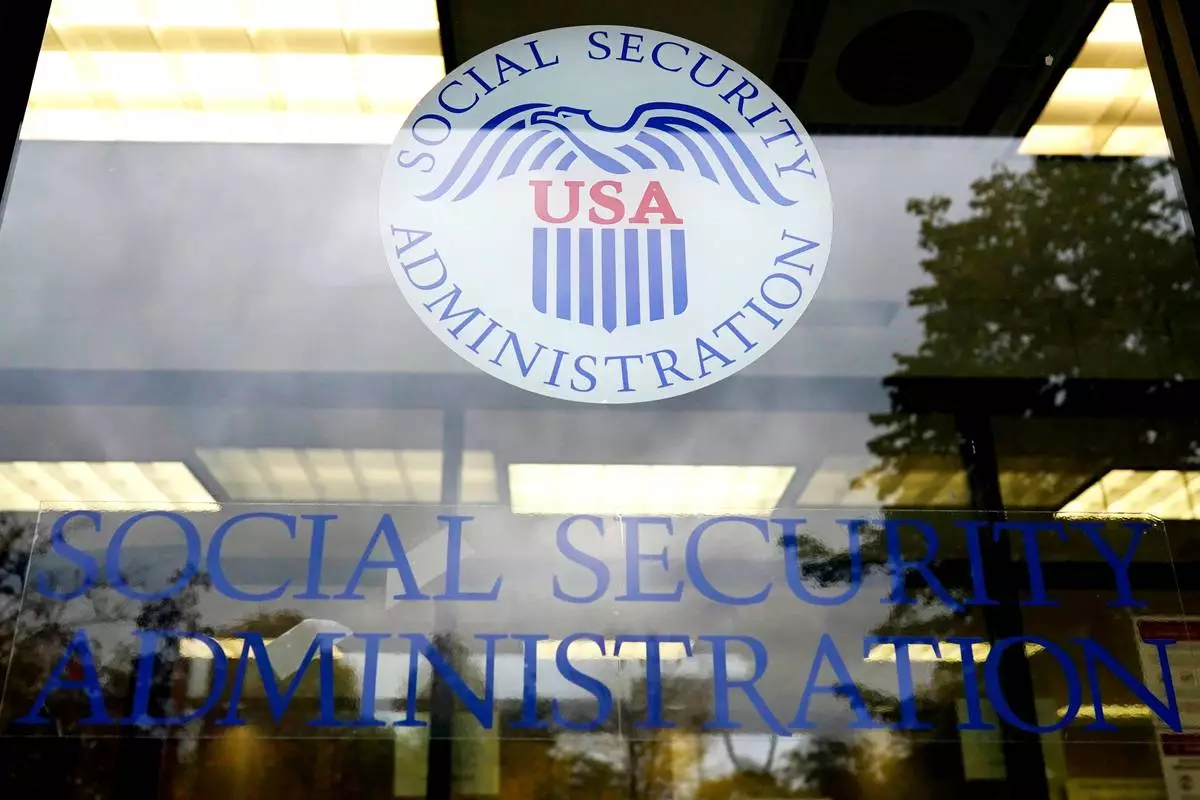
FILE - The Social Security Administration office is seen in Mount Prospect, Ill., Oct. 12, 2022.(AP Photo/Nam Y. Huh, File)


FILE - The Social Security Administration office is seen in Mount Prospect, Ill., Oct. 12, 2022.(AP Photo/Nam Y. Huh, File)

WASHINGTON (AP) — More than a year after National Guard members began patrolling the streets of the nation's capital, a federal appeals court on Wednesday opened a hearing by asking the government if there were any limits on a president's authority to call up the guard in D.C.

The hearing began with the three-judge panel collectively questioning the government’s attorney, Eric McArthur. Judge Cornelia T.L. Pillard asked how the government's argument about an administration's authorities was “not federalization and therefore running up against" the Posse Comitatus Act, an 1878 U.S. law forbidding the use of the federal military for domestic law enforcement unless authorized by the Constitution or Congress.

The hearing comes months after the court paused a lower court’s ruling that President Donald Trump's deployment of the guard was illegal.

Trump deployed the guard in August 2025 as part of what he said was a crime-fighting mission in Washington, D.C. The force, which rose to a peak of about 5,000 troops over the summer, has supported arrest operations, patrolled city streets and neighborhoods and participated in cleanup efforts.

Trump's Republican administration says the deployment has contributed to a decrease in crime in the city, where crime was already on the decline before the National Guard arrived. Officials and activists in the overwhelmingly Democratic city say the deployment is a waste of taxpayer money and has normalized the militarization of a major American city.

The three judges on the panel were nominated by Democratic presidents: Pillard by Barack Obama, Bradley Garcia by Joe Biden and Judith Rogers by Bill Clinton.

At the heart of the court case, brought by D.C.'s attorney general, is whether the president has the authority to deploy the National Guard to the city, which, as a federal district, has limited autonomy over its own affairs. The U.S. Constitution gives federal lawmakers authority over the District of Columbia, while the Home Rule Act of 1973 lets residents elect a mayor, a council and neighborhood commissioners.

The city has argued that the mobilization is an illegal use of the military for domestic law enforcement.

Last December, the three-judge panel that paused the lower court's ruling said Trump might prevail in his argument that the president “possesses a unique power” to mobilize the guard in Washington.

The court went on to say in a unanimous 32-page ruling that other factors also favored the Trump administration, including the “disruption to the lives of thousands of service members,” as well as what it said was the president’s interest “in the protection of federal governmental functions and property within the nation’s capital.”

The judges found that the district “has not identified any ongoing injury to its statutory interests.”

Even if D.C. wins at the appeals court level, the Trump administration will undoubtedly go to the U.S. Supreme Court, which has already shown deference to the president in a number of cases.

Syracuse law professor William Banks said D.C. might have a slim argument under its home rule, questioning whether National Guard units can be deployed to the city when it isn’t authorized by local law.

But, he said, outside of that argument “there is no overarching federal principle that would bail out the district in this case."

Because D.C. is not a state and because the president is commander in chief, there’s a "tremendous amount of leeway and discretion for the president” to control or delegate control of the local National Guard and out-of-state units, Banks said.

Margaret Hu, a professor at the William and Mary School of Law, said one issue to look for was raised by states supporting the deployment in court briefs. They argued the president was reacting to an emergency. Hu said the open-ended manner of the deployment might allow a challenge to that.

“Some argue that the indefinite nature of the deployment means that there’s no emergency justification here,” she said.

U.S. District Judge Jia Cobb concluded last November that Trump’s military takeover in Washington illegally intrudes on local officials’ authority to direct law enforcement in the district.

Cobb found that while the president does have authority to protect federal functioning and property, he can’t unilaterally deploy the D.C. National Guard to help with crime control as he sees fit or call in troops from other states. Cobb, who was nominated by Biden, put her order on hold for 21 days to allow the appeal by the Trump administration.

The appeals court stayed the order and has allowed the guard to remain in place while the case is pending.

The mobilization, extended until January 2029 by the Defense Department, has taken on a sense of permanence, despite the court case.

The federal government awarded a $292 million contract to a private company to provide members of the Joint Task Force-D.C. with apartments. The numbers have grown as well, ballooning to around 5,000 during the height of the semiquincentennial celebration. As of last week, that number had dropped to about 2,900.

Members of the National Guard walk past the Lincoln Memorial Reflecting Pool, where some water can be seen, Tuesday, Oct. 13, 2026, in Washington. (AP Photo/Jacquelyn Martin)

Members of the National Guard walk past the Lincoln Memorial Reflecting Pool, where some water can be seen, Tuesday, Oct. 13, 2026, in Washington. (AP Photo/Jacquelyn Martin)

Recommended Articles