Tianchi Lake in northwest China's Xinjiang Uygur Autonomous Region saw its first snowfall of the year on Friday.
Mingling with the autumn colors, the fresh snow gave the view a serene and ethereal beauty.
After the snowfall, light mist rose through the mountains as clouds drifted across the slopes. Snow covered parts of the mountains, while autumn colors remained vivid elsewhere. Nestled among the peaks, the lake's surface was veiled in vapor and shimmering softly.
Sightseeing boats glided through the mist as mountains, forests, lake, snow and clouds merged into a striking landscape.
The unexpected first snow also delighted visitors. Dressed in warm clothing, many strolled along the lakeshore and through the wooded paths, stopping to take photos and capture the fleeting beauty of late autumn.

Xinjiang’s Tianchi Lake welcomes first snowfall
China's first-ever multi-generational space rice research has taken a new step toward humans' ability to fully grow food in orbit, with the Shenzhou-23 crew completing another round of sample collection, sowing, and storage aboard the Tiangong space station.
The research project aims to study the molecular mechanisms behind rice's multi-generational genetic stability and environmental adaptability in microgravity. Over the past week, the three astronauts collected a new batch of samples, which will be returned to Earth for scientists to analyze at the phenotypic and molecular levels, helping reveal how long-term microgravity affects rice genetic stability.
China's space rice research began in 2022, when the Shenzhou-14 crew conducted the world's first full life-cycle rice cultivation experiment in space. During that mission, six rice seeds were grown aboard Tiangong for 120 days, producing 59 first-generation space-grown seeds that the crew returned to Earth.
On May 24 this year, the Shenzhou-23 spacecraft carried a new batch of rice seeds into orbit. The seeds fall into two groups: ordinary seeds that have never left Earth, and third-generation descendants bred on the ground from the 59 space-grown seeds harvested in 2022. Both are Chinese japonica varieties known for their adaptability and three- to four-month growing cycle.
After more than four months in orbit, the Shenzhou-23 crew has reached the first harvest and begun second-generation cultivation using two propagation methods. The aim is to compare how space-flown and Earth-grown rice adapt to space, and to explore how different propagation methods affect second-generation space rice.
The second-generation space rice is expected to mature during the Shenzhou-24 mission, scheduled for later this year.
While the 2022 experiment covered a full life cycle "from ground seed to space seed," this year's research advances to "from ground seed to space seed to space seed" -- a repeating cycle that researchers hope could provide important theoretical support for in-situ crop production beyond Earth -- the ability to grow food in space without relying on resupply from Earth. Such a capability is considered essential for humanity's future exploration of deep space.
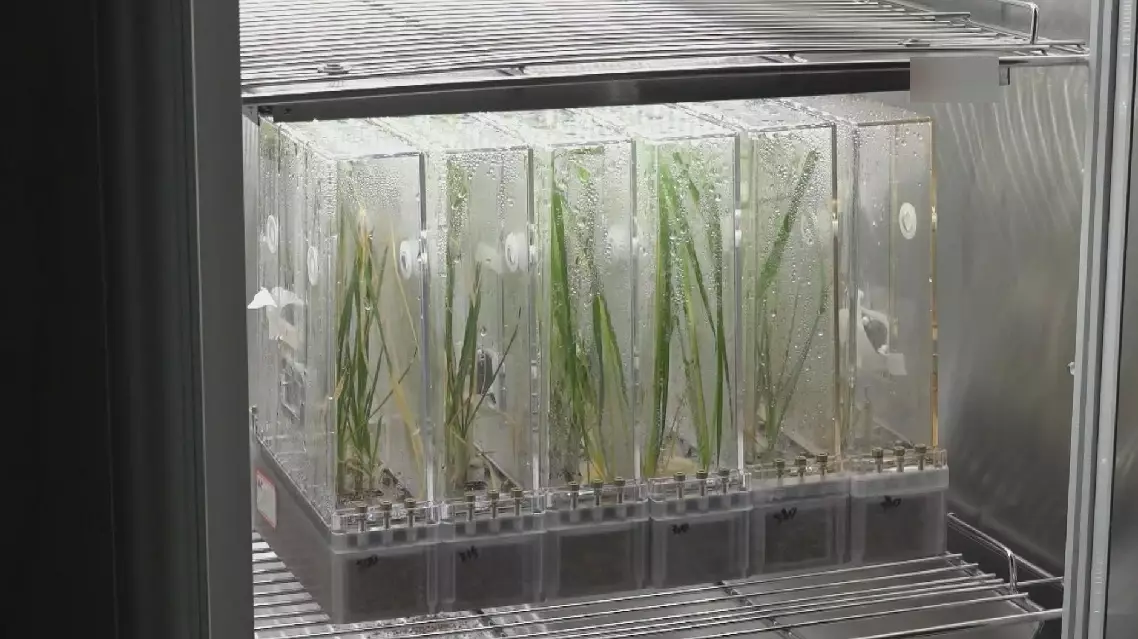
China's multi-generational space rice research advances toward growing food in orbit