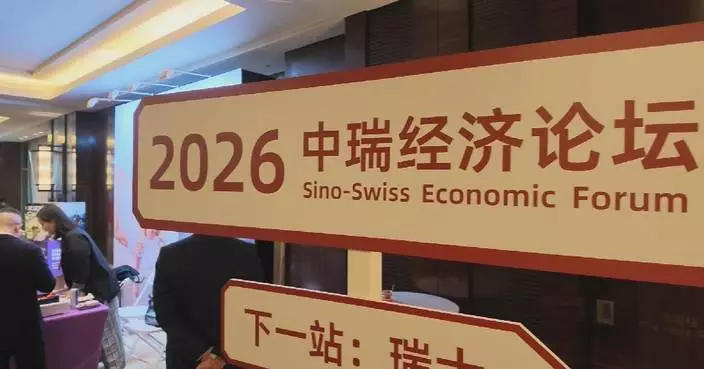
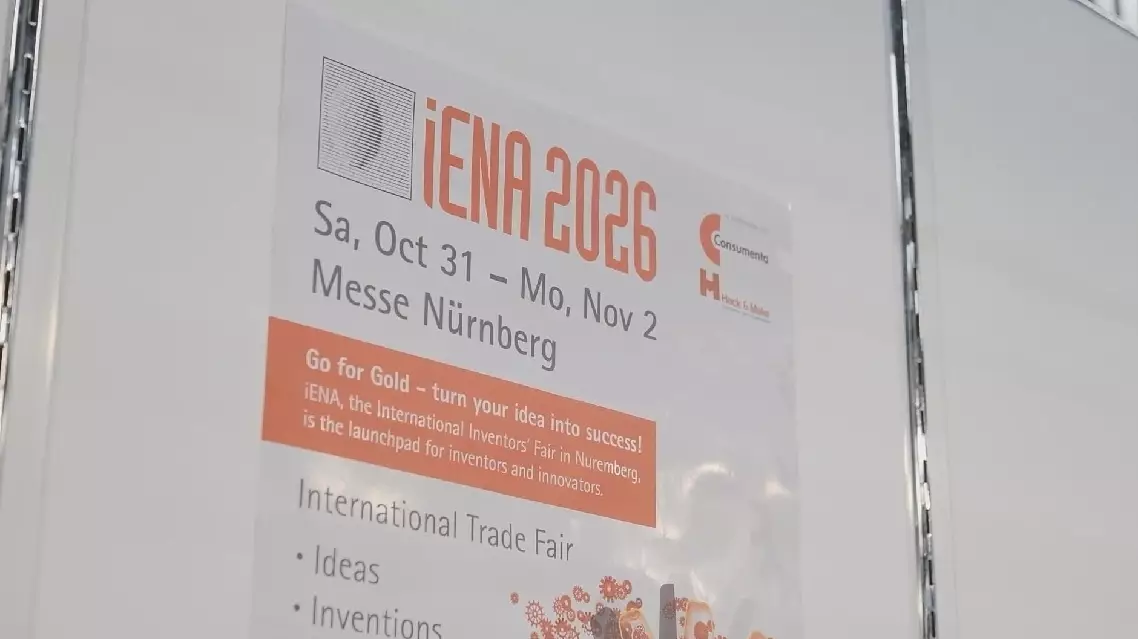
For the fourth consecutive year, China holds the top spot among international delegations at the Nuremberg inventors' fair, arriving at the 78th International Trade Fair for Ideas, Inventions and New Products (iENA) with a delegation of 145 projects, underscoring the country's growing weight in the world of invention.
The three-day event, which runs through Monday, has brought together individuals and organizations from more than 20 countries and regions to showcase nearly 600 inventions in the German city of Nuremberg.
The Chinese delegation, organized by the China Association of Inventions, is presenting projects spanning biomedicine, green energy, artificial intelligence and intelligent manufacturing, and exhibition officials say the contingent is valued as much for its quality as for its scale.
"Once again, the participation led by the Chinese Association of Inventions is our largest international delegation participating at iENA. And it's not only the largest, we can also say very honestly, it is one of the most professional," said Henning Koenicke, managing director of exhibition organizer AFAG.
Inside the Chinese exhibition area, the projects drawing the strongest interest are those that translate advanced research into concrete answers to pressing problems. One is a micro/nanorobot capable of entering the complex vascular environment of the human body, opening new possibilities for treating related diseases.
Elsewhere in the section, a system developed by Tsinghua University for intelligent flood modeling and forecasting combines drone-based remote sensing with artificial intelligence to rapidly simulate how floods form and evolve, delivering minute-level computations of a 24-hour flood process even in regions with complex terrain and scarce foundational data.
Also on display is a deep-Earth energy development system that fuses multi-source survey data with artificial intelligence to provide real-time monitoring and early risk warnings, supporting the efficient development of oil and gas resources deep underground.
This emphasis on applied solutions has not escaped the jury assessing the entries. Oliver Mayer, chairman of the international expert jury, said Chinese innovation impressed him as much this year as it had in previous ones.
"I can say, as every year, very impressive what China is able to deliver. China is very good at industrial production, industrial technologies for solving the world's problems," he said.
The inventive spirit at the fair is not confined to established research institutions. Among the delegation's youngest exhibitors, inventive ideas often grow out of small observations from daily life, as one primary school student's project demonstrates.
"My project is called 'Grandma's Little Sidekick'. It is a smart, user-following shopping cart, which is simple to operate. This is the beacon, and this is the base station. The beacon sends signals to the base station, allowing the cart to determine the user's direction and distance. I've also programmed two gesture commands: a fist, which starts the cart, and an open palm, which brings it to a stop," said Zhang Ting, a Chinese fifth-grader.
Founded in 1948, the Nuremberg International Inventors' Fair was created to give innovative inventions from around the world a platform and a path to commercial opportunity. It remains a venue of premieres, with around 98 percent of this year's exhibits being presented to the public for the first time.
This year's edition is particularly rich in environmental protection and energy technology, with significant new developments in mobility and other exhibits spanning electrical engineering, information technology, and education and research.
China sends largest delegation to Nuremberg inventors' fair for fourth consecutive year