Three high-altitude solar power projects have recently been completed in Nagqu City, southwest China's Xizang Autonomous Region, marking a step forward in ensuring stable green power supply for local livelihoods.
Relying on the combination of photovoltaic power and grid-forming energy storage, the three counties of Shuanghu, Baingoin and Biru will bid farewell to power instability caused by extreme weather in the past. Stable and reliable green electricity will continuously meet people's livelihood needs such as heating, medical care and education.
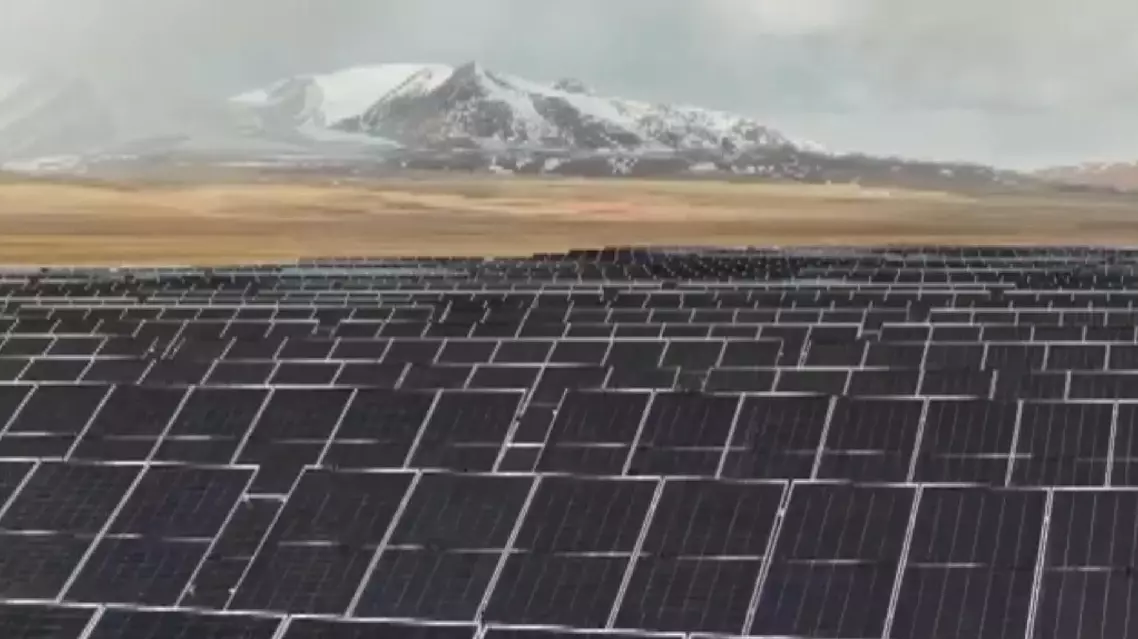
Located at an altitude of about 5,000 meters, Shuanghu is China's highest-altitude county. The newly completed 10-megawatt photovoltaic power station in the county is made up of more than 16,000 photovoltaic panels. Once operational, it will provide the county with a more stable supply of green electricity.
"After the project is put into operation, it will generate 15.59 million kWh of electricity annually, equivalent to more than half a year's electricity consumption of the entire county. It will save about 4,700 tonnes of standard coal and reduce carbon dioxide emissions by about 13,000 tonnes each year," said Zhu Yuegang, who is in charge of the Shuanghu new energy project under the Huadian Jinsha River Upstream Hydropower Development Co., Ltd.
The other two projects -- 20-megawatt solar power project in Baingoin and the 33-megawatt solar power project in Biru -- are sitting at an average altitude of over 4,700 meters.
When these projects become operational, the clean electricity supply in the three counties will add more than 85 million kWh annually, effectively solving the long-standing problem of unstable power supply and ensuring that basic public services such as heating, medical care and education run stably around the clock.
"This place is covered by snow for eight to 10 months a year. The photovoltaic modules we installed have solar panels on both the front and rear side, allowing us to capture sunlight reflected off snow and convert it into electricity. The bifacial power generation can boost efficiency by 7.4 percent. Thanks to this alone, the entire station can generate more than 16,000 kWh of extra electricity a day," said Tang Haonan, construction head of the Shuanghu photovoltaic power station.
Located in a remote area, Shuanghu's power grid is relatively weak, and its power supply has long been unstable.
"Very unstable. Strong winds and heavy snowfall would often bring down the power lines and cause outages, and the meat often went bad in the fridge. I bought a generator myself, but because of the weather here, it wasn't easy to generate electricity. Now with the establishment of the solar power station, the power supply is more stable," said He Qimin, owner of a supermarket in Shuanghu County.
Three high-altitude solar power projects completed in Xizang's Nagqu to ensure stable power supply