Skip to Content Facebook Feature Image

Mount Tai robot competition acts as proving ground for future applications

China

Mount Tai robot competition acts as proving ground for future applications
China

China

Mount Tai robot competition acts as proving ground for future applications

2026-11-02 20:50 Last Updated At:21:17

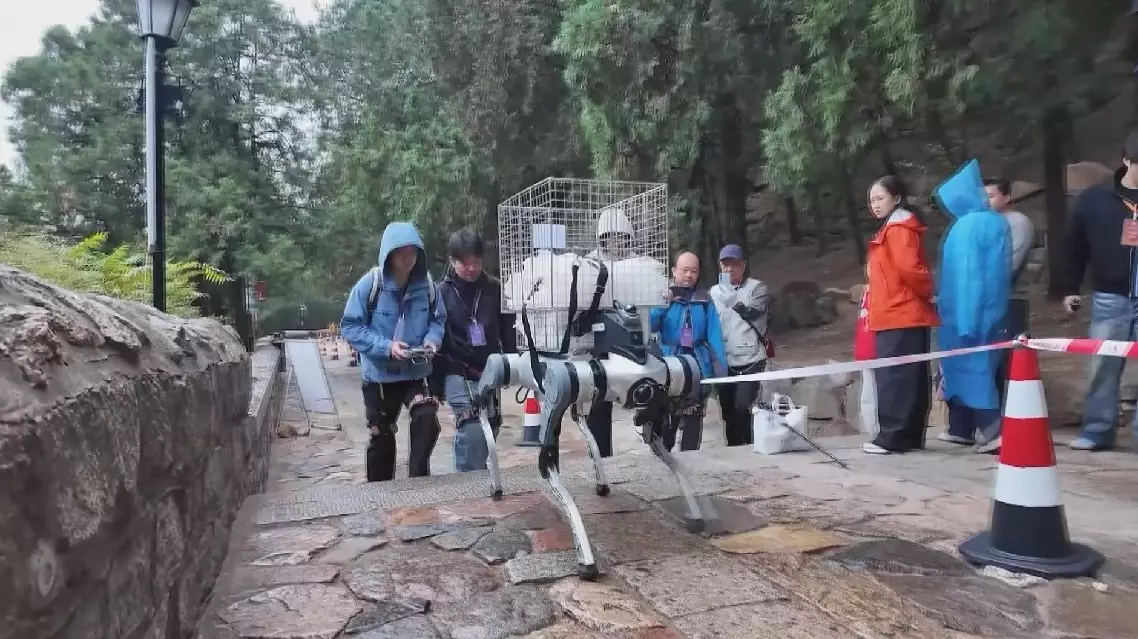
Held on the slopes of Mount Tai, one of China's most iconic peaks in eastern Shandong Province, a distinctive robot mountain climbing competition kicked off on Monday, turning the popular scenic area into a live proving ground for robots' extreme performance and future real-world deployment.

The inaugural China Media Group (CMG) World Robot Mount Tai Climbing Competition brought together nearly 90 teams of humanoid, quadruped, exoskeleton and other types of robots. Competitors tackled the 3.9-kilometer ancient stone path from Hongmen to Zhongtianmen -- ascending more than 3,100 steps with an elevation gain of nearly 640 meters, while morning mist and moss added extra layers of difficulty.

The competition is divided into two main categories of speed races and specialized events, with five events in total for different robot forms, including speed racing and load-carrying challenges.

The event provides a high-standard and real-world testing platform for the technological advancement and practical application of specialized mountain robots.

"For robots, this course is a natural training ground. It keeps changing in every possible way. If a robot can complete this race, it will make a huge difference to their progress," said Su Qingwei, the competition's chief referee.

At the load-carrying challenge, robots carry not only bulky cargo boxes, but also fragile eggs. Along the way, they must complete four mountain supply transport tasks.

Unlike the speed race, the load-carrying challenge is scored on the number of tasks completed, the condition of the items, and transport efficiency.

This competition provides robots with practical experience for future roles such as mountain transport and inspection -- capabilities that are currently in demand at the Mount Tai scenic area.

"During the operating season, the scenic area generates about 20,000 tons of waste every year. Most of it is carried out by hand. The climate and terrain are complex, so transport costs are high and efficiency is low. That is our biggest problem. During the competition, many companies talked with us in depth. They learned about the pain points we face in daily operations, which gives robot companies ideas and guidance for upgrading their products," said Zhao Ameng, a staffer at scenic area.

Experts noted that the event goes beyond displaying robot functions, more importantly, it pushes performance forward via real-world simulation and promotes in-depth participant exchanges for continuous refinement.

"The key value of this competition is that it uses a real-world setting as a natural testing ground for robots. The teams collect massive amounts of training data in actual tests, providing a model for smarter robots to be applied on a much larger scale," said Liu Wenqiang, Party secretary of China Center for Information Industry Development.
Mount Tai robot competition acts as proving ground for future applications

Mount Tai robot competition acts as proving ground for future applications

African and Chinese officials have called for stronger cooperation to combat corruption and protect investments, as countries seek to expand industrial development and infrastructure projects across the continent.

The call was highlighted at the China-Africa Anti-Corruption Forum in Cairo, where participants discussed governance, enforcement and ways to strengthen cooperation around investment and development projects.

Amr Darwish, an Egyptian parliament member, said corruption remained a major economic challenge for Africa.

"There are no accurate statistics about the corruption levels in Africa but research centers have calculated that corruption costs about 148 billion U.S. dollars annually which accounts to about 25 percent of Africa's GDP," said Darwish.

The scale of the losses threatens resources that could otherwise support infrastructure, public services and industrial growth. The African Union has previously cited estimates of 148 billion U.S. dollars in annual losses to corruption, although the precise cost is difficult to measure.

Darwish also called for closer cooperation between Egypt, China and other African countries involved in the Belt and Road Initiative, saying China's governance experience could inform efforts to expand infrastructure projects. The initiative is China's global infrastructure and investment program, with Africa among its major recipients of investment and construction engagement.

"Egypt and China cooperating in the Belt and Road with other African countries and friend countries makes it essential to work together and learn from China's experience," said Darwish.

Sabry El Gendy, an adviser to Egypt's minister of local development and an anti-corruption expert, said that awareness campaigns alone were insufficient to address graft.

"The corrupted will not be swayed away by awareness campaigns or training programs. Applying strict laws and imposing tough punishments without exceptions or favouritism will eradicate corruption. China's anti-corruption experience through the Communist Party is way before the Arab and African countries," said Gendy.

The forum underscored the economic importance of accountability as African countries seek investment to expand manufacturing, energy and transport infrastructure. Participants highlighted the need for stronger enforcement and cooperation to curb corruption, protect public resources and ensure that development projects deliver lasting benefits.

China, Africa step up anti-corruption cooperation to protect investments

China, Africa step up anti-corruption cooperation to protect investments

Recommended Articles