NEW YORK--(BUSINESS WIRE)--Nov 2, 2026--
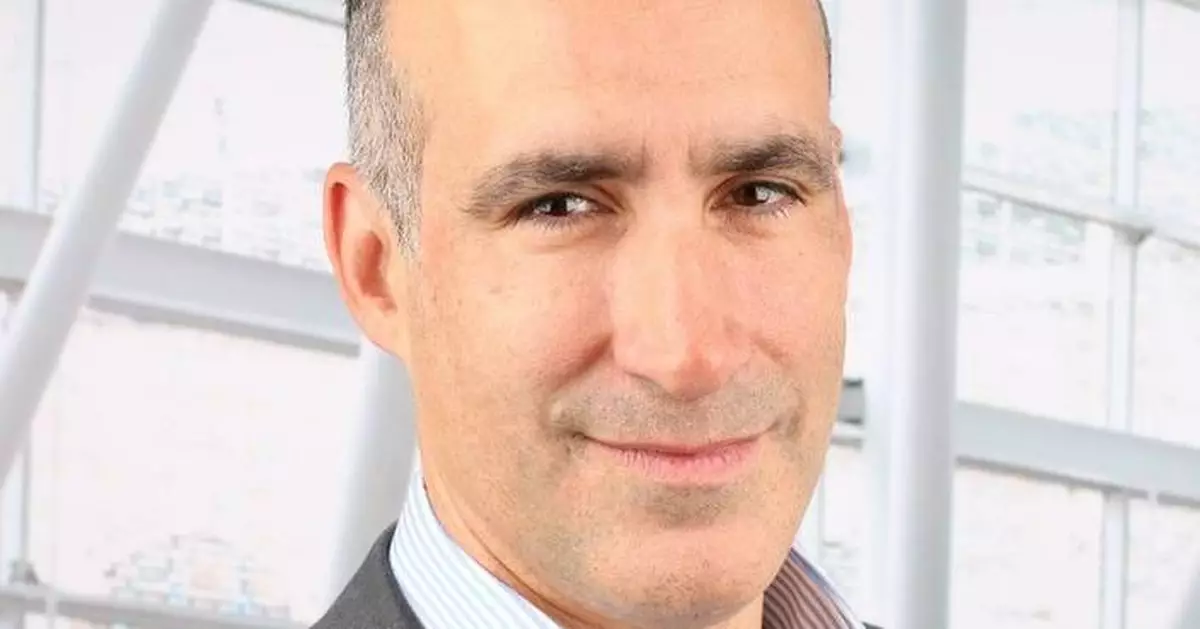
Global Student Accommodation (GSA), the specialist student housing investment manager, has appointed former Ivanhoé Cambridge executive, Simon Lauzier, as President, North America.
This press release features multimedia. View the full release here: https://www.businesswire.com/news/home/20261102003774/en/
Simon will lead GSA’s North American investment and asset management activity to maximize portfolio performance and deepen the long-term partnership GSA has built with Morgan Stanley Real Estate Investing (MSREI) and other key strategic relationships. He will also join the Executive Leadership Team of The Dot Group, GSA’s parent company, which also owns global student housing brand and operator Yugo, and Student.com.
A career on the investor’s side of the table
Lauzier joins from La Caisse (formerly CDPQ), Canada’s second-largest institutional investor, where he was Head of Financial Services and oversaw the integration of its real estate subsidiaries.
From 2017 to 2024 he held senior leadership roles at Ivanhoé Cambridge, then La Caisse’s global real estate investment subsidiary. As Chief Financial and Business Performance Officer, he led the transformation of the finance and business analytics functions to strengthen portfolio performance and chaired the Investment Committee, overseeing more than C$50 billion in acquisitions, dispositions and strategic partnerships. He also played a leading role in the repositioning of the portfolio toward logistics, multi-residential and alternative assets, while driving the expansion and optimization of the C$20 billion financing programs.
Previously, he spent 17 years at GE Capital in New York, Toronto, Paris, London and Milan. He led the European leg of GE Capital’s C$30 billion global real estate divestiture, executed more than C$10 billion of North American debt and equity transactions and built GE’s initial C$2 billion Canadian real estate equity platform. He is a CFA charterholder and a graduate of HEC Montréal.
Nick Porter, CEO of The Dot Group and Founder of GSA, said:
“Over three decades, student housing has moved from the margins of real estate to the core of institutional portfolios, and North America is one of the largest opportunities in front of us.
“Simon has spent his career on the same side of the table as our investors, deploying capital and building platforms for some of the world’s largest institutions. He understands the duty they carry to their own stakeholders, and the standards of discipline and performance that come with it. I know that is exactly the experience our partners want leading our North American business.
“With his leadership and vision, Simon is uniquely positioned to build on the existing bench strength of the GSA North American team, nurture the relationships that got us here and stay focused on maximizing the performance of our portfolios.”
Simon Lauzier, President, North America, GSA, said:
“Student housing offers what long-term investors look for: needs-based demand, resilient income and room to grow. GSA helped build this asset class, and its US platform gives us a strong foundation for growth across North America.
“I have spent most of my career as an institutional investor, so I know what our partners expect: rigor, transparency and consistent performance. My focus will be disciplined growth, strong performance across our portfolios and deepening the partnerships behind them. I also look forward to working closely with our Investor Solutions team and bringing more institutional capital into a sector that, at its heart, serves students starting a new chapter of their lives so they can thrive, pursue their ambitions and realize their full potential.”
Simon’s appointment builds on a period of growth for GSA in North America, with off-market deals and partnerships with institutional investors.
Notes to editors
About Global Student Accommodation (GSA)
Global Student Accommodation (GSA) is the specialist student housing investment manager and part of The Dot Group. GSA has an international presence across 11 countries, with assets in more than 80 leading educational cities. With flagship offices in New York and London, its North American portfolio comprises over 40 properties across 30 cities.
About The Dot Group
The Dot Group (“Dot”) is the global leader in student living, founded by Nick Porter, one of the original creators of the purpose-built student accommodation sector. Dot invests in, develops, manages and drives demand for student housing worldwide through GSA, Yugo and Student.com.
For further information, please visit: www.gsagroup.com | www.thedotgroup.com

Simon Lauzier, President North America, GSA
KYIV, Ukraine (AP) — Residents of Ukraine and Russia received phony emergency alerts from government-run mobile apps that were hacked, authorities in both countries said. The phony alerts in Ukraine included a warning about an imminent nuclear threat.
It was not clear if the attacks late Sunday in Ukraine and early Monday in Russia were related. Ukraine said its mobile app, which residents rely on to seek safety from Russian missile and drone strikes, was up and running again after being temporarily suspended. Russian authorities said efforts to restore its emergency alert mobile app were ongoing.
The cyberattacks came as a limited ceasefire expired Monday in Ukraine's southern Kherson region, where an agreement between Ukraine and Russia allowed humanitarian aid and evacuation missions into front-line areas in Russian-occupied territory.
Ukrainian authorities reported multiple Russian drone attacks in the region early Monday, hours after the ceasefire ended.
A Russian Telegram channel with links to the country's security services said Monday that a hacking group, Hitcore, claimed responsibility for the breach of the Ukrainian emergency alert system. The Associated Press did not independently verify the claim, and the identities, affiliations or motivations of the purported hackers remained unclear.
The alerts received by Ukrainians — making false claims of high radiation levels, a chemical threat and public disturbances in Kyiv — were written in English, Russian and Ukrainian. The English language alerts contained spelling and grammatical errors.
One of the messages, written in Russian, said: “Hi! There will be a nuclear threat across Ukraine. Do not worry, the Oreshnik is incoming,” a reference to a Russian ballistic missile.
There was little indication the fake alerts caused panic in Ukraine. Instead, there was a flood of humorous posts online, with social media users sharing photos of their pets relaxing and apocalypse-themed images generated by artificial intelligence. A photo shared of Kyiv Mayor Vitali Klitschko, a former international kickboxing champion, included the message: “It’s a good thing we have a boxer for a mayor.”
In a Telegram post late Sunday following the breach, Ukraine’s air raid alert channel said “unauthorized parties” had interfered with the app’s operation and warned users not to click on links in “suspicious notifications.”
Ukraine's state-run Center for Countering Disinformation urged people to monitor other emergency channels on social media while the cyberattack was being addressed.
A spokesman for Ukraine’s air force command, Yurii Ihnat, said in a television interview that the cyberattack had no impact on Ukraine’s security and defense operations.
In a statement, Russia’s Emergency Situations Ministry said hackers sent a false alert through its app at approximately 2:45 a.m. Moscow time on Monday across 33 of Russia’s 89 regions. It did not say who it believed carried out the attack.
The ministry said that the digital vulnerability exploited by the attackers had been identified and that “necessary measures” were being taken to prevent a similar breach. It also reassured Russians that the wider public alert system was working normally through SMS messages, media broadcasts and municipal sirens and loudspeakers.
Kremlin spokesperson Dmitry Peskov said all of Russia’s state agencies were under the constant threat of cyberattacks, including a growing number that use artificial intelligence.
“All government bodies must take steps to improve the cybersecurity of our digital resources,” Peskov said.
As the ceasefire in Ukraine's Kherson region came to an end on Monday, the regional administration said that a 62-year-old woman and a 73-year-old man were hospitalized with blast injuries in the city of Kherson.
The brief pause in fighting, which began on Oct. 27, was part of a humanitarian aid and evacuation mission in the Russian-occupied city of Oleshky, and marked the most significant truce between Kyiv and Moscow since Russia’s full-scale invasion began nearly five years ago.
Speaking to reporters in Kyiv on Monday, Ukraine’s ombudsman and lead civilian negotiator for the mission, Dmytro Lubinets, said he hoped the localized ceasefire and evacuation would act as a “model” for other such efforts. He said it could “add to the momentum” of three-way negotiations between Ukrainian, Russian and U.S. officials expected this month.
Ukraine’s general staff said Monday that Russia’s military had bolstered its drone defenses and replenished ammunition supplies in the area during the ceasefire.
Elsewhere in Ukraine, emergency services reported that drone strikes injured 12 people in the eastern Kharkiv region and damaged a refrigeration facility, greenhouses and residential buildings.
Five people were also reported injured in the Black Sea port city of Odesa, where a warehouse was targeted and homes were damaged.
Russia’s Ministry of Defense said Monday that it shot down 212 Ukrainian drones overnight, while the head of Russia’s Samara region, Gov. Vyacheslav Fedorishchev, said in a statement that local air defenses were repelling an aerial attack, but did not give further details.
Independent Russian media outlets later reported that Ukrainian drones had targeted one of Europe’s largest oil transport hubs in Samara.
Katie Marie Davies contributed to this report from Manchester, England.
Follow the AP’s coverage of the war in Ukraine at https://apnews.com/hub/russia-ukraine
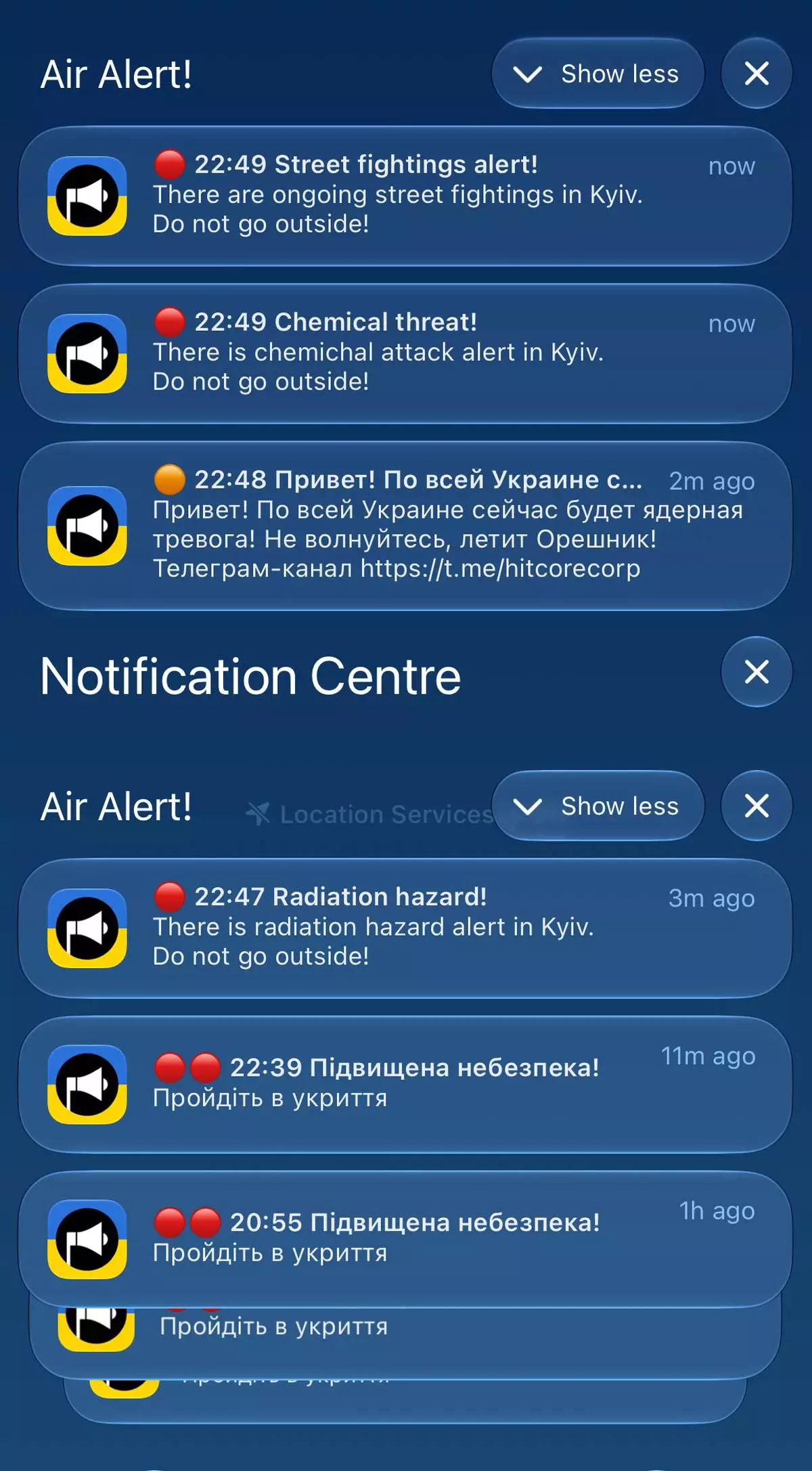
This screenshot made on a smartphone shows a series of false alerts received late Sunday, Nov. 1, 2026 from an emergency alert mobile application that was subject to a cyberattack, in Kyiv, Ukraine. Third message in Russian reads "Hi! There will be a nuclear threat across Ukraine. Do not worry, the Oreshnik is incoming. Telegram channel: [link]", Fifth and sixth messages in Ukrainian read "Increased danger, Go to the shelter". (AP Photo) Photo taken with a smartphone.
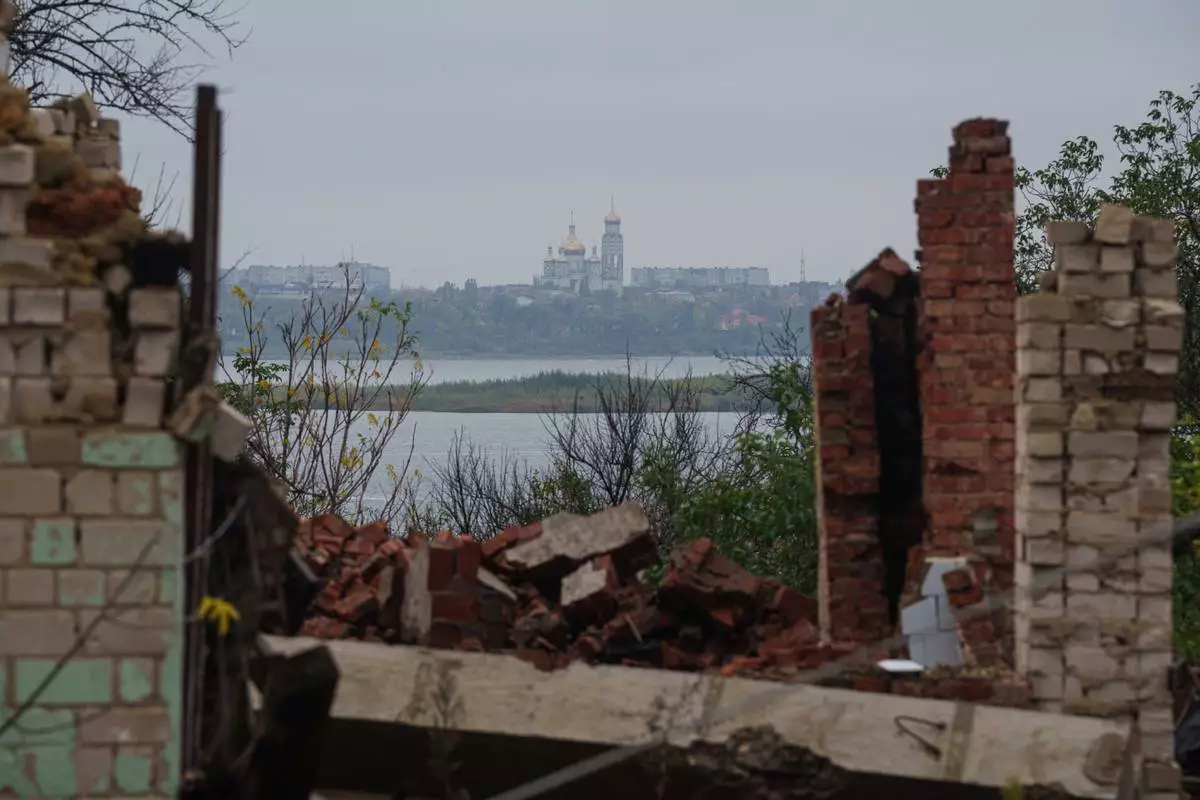
St. Andrew's Cathedral in Russian-occupied Nova Kakhovka, is seen across the Dnipro River from the village of Kozatske, during a localized ceasefire linked to a humanitarian aid mission to Oleshky, Kherson region, Ukraine, Saturday, Oct. 31, 2026. (AP Photo/Evgeniy Maloletka)
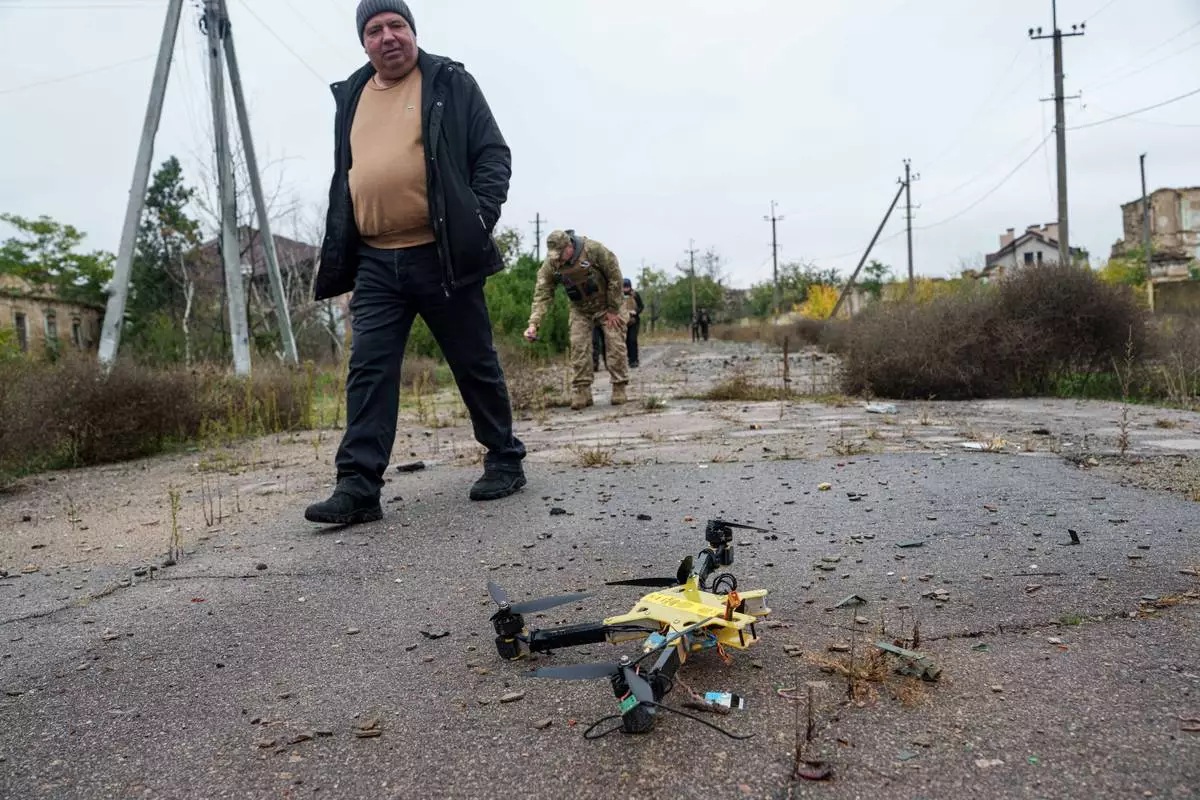
A representative of the Nova Kakhovka administration walks past an unexploded Russian FPV drone during a localized ceasefire linked to a humanitarian aid mission to Oleshky, in the village of Kozatske, Kherson region, Ukraine, Saturday, Oct. 31, 2026. (AP Photo/Evgeniy Maloletka)
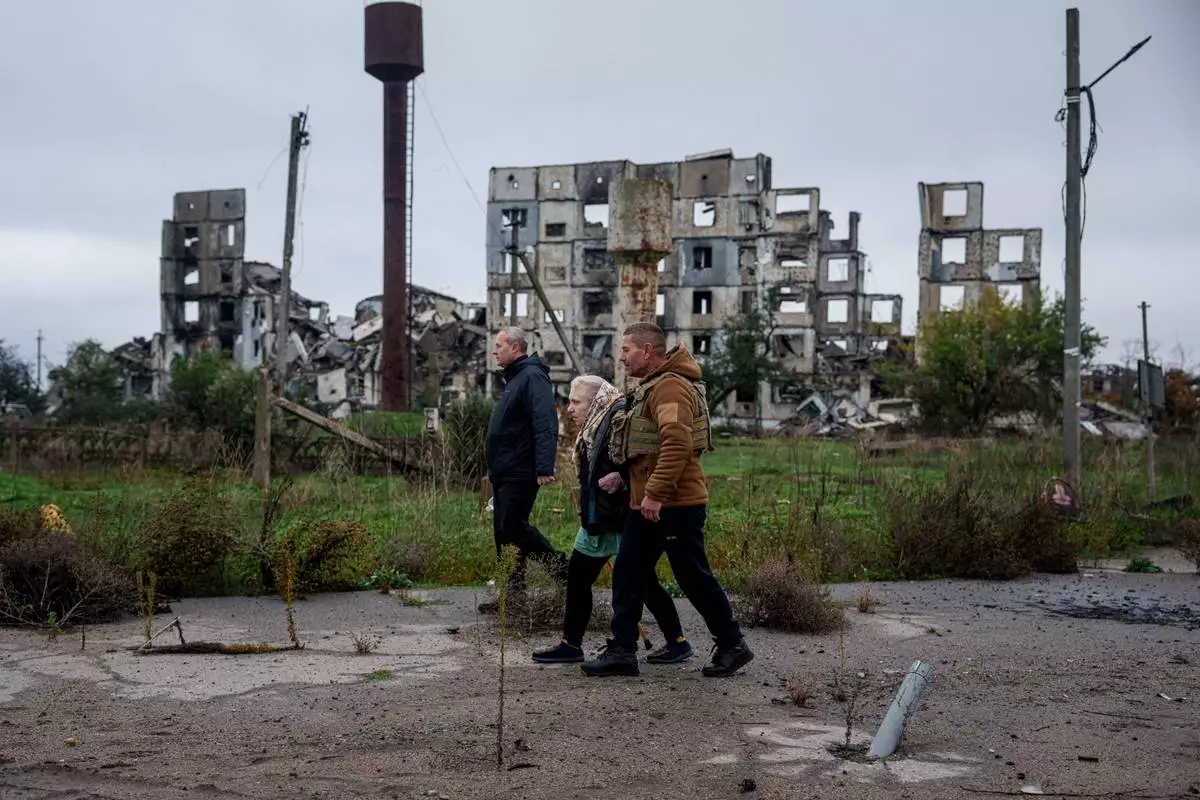
Oleh Tarabaka, head of the Nova Kakhovka military administration, left, and Vadym, a Ukrainian sergeant of the 42nd Marine Brigade, right, help evacuate Antonina, a local resident, as they walk past a destroyed residential building in an area contaminated with anti-personnel mines, during a localized ceasefire linked to a humanitarian aid mission to Oleshky, in the village of Kozatske, Kherson region, Ukraine, Saturday, Oct. 31, 2026. (AP Photo/Evgeniy Maloletka)
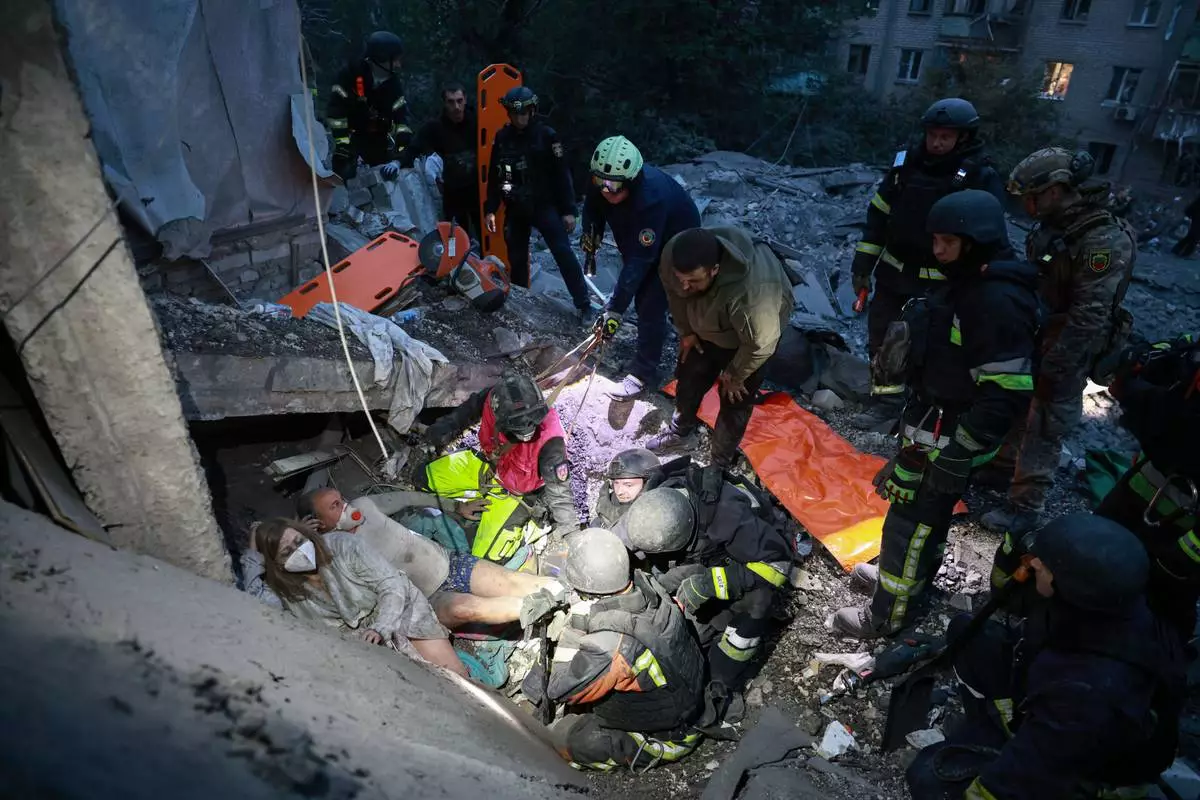
Rescue workers pull a family from the rubble of a residential building destroyed by a Russian airstrike in Zaporizhzhia, Ukraine, Saturday, Oct. 10, 2026. (AP Photo/Kateryna Klochko)