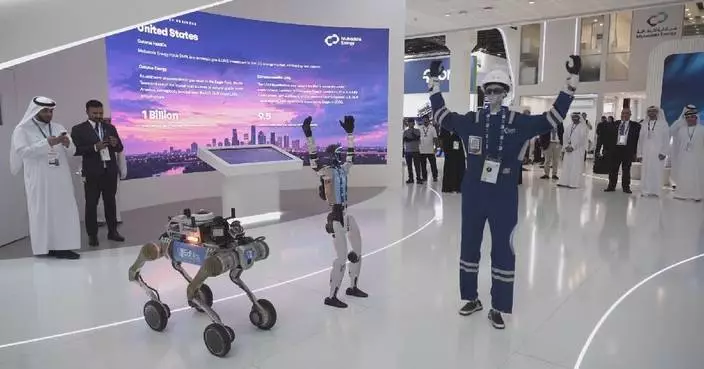

Developers made careful preparations for the inaugural China Media Group (CMG) World Robot Mount Tai Challenge in Tai'an, east China's Shandong Province, enabling their robots to navigate the demanding course and underscoring how real-world testing is accelerating progress in embodied intelligence.
The event was held on Monday, bringing together nearly 90 teams for the competition, which was divided into speed races and specialized events, with five events in total across robot forms including humanoid, quadruped and exoskeleton.
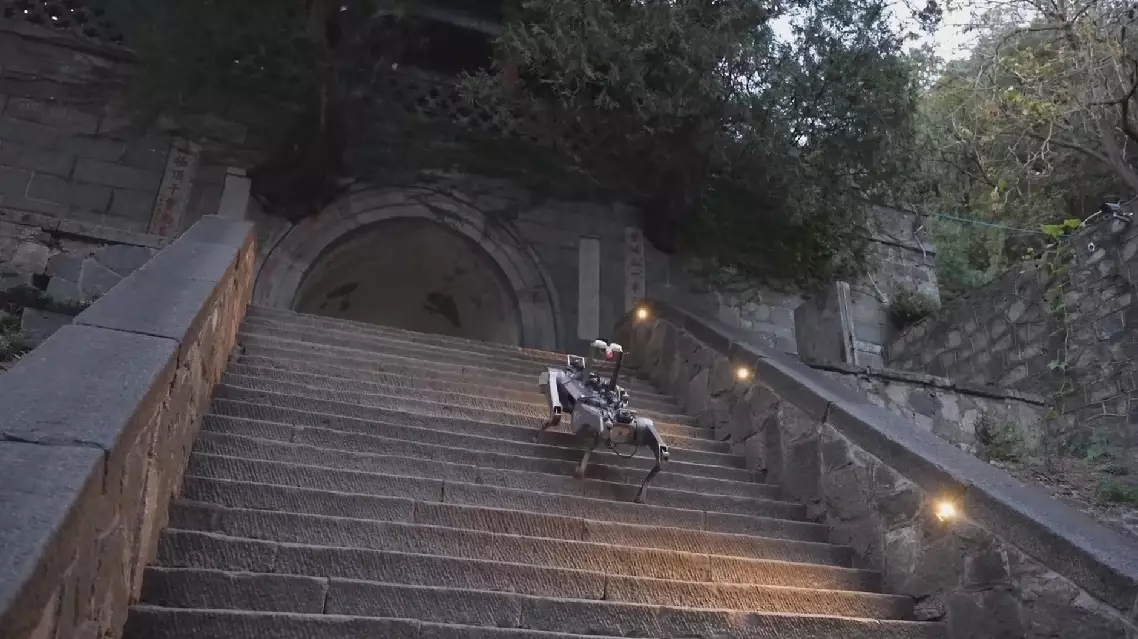
Competitors tackled the 3.9-km ancient stone route from Hongmen to Zhongtianmen, climbing more than 3,100 steps with an elevation gain of nearly 640 meters, while the morning mist and moss on the stones added to the difficulty.
At Shandong University's VSISLab, student Li Zhongzheng was looking forward to a good result in the race with advanced robots.
"This is a robot we built for a competition. We used a Unitree G1 robot, plus a depth camera," Li said.
He said the most urgent task before the contest was getting the robot into shoes.
"The terrain at Mount Tai is quite complex -- it includes uphill and downhill slopes, stairs going up and down, and a series of slippery wet surfaces," Li said.
The team from Beijing Lingyi Technology, a wholly owned subsidiary of Hangzhou-based Unitree Robotics, had to work out how to carry its cargo without tipping the robot over.
"We need to transport 4 boxes of bottled water, 4 boxes of instant noodles, and 4 thermos flasks. But if we add the thermos flasks on top, it would raise the robot's center of gravity too high, and with too high a center of gravity it would get pulled down. We made this cloth bag mainly to insert the thermos flasks in from the side, so that we can lower the center of gravity as much as possible," said Chen Xiyun, head of the team.
Su Qingwei, chief judge of the competition, said the terrain posed challenges beyond those of a typical robot contest.
"The terrain is more challenging than what robots normally encounter in competitions. There are steps of different heights and widths, as well as flat stone paths and cobblestone paths. The robots have to adapt to all these different conditions," Su said.
As software matters as much as hardware, Chen said the team adjusted the robot dog's gait so that it walked lower than usual, which helped it handle the steeper stretches.
"We adjusted the robot dog's walking posture through software. As you can see, its walking posture is now lower than usual. By lowering its center of gravity while walking, it can handle those relatively steep surfaces as well as possible," Chen said.
Robot makers brace for extreme terrain in Mount Tai climbing contest