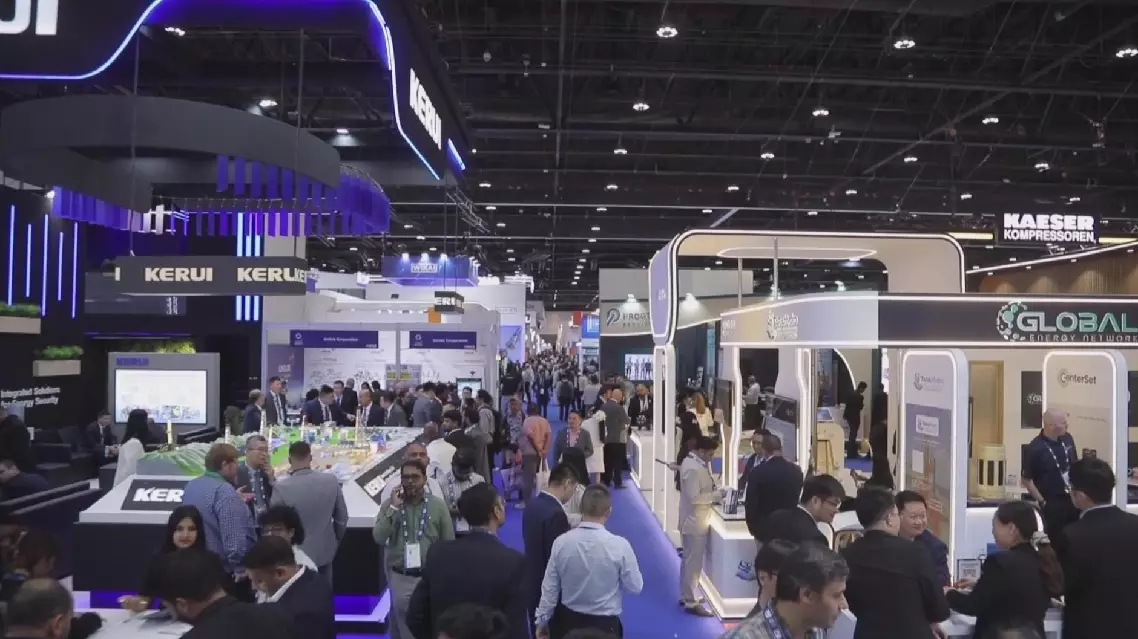
Chinese companies account for more than half of Asian participants at the Abu Dhabi International Petroleum Exhibition and Conference (ADIPEC) 2026, the world's largest energy event, where they are showcasing their latest advances in clean energy, smart technology and oilfield development amid growing appetite for Chinese expertise across the Middle East.
The four-day event, running through Thursday at the ADNEC Centre Abu Dhabi under the theme "Performance under pressure: Energy systems in a new era," has attracted about 2,260 exhibitors from more than 170 countries and regions, with organizers expecting more than 239,000 visitors.
According to the event's organizers, this year's edition has drawn the largest Asian participation on record, with around 350 Asian exhibitors and six national pavilions, of which China represents more than half, as the country joined the exhibition with nearly 190 companies offering comprehensive energy services.
Whether in traditional oil and gas or renewable energy, the Middle East market is growing steadily, with the UAE emerging as a leading regional market for Chinese firms.
One of them is Shandong Kerui, a Chinese oil services and equipment company. For the firm's senior vice president, the UAE serves as the starting point of its overseas expansion.
"UAE's current positioning is a high-end market for Kerui. It's the regional hub [from which] we can spread out globally. We start from the UAE, we [go] to the GCC, we [go] to the Middle East and in the same way we come to the Middle East and North Africa (MENA) and Africa, and we come to Europe as well as South Asia. China as a manufacturer or service provider, it becomes a very giant player now, this is very [much] the influence, because of our innovation and understanding of the market, our breakthroughs, all that [helps] get the trust of the local clients," said Zhao Tingjian, senior vice president of Shandong Kerui.
That ambition is backed by hard numbers, with the International Energy Agency projecting that China will meet nearly half of the growth in global electricity demand through 2030.
Meanwhile, Saudi Arabia and the UAE have set targets for renewable energy to make up 50 percent and 44 percent respectively of their energy mix by the same year, placing Chinese companies and technologies at the center of the region's energy transition.
"China is very advanced. In recent years it has expanded into the Gulf countries and there is a lot of appeal [for Chinese technology] in the Gulf market… Solar technology is advanced in China; in Oman we have built several projects for solar panels. It's been successful… Dealing with China is very comfortable and easy and their response is fast. There is strong trust in purchasing Chinese technology," said Hamdan Al Jahaffi, managing director of Tatweer Energy LLC, an Oman-based equipment rental and service company for the oil and gas industry.
Chinese exports of solar cells and equipment to the region spiked 51 percent last September year on year, driven by demand from the Middle East's largest energy consumers, Egypt, Saudi Arabia and the UAE. The country is targeting to add more than 30 gigawatts of green energy within the next three years, on its way to a total of 100 gigawatts.
With China's strongest presence yet at the world's largest energy gathering, ADIPEC is expected to take these figures to new heights, as China and its Middle Eastern partners signal their willingness to carry the energy partnership into a promising future.
Chinese firms turn out in force at UAE's top energy event