SHANGHAI--(BUSINESS WIRE)--Nov 10, 2026--
Robbyant, an embodied AI company within Ant Group, today announced the open-source release of LingBot-Touch, a tactile foundation model that gives robots a critical missing sense by enabling robust touch perception.
This press release features multimedia. View the full release here: https://www.businesswire.com/news/home/20261109284905/en/
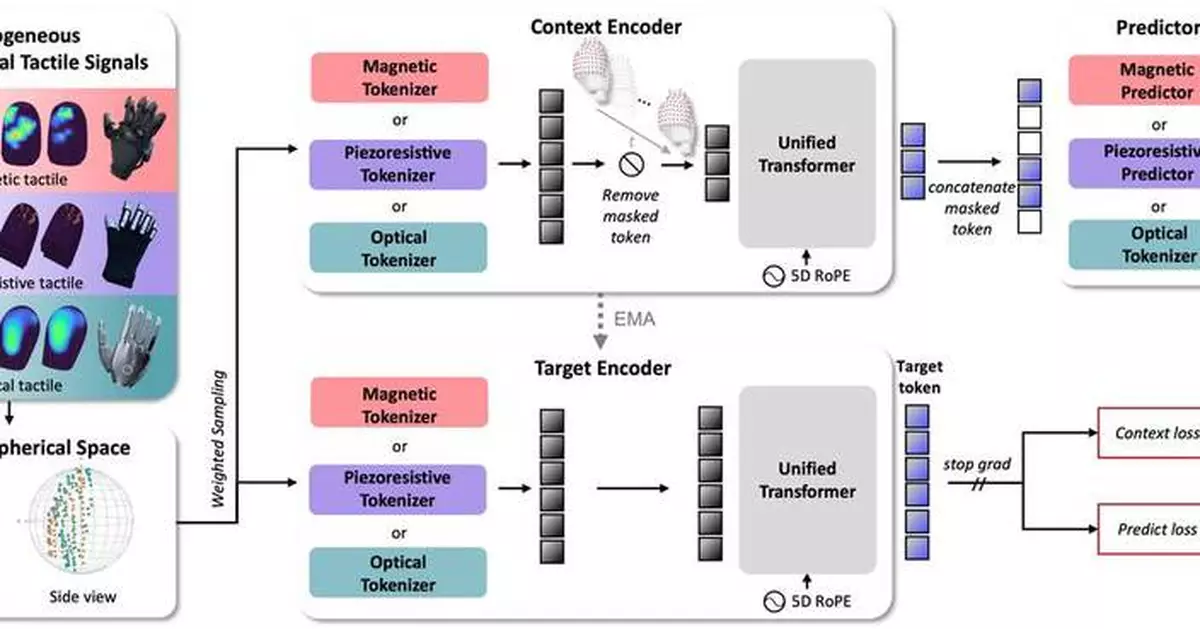
Pre-trained on nearly 5,000 hours of real-world tactile data, the model covers three mainstream sensing modalities—magnetic tactile, visual tactile, and piezoresistive sensing—and translates their diverse signals into a unified tactile representation. This allows different dexterous hands and action models to share and reuse tactile understanding, enabling robots to not only “see clearer” and “think deeper,” but also “feel sharper” during fine manipulation tasks, such as turning pages, unscrewing bottle caps, and identifying Mahjong tiles.
A Unified Tactile Representation Across Sensors and Hands
Equipping robots with tactile sensors does not automatically give them useful touch perception. Commercial tactile sensors are still in an early stage of development, with visual tactile, magnetic tactile, and piezoresistive approaches each carrying distinct advantages and limitations. Given differing cost structures and application scenarios, multiple technical routes are likely to coexist for the foreseeable future.
A more fundamental challenge lies in data compatibility. The same physical contact can produce different raw signals depending on sensing principles and contact-point layouts. If a model learns to interpret only one type of sensor, its tactile experience may become difficult to reuse when the sensor or dexterous hand changes, forcing teams to re-collect data, retrain models, and re-adapt their systems. Amid rapid hardware iteration, this tight coupling creates repeated development work and raises integration costs for hardware vendors, robot integrators, and model developers.
For tactile perception to scale, robots must move beyond dependence on specific sensor signals. Data from different sources should be trainable together, and accumulated tactile capabilities should be reusable across sensors, dexterous hands, models, and tasks.
LingBot-Touch addresses this challenge through a unified architecture. It provides separate encoding pathways for different sensing principles, processes heterogeneous raw signals, and maps contact points from different layouts into a shared fingertip coordinate space. A shared model then learns contact location, force distribution, and their temporal evolution, producing unified tactile tokens.
This design enables data collected from humans wearing tactile gloves and from teleoperated dexterous hands to be jointly used for training. Different action models can also leverage the trained model to extract contact features. The architecture is also designed to accommodate new types of tactile sensors as they emerge.
Significant Gains in Real-World Dexterous Manipulation
To evaluate how tactile representation improves real robot performance, Robbyant conducted 26 real-world tests across two dexterous hands, Sharpa Wave and XHand. After integrating LingBot-Touch, four action models—LingBot-VLA, π0.5, Diffusion Policy, and T-Rex—achieved average task success rate improvements of approximately 14 to 26 percentage points compared with operating without tactile input.
In one representative test using T-Rex to control Sharpa Wave for unscrewing a bottle cap, the success rate was 56.25% without tactile input and 62.5% when raw sensor signals were directly fed into the policy. With LingBot-Touch’s tactile representation, the success rate rose to 90%.
On XHand, Robbyant’s team further validated cross-hardware reusability. The magnetic tactile sensor used on XHand was not included in LingBot-Touch’s pre-training data; all magnetic tactile experience came from human glove-collected data. To evaluate this reusability, the team kept LingBot-Touch’s parameters unchanged and trained only the action model using XHand demonstration data.
Flexible Model Sizes and Open-Source Availability
To balance perception capability with on-device compute constraints, Robbyant offers two model sizes. All 26 real-world tests were completed using the lightweight version, LingBot-Touch-Tiny, which contains approximately 5.3 million parameters. When integrated with LingBot-VLA, π0.5, and T-Rex, it adds only about 0.13% to 0.16% to total model size.
The larger-capacity version shows further potential in perception tests. As pre-training data approaches 5,000 hours, the model continues to benefit from additional data, indicating that tactile pre-training still has substantial room for scaling and improvement.
LingBot-Touch was evaluated across four different action models and is not tied to Robbyant’s proprietary models. It serves as a general-purpose perception layer between tactile sensors and action models, rather than a dedicated module built for a specific hardware platform or control policy. With LingBot-Touch, sensor and dexterous-hand manufacturers can select hardware based on cost and task requirements, while robotics teams can retain their own action policies. This significantly reduces the need to rebuild tactile capabilities each time a new hardware–algorithm combination is adopted.
LingBot-Touch's technical report and code are now open source. Developers can access and download the model on Hugging Face and GitHub.
Robbyant's unified robot brain already covers high-precision spatial perception, high-dynamic environment interaction, and generalizable dexterous manipulation, helping robots see clearer, think deeper, and act faster. With LingBot-Touch now integrated into LingBot-VLA, the robot brain's perception extends to the fingertips, enabling robots to "feel sharper" and further advancing Robbyant's general-purpose embodied intelligence.
About Robbyant
Robbyant is an embodied intelligence company within Ant Group, dedicated to advancing embodied intelligence through cutting-edge software and hardware technologies. Robbyant independently develops foundational large models for embodied AI and actively explores next-generation intelligent devices, aiming to create robotic companions and caregivers that truly understand and enhance people’s everyday lives and deliver reliable intelligent services across key use cases, such as elderly care, medical assistance, and household tasks.
To learn more about Robbyant, please visit: www.robbyant.com
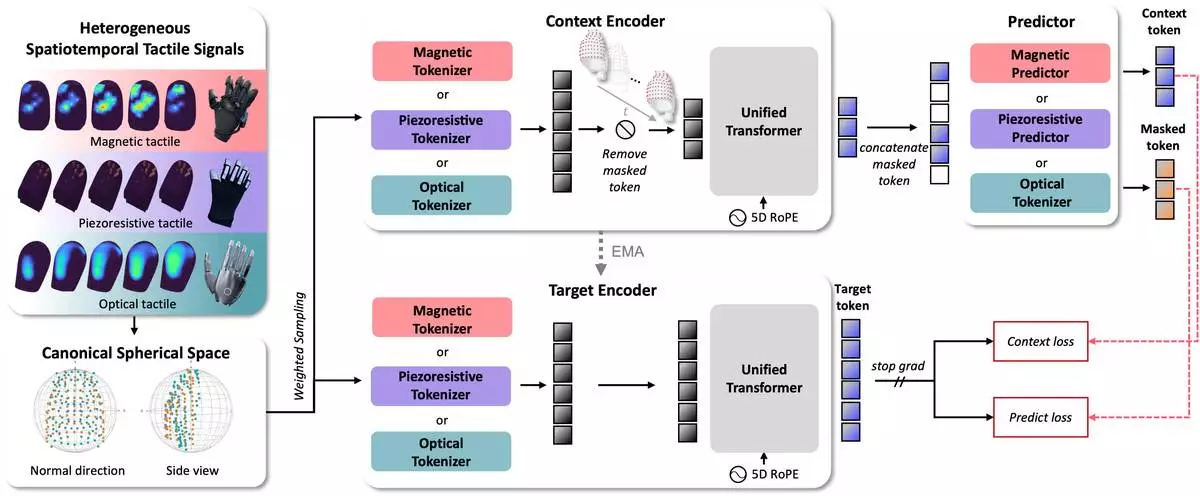
LingBot-Touch encodes magnetic tactile, visual tactile, and piezoresistive signals into unified tactile tokens for use by different action models.
ABU DHABI, United Arab Emirates (AP) — Three-way talks between Russia, Ukraine and the United States opened Tuesday in the United Arab Emirates, as Washington renews its push to end the war that followed Moscow's all-out invasion nearly five years ago.
The two-day session in the UAE's capital, Abu Dhabi, is the first such meeting since February. It will focus on security guarantees, the White House said before the discussions. Russia sees NATO as a threat, and Ukraine wants to prevent future Russian invasions.
Hopes of progress in ending Europe’s biggest conflict since World War II are tempered by the absence of any significant breakthroughs in three previous rounds of talks early this year. The war has already killed hundreds of thousands of soldiers and thousands of civilians, analysts and humanitarian organizations say.
There are no signs the fighting is abating, and the talks took place against a backdrop of new long-range strikes between Russia and Ukraine. The two armies are largely deadlocked on the front line.
Russia launched 162 drones of various types and a ballistic missile at Ukraine overnight, Ukraine’s air force said.
Meanwhile, Russia’s Ministry of Defense said that its forces shot down 155 Ukrainian drones overnight above eight Russian regions, as well as the Crimean Peninsula, which Russia annexed from Ukraine in 2014.
U.S. President Donald Trump’s son-in-law, Jared Kushner, said on X that he and fellow envoy Steve Witkoff were working on a “negotiated solution that can deliver lasting peace and create the conditions for a sovereign, secure, and prosperous Ukraine within a more stable European security environment.”
The head of the Russian delegation, Vladimir Medinsky, noted at the start of the talks that the Russian delegation “has become bigger and more professional.”
He expressed hope that the meeting “will allow us to advance on the path towards peace in the interests of the people of Russia and the people of Ukraine.”
Rustem Umerov, the head of Ukraine’s Foreign Intelligence Service who is leading Kyiv's delegation, said that the day began with a meeting between the Ukrainian team, the U.S. envoys and representatives from the United Kingdom, France, Germany, Italy, NATO and the European Commission.
The Russian and Ukrainian governments remain far apart on key elements of any prospective deal.
Russian President Vladimir Putin wants Ukraine to pull its troops back from Donetsk, Luhansk, Zaporizhzhia and Kherson — the four regions that Moscow annexed in September 2022 but never fully captured. He also demands that Ukraine abandon its bid to join NATO, accept strict limits on its military and drop restrictions on the Russian language and the Moscow-affiliated Orthodox Church in Ukraine.
Putin wants a comprehensive peace deal on those conditions and won’t agree to a general halt in hostilities, arguing that it would only allow Ukrainian troops to rest and replenish their weapons stockpiles. He has warned that Russia will achieve its goals by force if Kyiv refuses to meet its conditions for peace.
Ukrainian President Volodymyr Zelenskyy, who was visiting Denmark on Tuesday, rejects Putin’s demands to voluntarily cede territory that Russia hasn't been able to take on the battlefield. Zelenskyy also rejects any limits on Ukraine's military or its arrangements with Western partners, which Kyiv sees as essential security guarantees to stop Moscow from invading again.
Ukraine argues that an immediate ceasefire is the necessary first step toward negotiating a wider settlement and says a direct meeting between Putin and Zelenskyy is the only way territorial issues can be settled.
The Russian and Ukrainian delegations include senior officials who have attended previous rounds of talks.
Russia’s chief negotiator is Medinsky, a Putin aide who has led Moscow’s team since the first direct peace talks with Ukraine in Istanbul in March 2022. The Russian delegation also includes deputy foreign ministers Sergei Ryabkov and Mikhail Galuzin, military intelligence chief Igor Kostyukov and deputy chief of the General Staff’s operational department, Yuri Zhigarlovsky.
Apart from Umerov, the Ukrainian delegation also reportedly includes Zelenskyy’s chief of staff, Kyrylo Budanov, his deputy, Sergiy Kyslytsya, and Davyd Arakhamia, the parliamentary faction leader of Zelenskyy’s Servant of the People party.
Last week, Trump declared that some kind of grand deal about European security was in the works, describing it as “a big agreement” that is “going to involve more than Ukraine.”
Kushner said Monday on X that a “comprehensive and lasting settlement will also require direct engagement between Russia and our European partners on the broader security arrangements that affect them.” The discussions in Abu Dhabi will set the stage for “that engagement to begin in the near future, as part of a broader multilateral process,” he said.
Moscow has praised the broad approach.
“We can only welcome the (U.S.) negotiators on President Donald Trump’s request proposing to put the issue of collective security on top of the agenda of the talks on a Ukrainian settlement,” Russian Foreign Minister Sergey Lavrov said.
Just before Moscow launched the full-scale invasion on Feb. 24, 2022, it demanded that NATO roll back its deployments in the trans-Atlantic alliance’s member countries in Central and Eastern Europe, seeing their presence as a security threat. Similar demands will likely be part of any comprehensive peace deal proposed by Russia.
Kushner said that before the start of the three-way talks, he and Witkoff would meet separately with envoys from Ukraine, the European Union, NATO, Germany, France, the United Kingdom and Italy to “continue the close consultation and coordination we have undertaken on European security and Ukraine’s postwar future over the past several weeks.”
Some in the EU see Washington's proposals as too accommodating to Moscow.
Russia has objected to the Europeans’ involvement in the three-way talks, but said that EU representatives could join at a later stage.
While the ground battles have morphed into a war of attrition along the 1,200-kilometer (about 750-mile) front line, Russia and Ukraine have ramped up their long-range strikes with drones and missiles.
Russia has intensified its air campaign against Ukraine’s power grid, seeking to weaken the country’s resolve as winter sets in. Moscow has relied on ballistic missiles and jet-powered drones, taking advantage of Ukraine’s shortage of U.S.-made Patriot interceptors.
Ukraine, meanwhile, has escalated its drone strikes on Russian oil refineries.
Follow the AP’s coverage of the war in Ukraine at https://apnews.com/hub/russia-ukraine
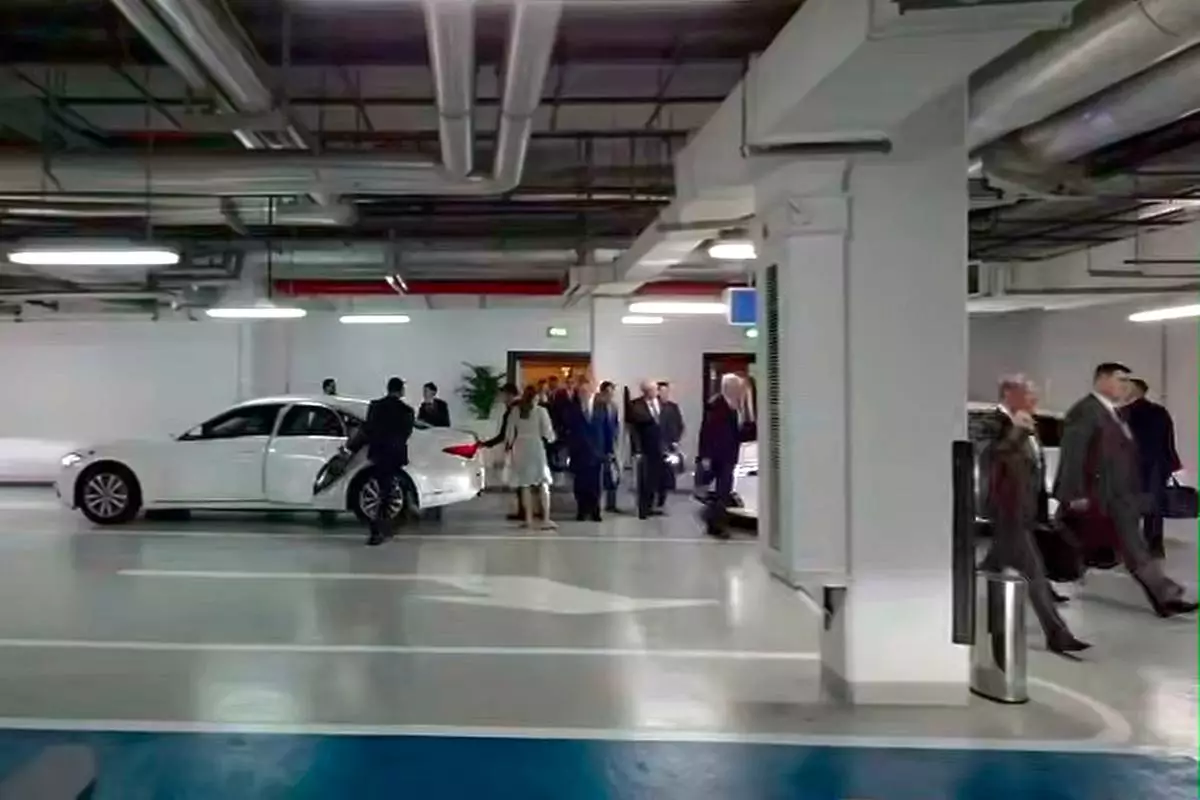
In this photo taken from video provided by Russian Foreign Ministry Press Service, members of the Russian delegation leave for the venue where US-brokered peace talks are taking place between delegates from Russia, the United States and Ukraine in Abu Dhabi, United Arab Emirates, Tuesday, Nov. 10, 2026. (Russian Foreign Ministry Press Service via AP)
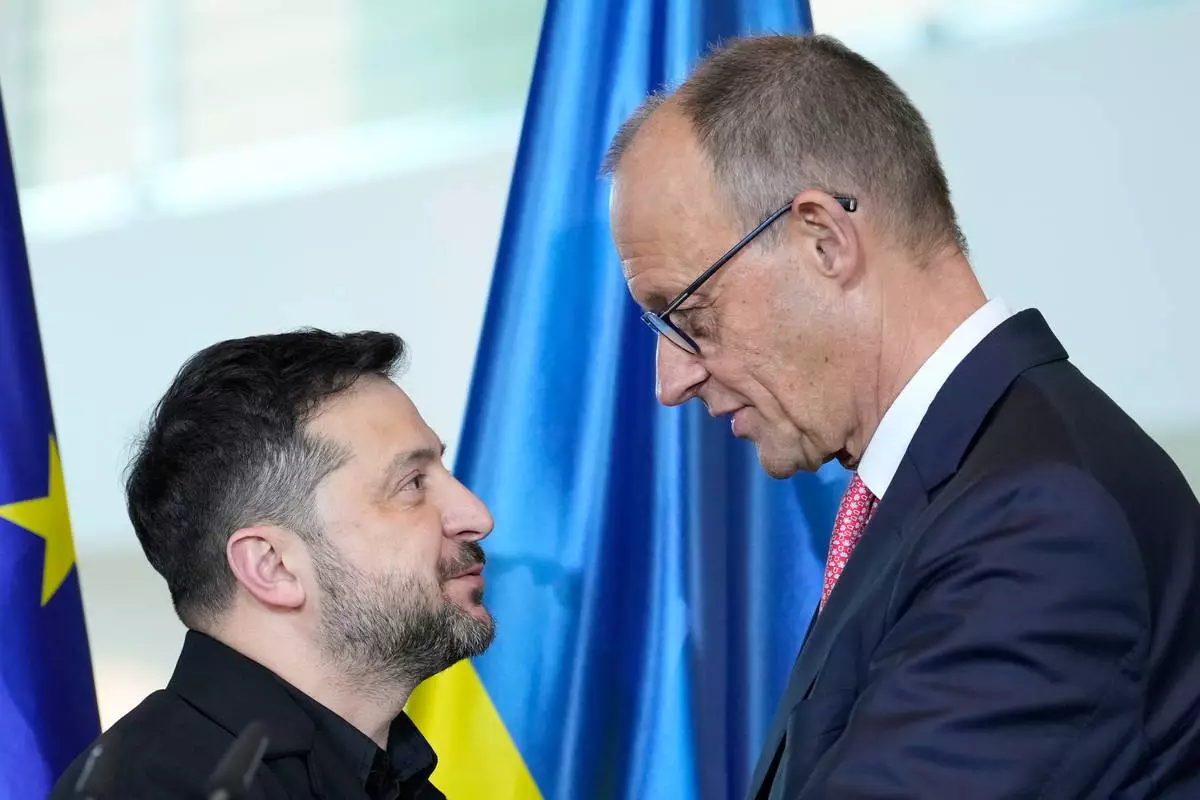
German Chancellor Friedrich Merz, right, and Ukrainian President Volodymyr Zelenskyy attend a press conference in Berlin, Germany, Tuesday, Nov. 3, 2026. (AP Photo/Ebrahim Noroozi)
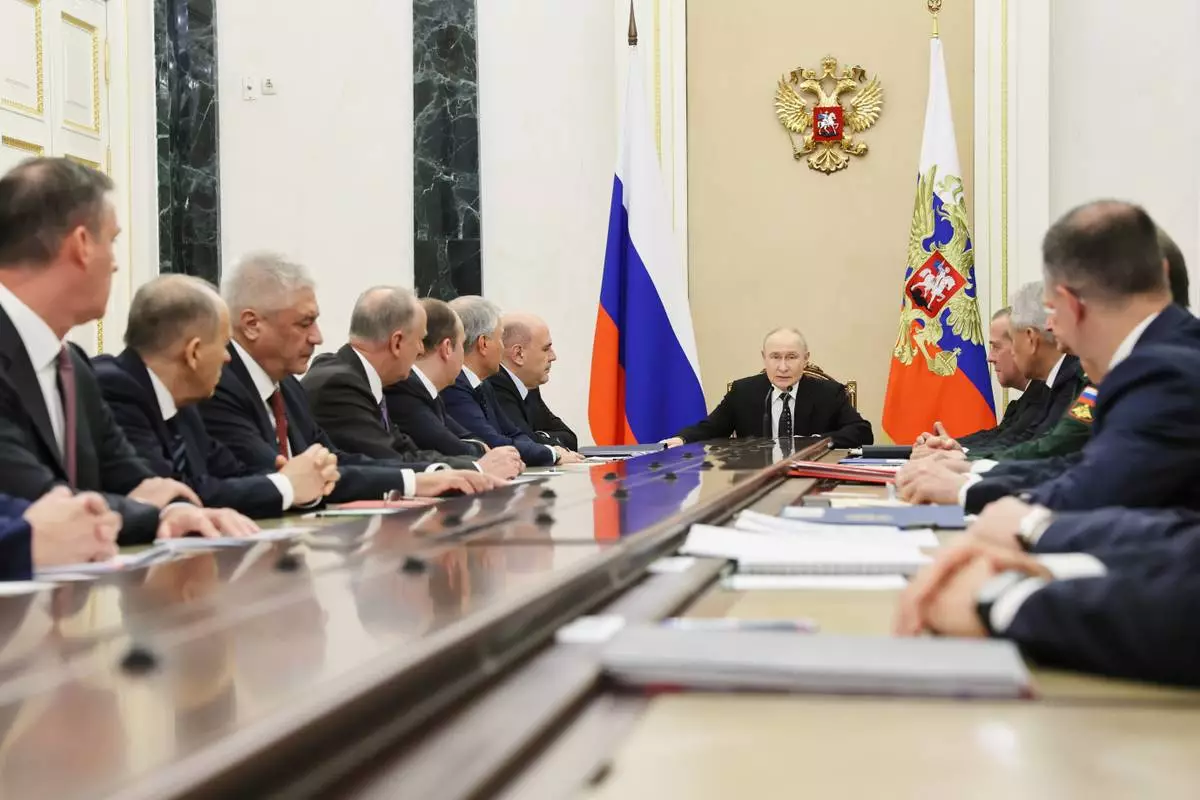
Russian President Vladimir Putin, center, chairs the Security Council meeting in Moscow, Friday, Nov. 6, 2026. (Alexei Babushkin, Sputnik, Kremlin Pool Photo via AP)
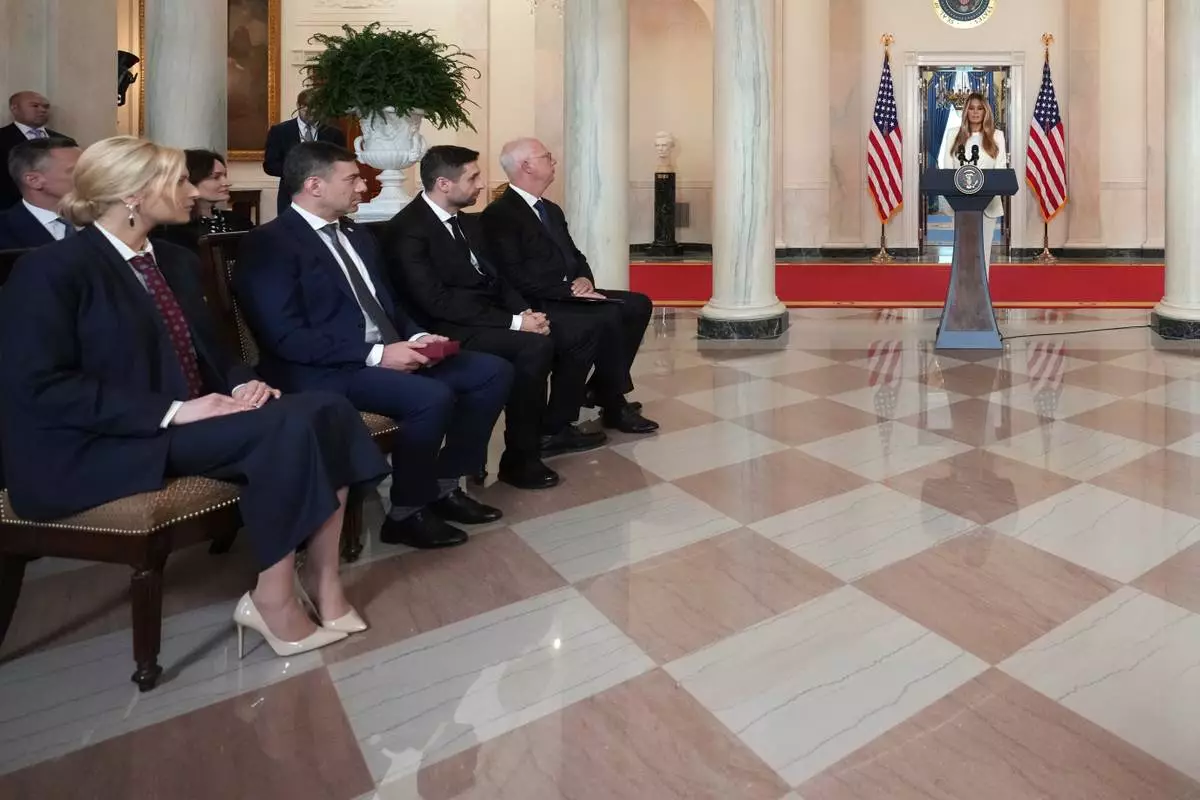
First lady Melania Trump speaks as Russia's Commissioner for Human Rights Yana Lantratova, from left, Ukraine's human rights ombudsman Dmytro Lubinets, Davyd Arakhamia, lawmaker with President Zelenskyy's Servant of the People's party, and Russian Presidential Envoy Kirill Dmitriev listen during a meeting with Russian and Ukrainian representatives in the Grand Foyer of the White House, Thursday, Nov. 5, 2026, in Washington. (AP Photo/Alex Brandon)
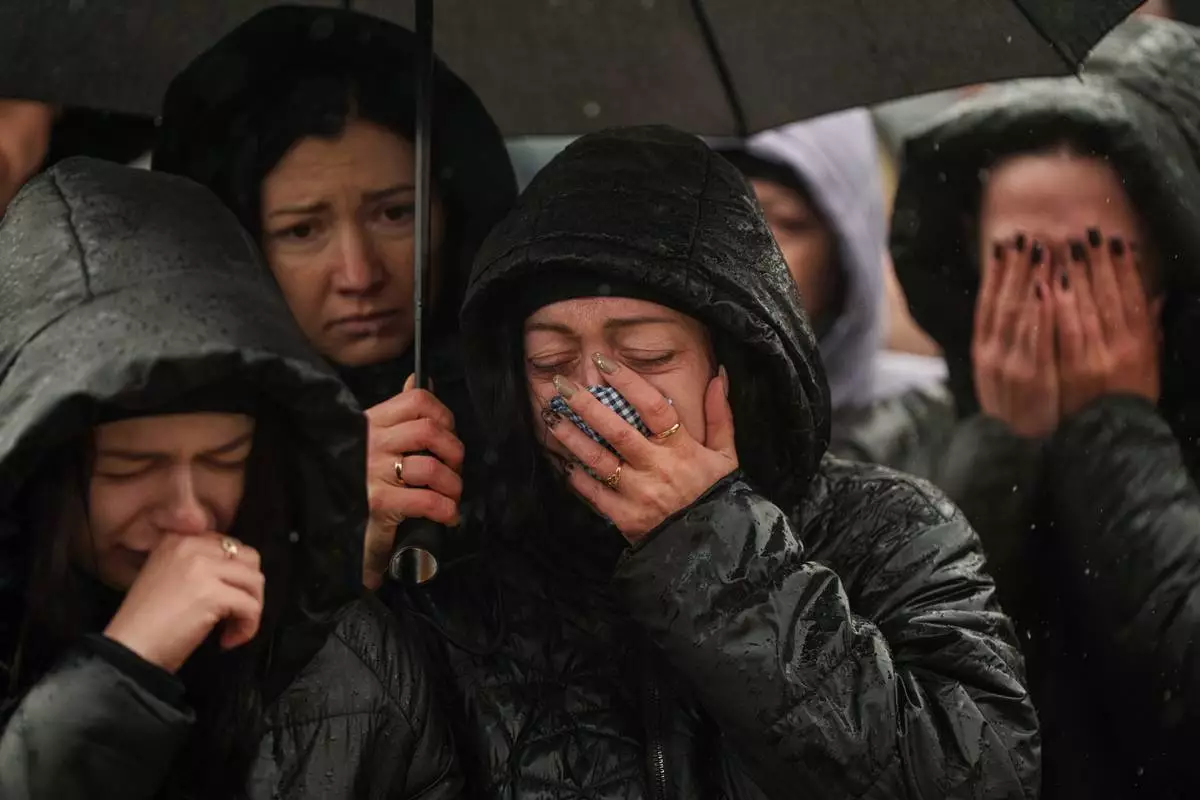
Family members cry beside the coffins of police officers Dmytro Besedin, Mykhailo Buzhenko, Mykola Balanda and Mykhailo Romanov, killed in a Russian airstrike that destroyed an underground school, and Serhii Berezhko and Oleg Dubetskyi, killed in an FPV drone attack in Komyshuvakha, during a farewell ceremony on Khortytsia Island in Zaporizhzhia, Ukraine, Saturday, Nov. 7, 2026. (AP Photo/Evgeniy Maloletka)
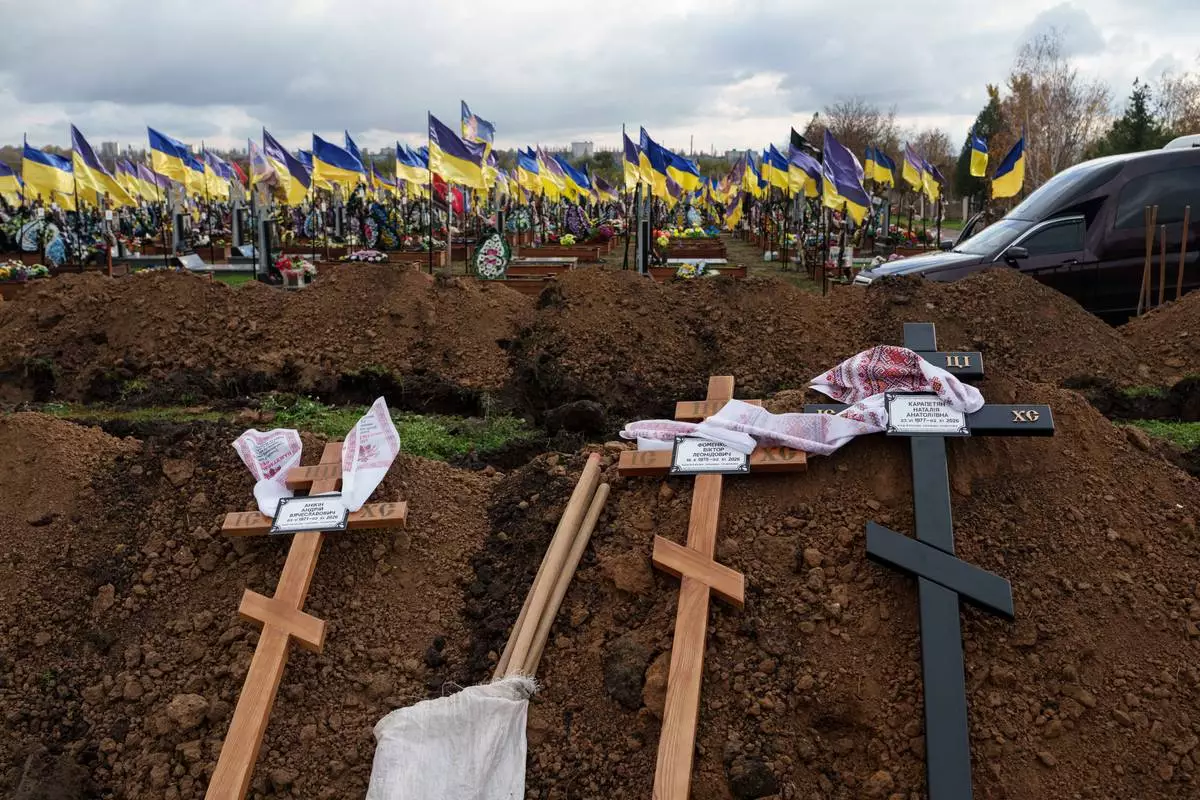
Crosses bearing the names of Viktor Fomenko, Natalia Karapetian and Andrii Anikin, killed in a Russian airstrike that destroyed an underground school in Komyshuvakha, lie in a cemetery in Zaporizhzhia, Ukraine, Saturday, Nov. 7, 2026. (AP Photo/Evgeniy Maloletka)