Skip to Content Facebook Feature Image

Balance Supports UK’s First Tokenized Retail Deposits on a Public Blockchain

Business

Balance Supports UK’s First Tokenized Retail Deposits on a Public Blockchain
Business

Business

Balance Supports UK’s First Tokenized Retail Deposits on a Public Blockchain

2026-11-18 03:47 Last Updated At:04:00

CALGARY, Alberta--(BUSINESS WIRE)--Nov 17, 2026--

Balance, Canada’s oldest and largest digital asset custodian, today announced its role as custodian and technology provider supporting Monument Bank’s launch of the UK’s first tokenized retail deposits on a public blockchain, using the Midnight network.

This press release features multimedia. View the full release here: https://www.businesswire.com/news/home/20261117265736/en/

Monument Bank is a UK-regulated digital bank with over £6 billion in customer deposits. The bank is tokenizing an initial £250 million of its deposits through MGBP, a shielded token developed by Monument on Midnight, a privacy-preserving public blockchain, for allocation to its retail deposit customers. The full issuance has been minted and is held in custody by Balance, with its infrastructure designed to support future expansion into additional financial products.

Midnight is a public blockchain network that uses zero-knowledge proofs to verify transactions without publicly revealing sensitive information. This enables financial institutions to take advantage of public blockchain infrastructure while maintaining the confidentiality of customer and transaction data.

Balance is the first Canadian digital asset custodian to support a bank in tokenizing its deposits. Its turnkey solution for Monument Bank brings together smart contract deployment, token minting and burning, secure custody, and ongoing smart contract administration. This allows Monument to focus on its customers and banking services, while Balance safeguards the tokens and provides the technology behind its tokenized deposits.

“Balance has been an integral partner in bringing our tokenized deposits to life,” said Wasim Khouri, Chief Commercial Officer of Monument Bank. “We were impressed by their ability to deliver the implementation in just four weeks after finalizing requirements, meeting an ambitious timeline while demonstrating technical expertise, professionalism, and close attention to detail. This was critical in being able to be the first bank in the United Kingdom to tokenise retail deposits. Their combined custody and technology capabilities give us a strong foundation for our tokenized deposit program.”

Tokenized deposits enable faster, around-the-clock settlement, simpler reconciliation, and automated payments based on client instructions. These capabilities can reduce manual processing and transaction costs for banks, potentially translating into lower fees and fewer payment delays for customers. They also lay the groundwork for new services, such as AI agents that initiate payments on a customer's behalf, subject to predefined rules governing spending limits, authorized recipients, and transaction approvals.

“Tokenizing deposits takes more than deploying a smart contract. It requires secure custody, clear governance, strict controls over who can authorize transactions, and reliable reconciliation between on-chain activity and the bank’s records,” said George Bordianu, Co-founder and CEO of Balance. “These are the foundations that allow a bank to adopt new technology and expand their product offering without compromising accountability or operational discipline. We’re proud to help Monument put them into practice on Midnight, and we look forward to helping Canadian banks and credit unions bring the same capabilities to their customers.”

Balance’s turnkey Tokenization-as-a-Service suite enables financial institutions to tokenize deposits, securities, and other real-world assets, issue stablecoins, and facilitate conversions between tokenized deposits and stablecoins. The suite supports Ethereum, Midnight, Solana, Stellar, Cardano, and other blockchain networks, including permissioned deployments using Hyperledger Besu. Each implementation is tailored to the institution’s asset, governance, privacy, regulatory, and integration requirements, bringing together the following capabilities:

“This is Canadian-built infrastructure helping a UK bank bring nearly half a billion Canadian dollars in tokenized deposits to market,” added Bordianu. “It shows that Canadian financial technology can compete and deliver on the international stage, and presents an opportunity for our own financial institutions to follow suit. At Balance, we've proven that the expertise and infrastructure are here to help Canadian banks and credit unions move from exploration to commercial deployment. Let's put them to work at home.”

To learn more about Monument Bank’s tokenization initiative, visit their website.

To learn more about Midnight and its technology, read their blog post.

To discuss your institution’s tokenization plans, email us at contact@balance.ca.

Important Information
This announcement describes Balance’s supporting custody and technology role. Balance holds the MGBP tokens, not the underlying bank deposits, which remain with Monument Bank. This announcement is not an offer or recommendation to acquire any token or banking product and does not constitute investment, legal, tax, or financial advice. Eligibility, availability, deposit rights, and any applicable protections are governed by Monument Bank’s product terms and disclosures and applicable law.

About Balance
Balance provides institutional digital asset custody and ancillary services, including settlement, escrow, and collateral management. Its infrastructure supports digital asset programs across custody, stablecoins, tokenization, and secured collateral workflows. Founded in 2017 and headquartered in Calgary, Balance works with financial institutions, investment platforms, and digital asset businesses to safeguard digital assets and support their related operations. For important disclosures and risk information, please visit www.balance.ca/disclaimer.

Balance, Canada’s oldest and largest digital asset custodian, today announced its role as custodian and technology provider supporting Monument Bank’s launch of the UK’s first tokenized retail deposits on a public blockchain, using the Midnight network. Monument Bank is a UK-regulated digital bank with over £6 billion in customer deposits. The bank is tokenizing an initial £250 million of its deposits through MGBP, a shielded token developed by Monument on Midnight, a privacy-preserving public blockchain, for allocation to its retail deposit customers. The full issuance has been minted and is held in custody by Balance, with its infrastructure designed to support future expansion into additional financial products.


Balance, Canada’s oldest and largest digital asset custodian, today announced its role as custodian and technology provider supporting Monument Bank’s launch of the UK’s first tokenized retail deposits on a public blockchain, using the Midnight network. Monument Bank is a UK-regulated digital bank with over £6 billion in customer deposits. The bank is tokenizing an initial £250 million of its deposits through MGBP, a shielded token developed by Monument on Midnight, a privacy-preserving public blockchain, for allocation to its retail deposit customers. The full issuance has been minted and is held in custody by Balance, with its infrastructure designed to support future expansion into additional financial products.
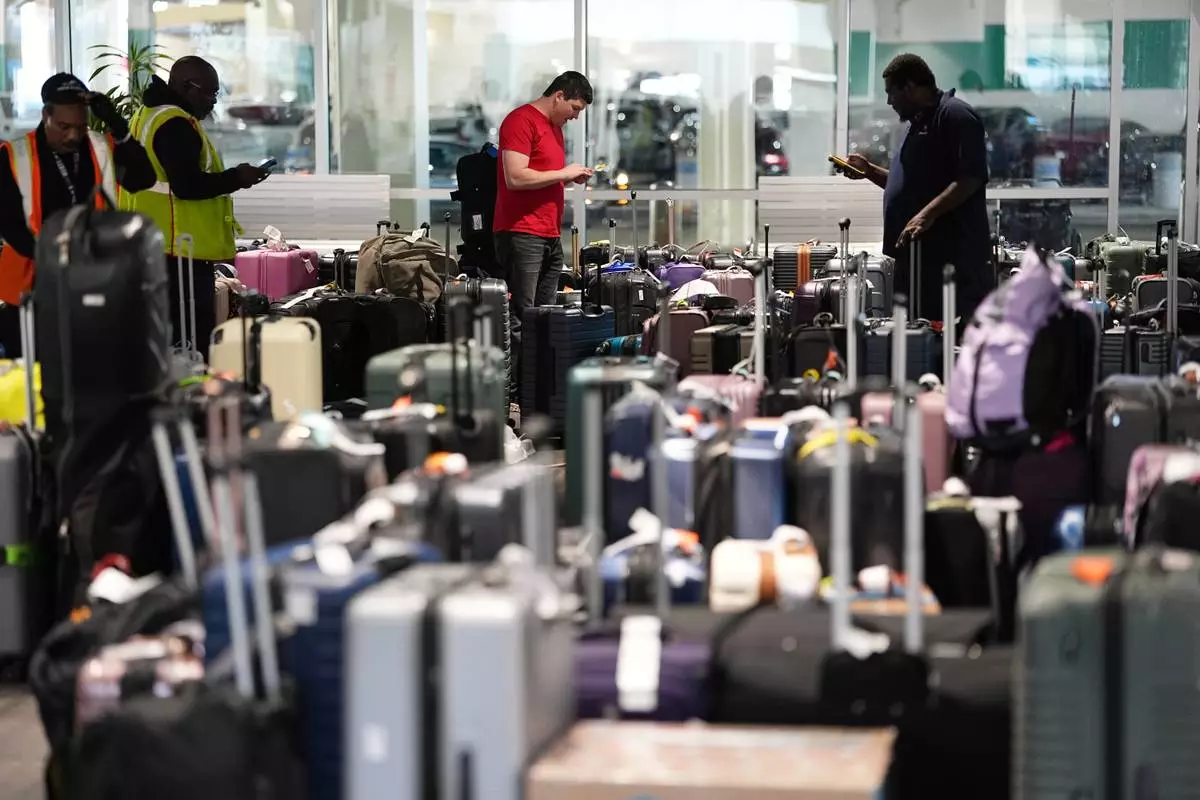
WASHINGTON (AP) — The Federal Aviation Administration has paused installing routers linked to last week’s ground stop that caused chaos for travelers, the agency said Tuesday.

The move comes amid growing scrutiny over the nation’s air traffic control system and as the Trump administration is making a new request for $50 billion to improve air travel. Democrats in the Senate are demanding that the administration provide clear answers about what went wrong.

President Donald Trump has blamed old technology and Democrats for the nationwide grounding of all planes and upheaval at the nation’s airports. But the FAA has been struggling to modernize the air traffic control system for decades — going back well before the first Trump administration.

FAA spokesperson Ian Gregor said the agency paused new installations of Juniper routers and disabled the functionality of all existing ones on Friday after technicians linked the problems to a new router in El Dorado, Arkansas. The FAA has said that another router installed three weeks earlier in Amarillo, Texas, also went haywire.

The system became overloaded when the federal contractor that maintains the FAA’s telecommunications network was replacing outdated copper wires with fiber optic lines across the nation.

The ground stop was needed, Transportation Secretary Sean Duffy said, after the new router that L3Harris installed in Arkansas resulted in a cascade of intermittent communications and radar signals at 17 of the 22 regional air traffic control centers. The centers direct planes cruising at high altitudes.

The FAA said that “excessive data” was flooding the system “at a rate of 1,000 connection attempts every 4 to 5 seconds.” That deluge created instability with “aircraft communications and radar feeds," the agency said.

For now, the FAA is relying on older Cisco routers that have been in place for 25 years to continue operating the network while they investigate the cause of Friday’s trouble.

The routers at issue last week are being tested in a lab at the headquarters of L3Harris.

A spokesperson for Hewlett Packard Enterprise, which owns Juniper, told ABC News that the company believes the routers were working properly when the ground stop occurred. The company did not immediately respond to inquiries from The Associated Press.

“Based on what we know today, the device functioned as it was configured to by the installer. It did not fail or act improperly,” the company said in its statement.

Democrats on the Senate Commerce Committee said they believe that only 400 out of more than 3,600 new routers have been installed.

“Identifying the device that failed does not establish why it failed. FAA must investigate further to determine the root cause and report to Congress on how it intends to prevent future issues,” the Democrats said in a letter sent to Duffy.

Upgrading the nation’s air transportation system is an effort that Congress has dedicated significant sums to in recent years. The problems with aging equipment at the FAA date back decades and past efforts to modernize the system have come up short.

Duffy has pushed Congress for billions more dollars to upgrade a system he said had been neglected for decades, saying again Monday that much more is needed.

The Trump administration on Tuesday sent a letter to key lawmakers outlining its request for $50.1 billion to modernize the system and make other improvements at airports.

The request calls for $10.1 billion for updating the nation’s air traffic control system. Similar amounts would go toward boosting airport infrastructure, replacing or refurbishing terminals at high-impact hubs, constructing five new traffic control centers and improving or replacing up to 140 FAA-owned air traffic control towers.

“Congressional approval of these funds will equip the FAA to deliver to the American people a brand-new air traffic control system that is safer, smarter, faster, and more efficient,” states the letter, which was obtained by The Associated Press.

Congress approved $12.5 billion last year to modernize much of the key infrastructure that more than 45,000 flights a day rely on to reach their destinations safely. The funds were earmarked for replacing outdated technologies such as copper wires, floppy discs and radars built in the 1980s, but much of that money will also go toward runway upgrades and other construction projects.

A traveler with a smartphone walks across a pedestrian bridge at Philadelphia International Airport in Philadelphia, Monday, Nov. 16, 2026. (AP Photo/Matt Rourke)

A traveler with a smartphone walks across a pedestrian bridge at Philadelphia International Airport in Philadelphia, Monday, Nov. 16, 2026. (AP Photo/Matt Rourke)

Luggage is set out for travelers to pick up at a baggage claim at Philadelphia International Airport in Philadelphia, Monday, Nov. 16, 2026. (AP Photo/Matt Rourke)

Luggage is set out for travelers to pick up at a baggage claim at Philadelphia International Airport in Philadelphia, Monday, Nov. 16, 2026. (AP Photo/Matt Rourke)

A building that housed a router blamed for a technical issue that caused a nationwide ground stop is seen Monday, Nov. 16, 2026, at South Arkansas Regional Airport in El Dorado, Ark. (Penny Chanler/The El Dorado News-Times via AP)

A building that housed a router blamed for a technical issue that caused a nationwide ground stop is seen Monday, Nov. 16, 2026, at South Arkansas Regional Airport in El Dorado, Ark. (Penny Chanler/The El Dorado News-Times via AP)

Recommended Articles