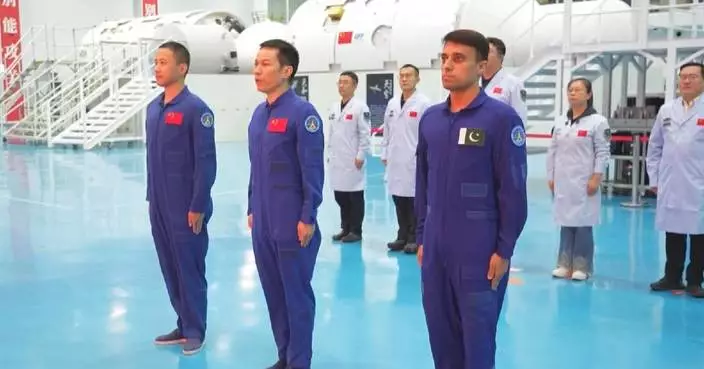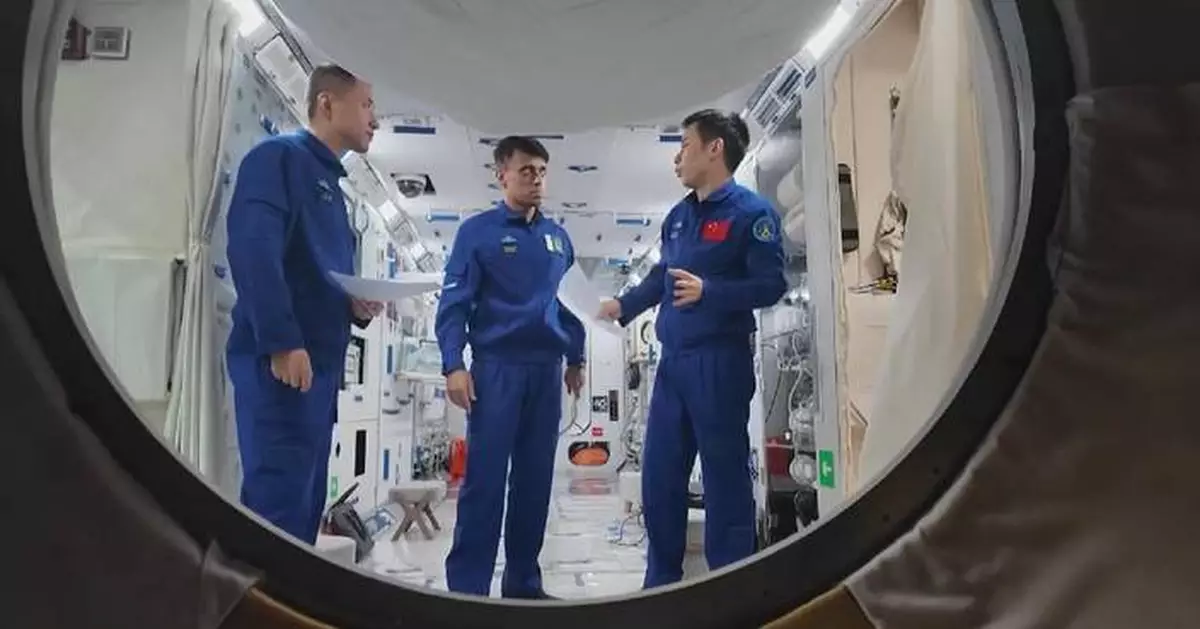
As China's Shenzhou-24 crewed spacecraft is scheduled to be launched at 08:18 (Beijing Time) Wednesday, the Astronaut Center of China (ACC) detailed how it combined strict professional training standards with thoughtful, tailored support for Pakistani astronauts over the past seven months.
Chinese astronauts Tang Hongbo and Wu Yi as well as Pakistan's Muhammad Zeeshan Ali have been announced as the crew members of the Shenzhou-24 spaceship, which is to be launched from the Jiuquan Satellite Launch Center in northwest China, according to the China Manned Space Agency (CMSA).
The Shenzhou-24 mission marks the first joint flight involving Chinese and foreign astronauts in the history of China's manned space program, while Ali will become the first foreign astronaut to visit the Tiangong space station.
In April this year, two astronauts from Pakistan arrived at the ACC in Beijing and began seven months of professional training. Their living area was arranged to facilitate their study, work and training, with all basic daily supplies in place and study rooms, gyms and cultural experience areas available.
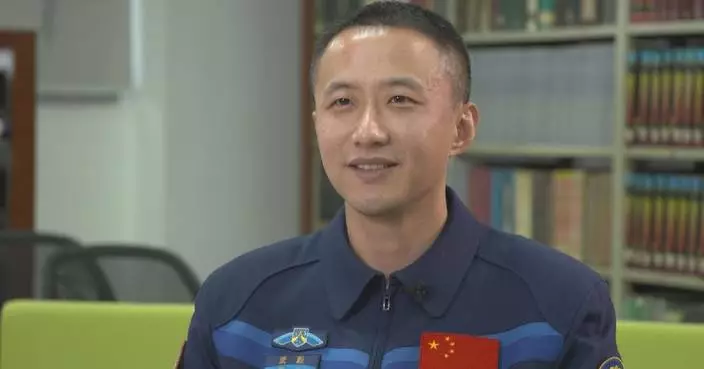
"[The center] took into account their background and living habits, especially their psychological needs. After all, they came to China from another country. Here, they are in a relatively unfamiliar environment, far from their homeland and families, with some language barriers. Under these circumstances, we first set a management and support philosophy. We must make the rules and requirements clear, and training standards must not be lowered. On the basis of this principle, we need to provide meticulous support so that they can feel at ease and comfortable physically and psychologically, and devote themselves wholeheartedly to high-intensity training sessions," said Li Sen at the center.
Following the principle giving top priority to mission execution and guaranteeing efficient training and an orderly life, the center has provided support across clothing, food, housing, transport and training integration for the two Pakistani astronauts.
They were outfitted in line with China's astronaut clothing system, with training suits and special uniforms for ground ceremonies prepared. Meals were planned under a special nutrition support program for the ground training period, based on China's flight mission experience.
"We fully respect and take into account some of their living habits. We need to consider their tastes, as well as letting them enjoy Chinese cuisine and food culture. Ultimately, they still have to carry out the mission, so we make the transition gradually," said Li.
Language support has been tailored to the Pakistani astronauts' Chinese-language foundation, with graded courses and bilingual textbooks prepared in advance for professional instruction. Physical training follows a step-by-step approach, with a special strengthening plan designed to ensure scientific and safe training. Professional training sessions for conducting the mission are put as the top priority.
"Relevant standards and requirements have been set for short-term flight. Certainly, the standards are based on the flight standards for Chinese astronauts and will not be lowered. On the premise of meeting the basic mission requirements, they also need to learn more about how to respond to possible emergency situations. Overall, there is no distinction between Chinese and Pakistani astronauts [in training standards]," said Li.
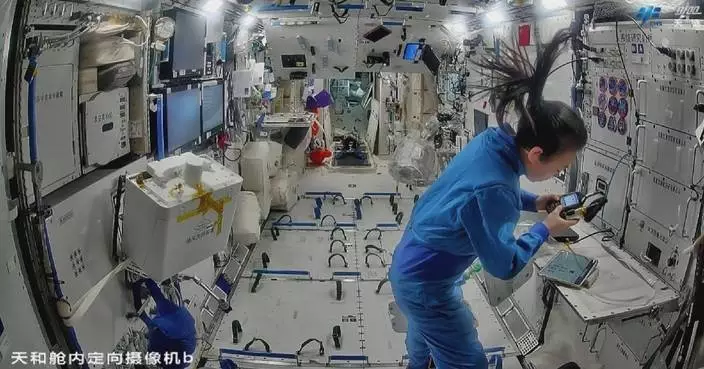
Ali, a former pilot, will fly as a payload specialist on a short-term in-orbit mission, during which he will operate scientific experiment payloads from Pakistan.
"For the in-orbit scientific experiments Ali will carry out during the mission, we have designed in detail the content he needs to operate. We need to help them improve scientific literacy and accurately operate and observe what is required in the experiment project, so that they can both master the relevant control requirements and understand the significance of the experiment itself, as well as the design principles of the entire experimental apparatus. We want them to know the how as well as the why," said Li.
Facing the new mission scenario of the first joint flight by Chinese and foreign astronauts, the center is exploring and building a standard model for training foreign astronauts, covering daily life support, training sessions, assessment and selection, mission execution and post-return recovery.
"We will also continue to summarize our experience. After this mission is completed, we will improve it to form a standard model, laying a foundation for future short-term flights by astronauts from other countries. Basically, this mission model will set a benchmark. Of course, later we will also make some fine adjustments according to the differences of missions themselves," said Li.
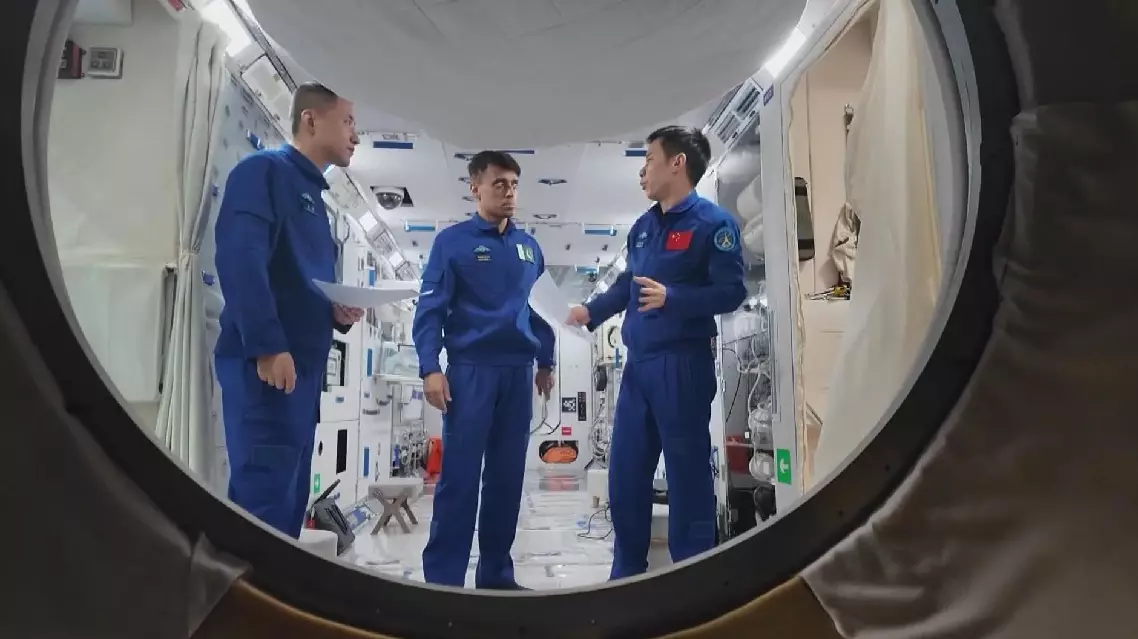
China provides thoughtful support for Pakistani astronauts' training