Former Vice President Al Gore, who started his career as a journalist, is returning to the industry as a newspaper owner in his Tennessee town.
The Lake family, which has operated the Carthage Courier for five decades, said Tuesday it will sell the paper to Gore in the coming weeks. The weekly paper serves Smith County in central Tennessee, which has roughly 20,000 residents and sits about 55 miles (88 kilometers) east of Nashville.
As the beleaguered news industry struggles with newspaper closures and growing news deserts, Gore characterized the purchase as a move that preserves an independent local voice in Carthage and Smith County.
“Having spent my early years as a military reporter in Vietnam and later at the (Nashville) Tennessean, I am a firm believer that a free, independent local press is irreplaceable for the enduring health of our community," Gore said in a statement.
Terms of the sale weren't disclosed, and it wasn't clear how involved Gore, 78, will be in the paper’s operations. His office and the outlet wouldn’t answer questions Tuesday or provide additional details.
The Courier's announcement omitted Gore's political resume, presenting him simply as a local man buying his small town's paper to keep it locally owned.
Before entering politics, Gore spent six months as a military reporter in the U.S. Army during the Vietnam War. He returned to Tennessee and worked for a few years as an investigative reporter at The Tennessean before running for Congress in 1976.
Gore, a Democrat, represented Tennessee in both chambers of Congress, served as President Bill Clinton’s vice president from 1993 to 2001, and ran for president twice. After losing the 2000 presidential election to George W. Bush, he went on to win the Nobel Peace Prize for his climate activism and an Academy Award for the documentary, “An Inconvenient Truth.”
The Courier’s website notes that it covered the early political pursuits of Gore’s father, Albert Gore Sr., who represented the state in the U.S. House and Senate.
Tim Franklin, chair of local news at Northwestern University’s Medill School of Journalism, Media, Integrated Marketing Communications, said Carthage residents may have “some healthy skepticism” about a politician owning the paper.
“But I would be surprised if the Carthage Courier becomes a mouthpiece for the Democratic Party,” he said.
Franklin wondered if the former vice president might write a column, and if the publication would remain narrowly focused on local news.
Gore is far from the first politician to purchase or own a newspaper. Throughout the 1900s, several senators, governors and even a U.S. president, Warren Harding, had local papers in their business portfolios.
More recently, consumer advocate Ralph Nader, one of Gore's former political rivals, helped launch a local newspaper in Winsted, Connecticut, in 2023 that was purchased months later by a national media company.
Associated Press journalist Mike Sisak contributed to this report.
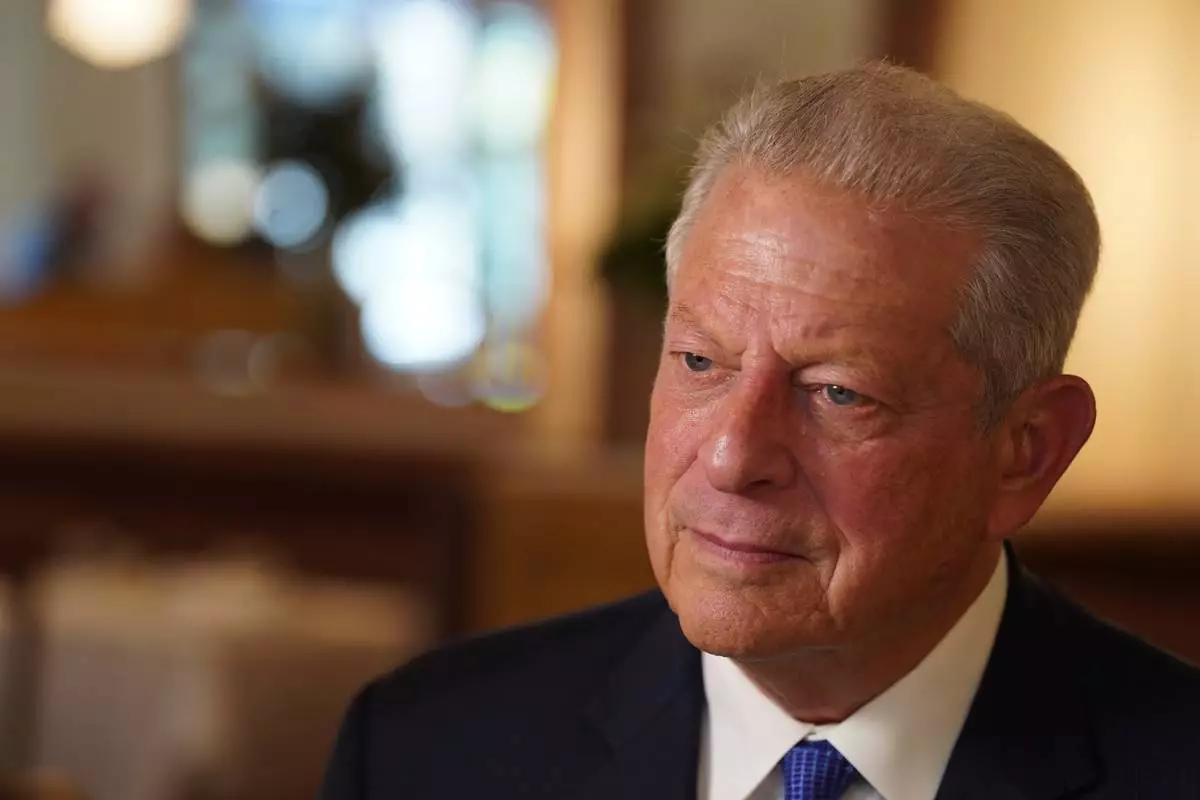
FILE - Former Vice President Al Gore listens during an interview in New York, Sept. 21, 2026. (AP Photo/Mary Conlon, File)
WASHINGTON (AP) — Kilmar Abrego Garcia, a Salvadoran national mistakenly deported as part of the Trump administration's immigration crackdown, was leaving the U.S. voluntarily for Spain on Tuesday, according to a person familiar with the matter.
Abrego Garcia's departure, which would come after months of legal wrangling over his case, could bring to a conclusion what has become a defining saga of the second Trump administration's mass deportations agenda. A judge told Abrego Garcia to self-deport by Tuesday, according to the person familiar with the matter, who spoke on condition of anonymity because they were not authorized to publicly discuss the case.
Abrego Garcia was arrested in Baltimore in March 2025 and deported to a Salvadoran prison in what an official later called an “administrative error.” He was fighting against a second deportation to a series of African countries proposed by Department of Homeland Security officials.
Maryland Sen. Chris Van Hollen, who met with Abrego Garcia while he was pressing for his release from a Salvadoran mega-prison, described Abrego Garcia as a “free man” and said he is traveling to a country of his choice.
“I am relieved that he will be safe, in a country of his choosing, and free – including from this Administration’s constant persecution,” he said in a statement.
Abrego Garcia's deportation in early 2025 came as the Trump administration was ramping up its immigration crackdown, promising to deport 1 million people annually. Through an infusion of billions of dollars approved by Congress, the administration later supercharged its immigration enforcement capabilities, increasing its cadre of immigration officers, expanding detention capabilities and pushing to deport an increasing number of people.
Attorneys who represented Abrego Garcia in both the Maryland immigration proceedings and his criminal case in Tennessee didn’t immediately respond to messages seeking comment. A spokesperson for We Are CASA, an advocacy group that has supported Abrego Garcia and his family, declined to comment.
“Our priority continues to be keeping the family safe,” said the spokesperson, Jossie Flor Sapunar.
DHS did not immediately respond to a request for comment.
The 31-year-old Abrego Garcia has an American wife and child and has lived in Maryland for years, but he immigrated to the U.S. illegally as a teenager. In 2019, an immigration judge ruled that he could not be deported to El Salvador because he faced danger there from a gang that had threatened his family. The judge allowed him to live and work in the U.S. under Immigration and Customs Enforcement supervision, but he was not given residency status.
Facing public pressure and a court order, President Donald Trump’s administration brought him back in June 2025, but only after securing an indictment charging him with human smuggling in Tennessee. A federal judge dismissed that case in May, finding that the Justice Department’s pursuit of criminal charges was designed to punish Abrego Garcia for challenging his deportation. The government is appealing.
The Trump administration vowed to deport him to a third country, threatening to send him to Uganda, Eswatini, Ghana, and, most recently, Liberia.
Abrego Garcia had argued that if he were going to be deported, it should be to Costa Rica, which previously agreed to take him. But Todd Lyons, the former acting director of U.S. Immigration and Customs Enforcement, said in a March 2026 memo that deporting Abrego Garcia to Costa Rica would be “prejudicial to the United States.”
Abrego Garcia should be sent to Liberia because the U.S. has spent governmental resources and political capital in negotiating for it to accept third country nationals, Lyons wrote. The push for deportation to Liberia continued even after the U.S. signed an agreement with Costa Rica to accept deportees who cannot legally be returned to their home countries.
The case took an unusual turn Oct. 6, 2026, when, five minutes before a hearing expected to determine whether U.S. Immigration and Customs Enforcement could detain and deport Ábrego Garcia to the West African country of Liberia, attorneys for both sides left the courtroom, along with Abrego Garcia.
When they returned 15 minutes later, it was announced the hearing was canceled. The two sides then gathered for another 90 minutes before leaving the courthouse without explanation. Abrego Garcia’s attorney said only the court case was not ready to proceed and he instructed reporters to watch the docket to learn the status of the case.
Associated Press reporters Hallie Golden and Rebecca Santana contributed.

FILE - Kilmar Abrego Garcia arrives at the federal courthouse, Feb. 26, 2026, in Nashville, Tenn. (AP Photo/George Walker IV, File)