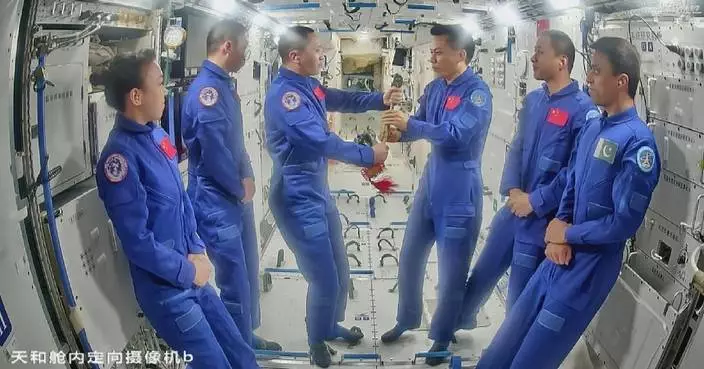
Arslan Mehmood, a teacher at the Confucius Institute Islamabad, a department of the Beijing Language and Culture University, recalled the Chinese-learning journey of Pakistani astronaut Muhammad Zeeshan Ali, who made history on Wednesday as the country's first citizen to enter space aboard China's Shenzhou-24 crewed spacecraft, and praised him as hardworking and diligent.
The spacecraft lifted off from the Jiuquan Satellite Launch Center in northwest China on Wednesday morning, and the crew entered Tiangong that afternoon.
In January this year, eight trainees from Pakistan's Space and Upper Atmosphere Research Commission came here to learn Chinese, with Mehmood as their Chinese teacher.
At the time, Mehmood had no idea that one of his students would become the first astronaut in Pakistan's history. After learning the news, he bought a model spacecraft and placed it in his office. "When he arrived, he couldn't speak any Chinese at all -- he didn't even know 'ni hao (hello).' We started teaching him from 'ni hao (hello)'," said Mehmood.
What was originally a one-month Chinese course was extended by another month at the students' own request, as they felt their Chinese was still not good enough.
Three hours of Chinese classes a day was no easy task for these beginners. Pronunciation, in particular, gave them plenty of trouble, but it also brought plenty of laughter to the classroom. To help the students correct their pronunciation, Mehmood even made a comparison chart for them. After going to China for space training, Ali has continued to learn Chinese. Now, the student who once could not even say "ni hao (hello)" is able to express his feelings in Chinese in front of the media. "When he started learning Chinese here, he couldn't speak any Chinese at all. Although it was only two months, our classes were relatively long -- three hours every day. After he was selected to go to China, he kept learning Chinese. By now, he should already be able to communicate with Chinese people in Chinese without any problem," he said. Mehmood has also begun looking forward to seeing his students again. He hopes to sit together with them and chat as they used to -- only this time, what they will talk about are stories from space.
"We want to meet them. We also want to recall with them what they were like when they first arrived. And we want to hear the whole story from their own mouths," he said.

Confucius Institute teacher recalls first Pakistani astronaut's Chinese language learning journey
China reports growth in logistics industry revenue, partly thanks to its construction of an integrated, multi-dimensional, and smart transport system.
From January to October, the total revenue for China's logistics industry came in at 12.3 trillion yuan (about 1.84 trillion U.S. dollars), increasing 4.2 percent from one year ago, according to data released by the China Federation of Logistics and Purchasing (CFLP) on Saturday.
Efforts to implement a "single-document" system for rail-water intermodal transport have deepened, facilitating better document integration across different modes of transport and improving transshipment efficiency.
Containerized rail-water intermodal volume and rail-road intermodal volume grew by 8.9 percent and 48.4 percent year on year respectively, as a multimodal transport network integrating road, rail, and water continues to take shape.
International channels remain highly efficient, with the capacity of international freight train services steadily increasing and the support capabilities of cross-border logistics channels further strengthened.
From January to October, China-Europe freight trains completed 18,600 trips, a year-on-year increase of 14.6 percent, and the service reports a consistently high proportion of fully loaded containers.
During the same period, China-Central Asia freight trains completed 12,100 trips, up 1.9 percent from one year ago, while the New International Land-Sea Trade Corridor handled over 1.13 million TEUs (twenty-foot equivalent units) via rail-sea intermodal freight trains.
"China is accelerating the development of international logistics corridors, port hubs, and cross-border intermodal transport systems. By cultivating internationalized logistics service capabilities and expanding nodes that connect domestic and international logistics, the country is effectively enhancing the stability and timeliness of cross-border logistics, thereby facilitating its deeper integration into global industrial and supply chain systems," said He Hui, vice president of China Federation of Logistics and Purchasing (CFLP).
A new breakthrough has been achieved in cross-border road transport.
TIR, an abbreviation for Transports Internationaux Routiers, or International Road Transport, is an international customs transit system that saves time and cuts costs for transport operators and customs authorities moving goods across borders. Notably, China became a member of the TIR system in 2016.
Recently, China's first inter-provincial shipment under the "TIR and expressway green channel" model departed the country via the Manzhouli port.
Under the guidance of the road network center of the Ministry of Transport, transport and customs departments in east China's Shandong Province and north China's Inner Mongolia Autonomous Region, leveraged an expressway reservation platform and smart electronic customs seals to shift the inspection process to the point of origin.
Before the truck departed from Shandong, customs officials inspected cargoes, and locked the vehicle's door with an electronic seal.
"Vehicles traveling across provincial borders on expressways are eligible for toll exemptions under the 'green channel' policy upon reaching the exit, with no requirement for cargo inspection again," said Wang Hongyu, officer of the toll road management section at the Inner Mongolia comprehensive administrative law enforcement corps for transportation.
The first "direct export" transaction -- a streamlined clearance process -- was recently successfully tested at the Erenhot highway port.
Supported by a digital regulatory system for "smart ports," the platform automatically assesses risks as soon as cargo arrives at the port checkpoint; vehicles not flagged for further inspection can be cleared for exit rapidly, without the need for additional on-site verification.
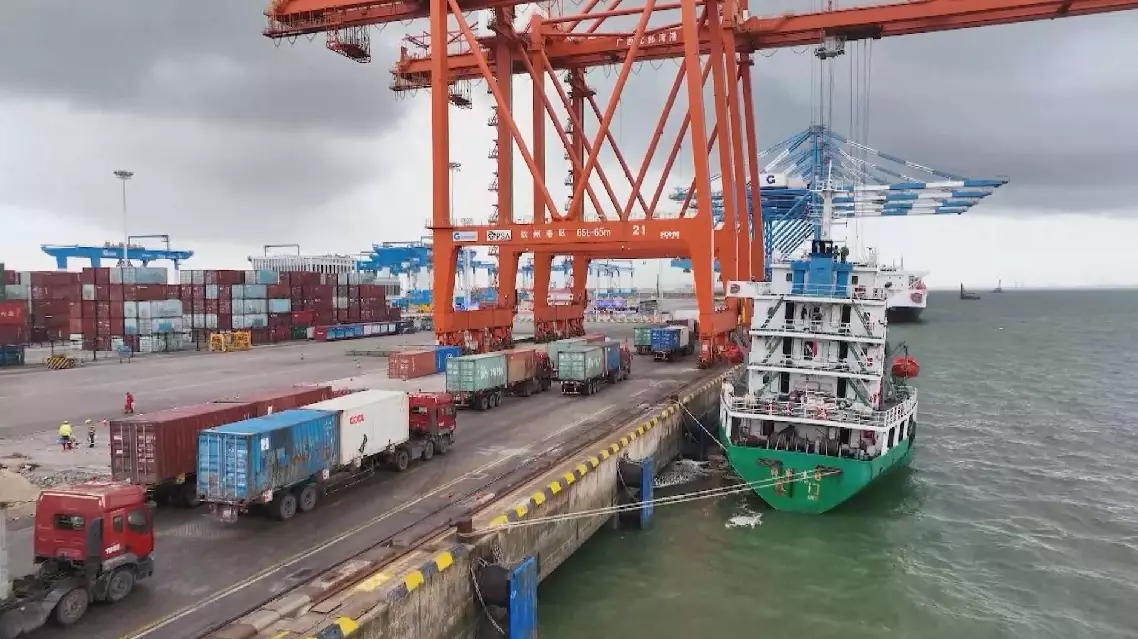
China reports growth in logistics industry revenue in Jan-Oct