China reports growth in logistics industry revenue, partly thanks to its construction of an integrated, multi-dimensional, and smart transport system.
From January to October, the total revenue for China's logistics industry came in at 12.3 trillion yuan (about 1.84 trillion U.S. dollars), increasing 4.2 percent from one year ago, according to data released by the China Federation of Logistics and Purchasing (CFLP) on Saturday.
Efforts to implement a "single-document" system for rail-water intermodal transport have deepened, facilitating better document integration across different modes of transport and improving transshipment efficiency.
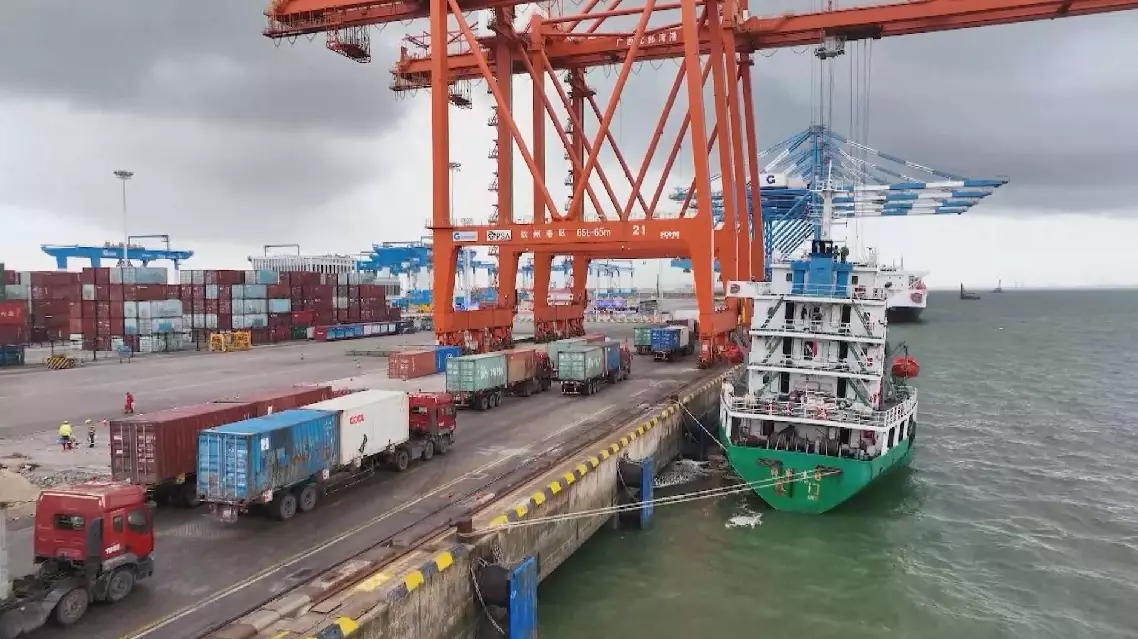
Containerized rail-water intermodal volume and rail-road intermodal volume grew by 8.9 percent and 48.4 percent year on year respectively, as a multimodal transport network integrating road, rail, and water continues to take shape.
International channels remain highly efficient, with the capacity of international freight train services steadily increasing and the support capabilities of cross-border logistics channels further strengthened.
From January to October, China-Europe freight trains completed 18,600 trips, a year-on-year increase of 14.6 percent, and the service reports a consistently high proportion of fully loaded containers.
During the same period, China-Central Asia freight trains completed 12,100 trips, up 1.9 percent from one year ago, while the New International Land-Sea Trade Corridor handled over 1.13 million TEUs (twenty-foot equivalent units) via rail-sea intermodal freight trains.
"China is accelerating the development of international logistics corridors, port hubs, and cross-border intermodal transport systems. By cultivating internationalized logistics service capabilities and expanding nodes that connect domestic and international logistics, the country is effectively enhancing the stability and timeliness of cross-border logistics, thereby facilitating its deeper integration into global industrial and supply chain systems," said He Hui, vice president of China Federation of Logistics and Purchasing (CFLP).
A new breakthrough has been achieved in cross-border road transport.
TIR, an abbreviation for Transports Internationaux Routiers, or International Road Transport, is an international customs transit system that saves time and cuts costs for transport operators and customs authorities moving goods across borders. Notably, China became a member of the TIR system in 2016.
Recently, China's first inter-provincial shipment under the "TIR and expressway green channel" model departed the country via the Manzhouli port.
Under the guidance of the road network center of the Ministry of Transport, transport and customs departments in east China's Shandong Province and north China's Inner Mongolia Autonomous Region, leveraged an expressway reservation platform and smart electronic customs seals to shift the inspection process to the point of origin.
Before the truck departed from Shandong, customs officials inspected cargoes, and locked the vehicle's door with an electronic seal.
"Vehicles traveling across provincial borders on expressways are eligible for toll exemptions under the 'green channel' policy upon reaching the exit, with no requirement for cargo inspection again," said Wang Hongyu, officer of the toll road management section at the Inner Mongolia comprehensive administrative law enforcement corps for transportation.
The first "direct export" transaction -- a streamlined clearance process -- was recently successfully tested at the Erenhot highway port.
Supported by a digital regulatory system for "smart ports," the platform automatically assesses risks as soon as cargo arrives at the port checkpoint; vehicles not flagged for further inspection can be cleared for exit rapidly, without the need for additional on-site verification.
China reports growth in logistics industry revenue in Jan-Oct