Chinese researchers have shared details of three newly disclosed pieces of evidence documenting the Japanese military's chemical warfare in China during World War II.
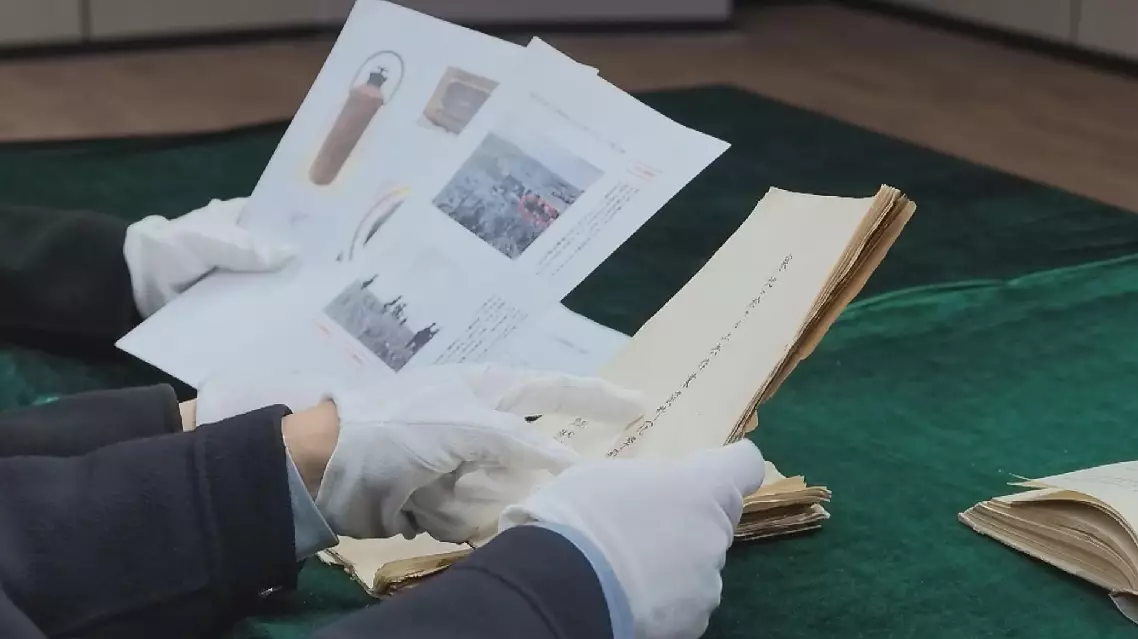
The items -- a refill canister for a chemical agent dispersal device and two historical documents related to chemical warfare -- were collected in Japan by the Exhibition Hall of Evidences of Crime Committed by Unit 731 of the Japanese Imperial Army, a museum built on the former site of the Japanese army's notorious biological and chemical warfare base in Harbin, the capital of northeast China's Heilongjiang Province.
Established as the nerve center for Japanese biological warfare in China and Southeast Asia during WWII, Unit 731 conducted human experiments on at least 3,000 people, and Japan's biological weapons killed over 300,000 people in China.
Released by the exhibition hall on Friday, the items together provide corroborating evidence of the Japanese military's weapons manufacturing, personnel training and field testing during its war of aggression in China.
The canister bears a nameplate listing its serial number, date of manufacture in 1938, and Japanese manufacturer, according to Jin Shicheng, head of the Publicity, Education and Exhibition Department of the exhibition hall.
Jin said the canister was a standard-issue chemical agent dispersal device used by gas units. Measuring 47 centimeters in length and 16.5 centimeters in diameter, it could hold about 9 kilograms of blister agents when fully loaded.
"These newly discovered items transform what were previously only documented accounts of crimes into tangible, concrete evidence, something one can actually see and touch. The canister is not some crude, improvised tool fashioned by an individual soldier, but a standard-issue weapon. This means that Japan's preparations for chemical warfare were, in fact, a premeditated, top-down state crime," said Gong Wenjing, director of the international research center for Unit 731 issues of the Harbin Academy of Social Sciences.
The Japanese military conducted over 2,000 chemical attacks across at least 19 Chinese provinces and regions during the war of aggression on China (1931-1945), resulting in severe civilian casualties, said Gong.
In addition to the refill canister, the two newly released documents provide further evidence that Japan's chemical warfare in China was a systematic program.
One document compiled in 1938 records the impact of extremely cold weather on chemical warfare operations.
Tan Tian, a researcher at the exhibition hall, said the document is divided into four chapters: the impact of meteorological conditions on poison gas, protective measures, the dispersal of toxic agents, and decontamination. It also includes details on the use of portable dispersal devices under extreme cold conditions.
"In Article 265, the document says the flow of the toxic agent from portable dispersal devices could sometimes be obstructed in extreme cold, hindering the dispersal process," Tan said.
The other document, compiled in 1942, is a collection of teaching materials and notes for Japanese chemical warfare trainees.
It is a 39-page compilation of teaching materials that analyzes and compares the properties of different categories of chemical agents and contains records of animal experiments and injuries caused to humans by chemical agents such as mustard gas and lewisite.
Notably, other materials in the exhibition hall include testimony from a Japanese soldier revealing the true purpose of the education.
"He wrote about the education of trainees and its true nature. While focused on 'gas protection' on the surface, it was actually designed to ensure proficiency in the use of chemical agents, serving as preparation for their eventual deployment," said Jin.
"This reflects the same deceptive cover used in both biological and chemical warfare. Unit 731 was a covert research and development group. It used epidemic prevention and water supply as a cover, while in reality it was a criminal unit conducting human experiments and biological warfare. As for chemical warfare, the situation was the same: the historical materials we discovered were cloaked in the guise of disease and poison prevention, when the actual purpose was to spread poison," Gong said.
According to the exhibition hall, such teaching materials were widely distributed among Japanese military units at the time. After the war, the Japanese military systematically destroyed evidence of its chemical warfare, so very few complete records were preserved.
"During its invasion of China, Japan violated international law by manufacturing large-scale chemical weapons and conducting extensive chemical warfare. The three pieces released today confirm from weapons manufacturing, personnel training and field testing that Japan's chemical warfare in China was a top-down, organized and systematic state crime," Jin said.
Chinese researchers share details of new evidence of Japan's chemical warfare in China during WWII