A spectacular Sun halo display, with a 22° halo, parhelic circle, sundogs and a tangent arc as well as 44° parhelia (sundogs) and 46° halo, was seen in Vemdalen, Sweden Dec 1 2017.

This fantastic range of halo phenomena was filmed by Ludvig Lundin in the Swedish ski resort of Vemdalen. Such dramatic displays usually occur naturally only in polar regions where the ice crystals of frozen fog, known as ‘diamond dust’, refract and reflect the sunlight like tiny prisms.

Near the Poles the crystals can be optically very pure and can have extremely regular hexagonal shapes. But in a place like Vemdalen, such halo-forming ice crystals will have been man-made.
Overnight, the ski resort’s extensive network of snow machines produces ice crystals that are particularly clear and regular.

As these float in the cold air of the morning, they’re just right for producing beautiful and extensive halo phenomena like these.

EL PASO, Texas (AP) — Duke's unlikely Atlantic Coast Conference title didn't get the Blue Devils anywhere close to the College Football Playoff berth that's supposed to go to every Power Four conference champion.
The consolation prize comes Wednesday in the Sun Bowl against Arizona State, a team just a year removed from winning the Big 12, making the CFP and nearly pulling a huge upset against Texas in the quarterfinals.
Defensive tackle Aaron Hall and his teammates figured their CFP hopes were dim despite the 27-20 overtime victory against No. 20 Virginia, and couldn't have been surprised when the upset opened the playoff door for a second Group of Five school in the 12-team field instead of the Blue Devils (8-5).
Now they move on to face the Sun Devils (8-4). It's the second meeting between the schools — both in the Sun Bowl. The first was a 36-31 ASU victory 11 years ago.
“The ACC title is definitely up there, right?” Hall said. “But at the end of the day, we were just talking about it, the joy of that has kind of faded just a little bit, right? You're always hungry for the next thing. So for us, we're just making sure that now it's about the bowl game, making sure we get that podium feeling again.”
A five-loss team was still alive for a spot in the ACC title game because of a five-way tie for second place that included the league's highest-ranked team, Miami.
The Hurricanes got a CFP bid and won at Texas A&M in the first round. They will kick off a Cotton Bowl quarterfinal against No. 2 seed Ohio State in the Dallas area a few hours after Duke is finished playing about 600 miles away in far West Texas.
“What we said we would do, we're doing,” said Duke coach Manny Diaz, whose two seasons of 9-4 and 8-5 have identically matched the previous two under Mike Elko, now coaching the Aggies. “They know they’re gonna be put on the stage here to be extraordinarily successful in all ways. But the neat thing is that there is still a tinge of disappointment in this team, despite winning the ACC title this year, of some things that could have been that weren't in our control. And hopefully that’ll be the fuel for the '26 Blue Devils.”
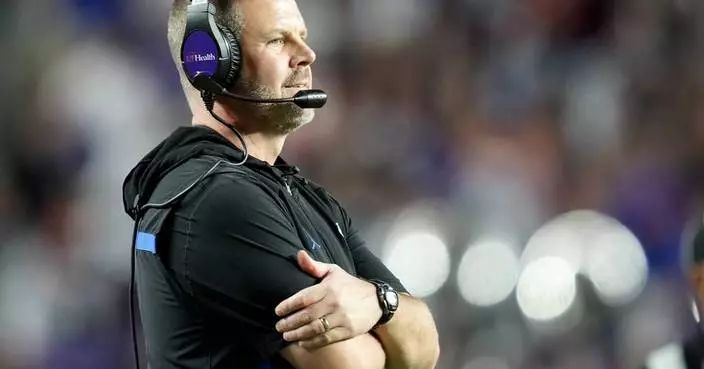
Sun Devils coach Kenny Dillingham will be on the sideline for the first time since signing a five-year contract extension that averages $7.5 million per season. He had been mentioned for several high-profile jobs in a busy coaching cycle.
Dillingham won't have the quarterback who played a big part in ASU's turnaround from 3-9 in 2023 to 11-3 a year ago. Sam Leavitt sustained a season-ending foot injury in early November and is in the transfer portal.
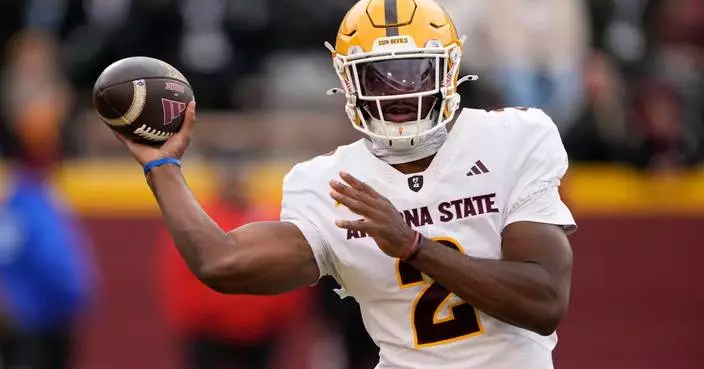
Jeff Sims, a former Georgia Tech and Nebraska quarterback, will start the bowl game, according to Dillingham. Sims has 886 yards passing with seven touchdowns and five interceptions in nine games.
There have been reports that Duke quarterback Darian Mensah is considering a move to the NFL, but Diaz has said Mensah is planning to play in the Sun Bowl. Mensah led the ACC with a Duke-record 30 touchdown passes, throwing for 3,646 yards with five interceptions. He had just one pick in nine conference games, including the title game.
“I hope it's a story every December, where either we've got a quarterback that's considering making the jump early or we've got a quarterback that's finished his eligibility that expects to be one of the top quarterbacks in the (NFL),” Diaz said. “We want to be a very quarterback-friendly offense.”
The biggest name choosing not to play in the Sun Bowl is Arizona State receiver Jordyn Tyson, who is headed to the NFL draft and projects as a first-round pick. Raleek Brown, who rushed for 1,141 yards, also isn't playing.
The biggest missing piece on the ASU defense is linebacker Keyshaun Elliott, who had seven sacks among 14 tackles for loss. Duke will be without defensive end Vincent Anthony Jr., who had 7 1/2 sacks among 13 tackles for loss.
Get poll alerts and updates on the AP Top 25 throughout the season. Sign up here. AP college football: https://apnews.com/hub/ap-top-25-college-football-poll and https://apnews.com/hub/college-football

FILE - Arizona State head coach Kenny Dillingham encourages his players prior to an NCAA college football game against West Virginia Saturday, Nov. 15, 2025, in Tempe, Ariz. (AP Photo/Ross D. Franklin, File)
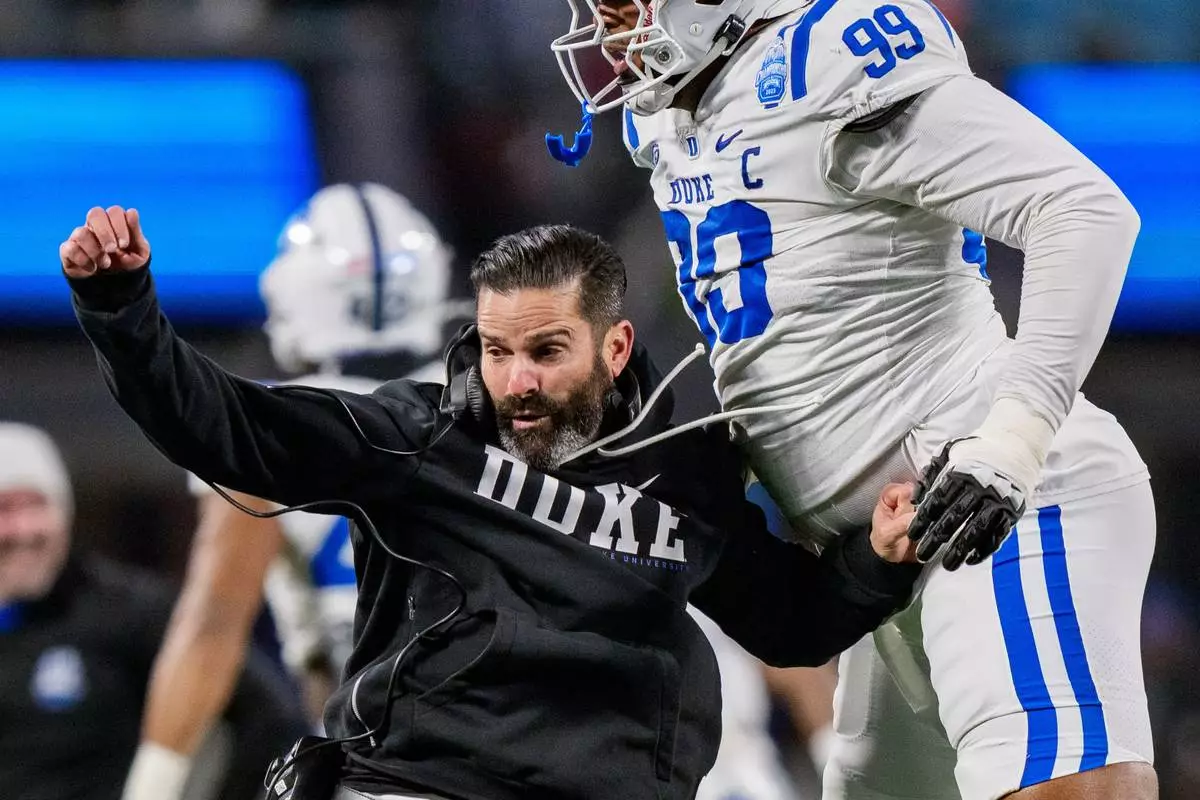
FILE - Duke head coach Manny Diaz, left, celebrates with defensive tackle Aaron Hall (99) after Virginia missed a field goal in the first half of the Atlantic Coast Conference championship NCAA college football game Saturday, Dec. 6, 2025, in Charlotte, N.C. (AP Photo/Jacob Kupferman, File)