Kairah Kelly models herself on Kim Kardashian – and says spending thousands has made her finally feel free.
A transgender teenager who modelled herself on Kim Kardashian says spending almost £15,000 on her new look has finally made her feel like a woman.
Click to Gallery
Kairah (Collect/PA Real Life)
Kairah Kelly, before transition, aged 14 (Collect/PA Real Life)
Kairah (Collect/PA Real Life)
Kairah and mum Angela (Collect/PA Real Life)
Kairah's bruised lips after having lip fillers (Collect/PA Real Life)
Kairah Kelly, before transition, aged 14 (Collect/PA Real Life)
Kairah (Collect/PA Real Life)
Born a boy, Kairah Kelly, 17, felt there was “something missing” until she came out in 2015 and modelled herself on the famous reality star.
Now, after spending thousands on lip fillers, hair extensions, make-up and designer shoes and wearing a “suffocating” steel-boned waist trainer for 20 hours a day, Kairah, of Middlesbrough, North Yorkshire, says she finally feels free.

Kairah (Collect/PA Real Life)
She said: “It’s shocking how much I have spent on my new look, but it is so worth it.
“I feel like the person I was always meant to be.”
Until September 2015, Kairah was known as Tyler, despite spending most of her life struggling with her identity.

Kairah Kelly, before transition, aged 14 (Collect/PA Real Life)
Uncomfortable as a boy, he would roam around the family home wearing make-up, nail varnish and heels.
With girls as his closest friends, Tyler was envious of their make-up, long hair and clothes.
Aged 11, he came out as bisexual before revealing he was gay to family and friends two years later.
But that was not enough, and after watching a video about a transgender woman, Tyler realised he was trapped in the wrong body.
Confiding in a friend who helped Tyler break the news to his mum, a trainee nurse, Angela Kelly, now 32.
And in September that year, he published a post on Facebook announcing that he was transgender and changing his name to Kairah, before going to school the following year as a girl.
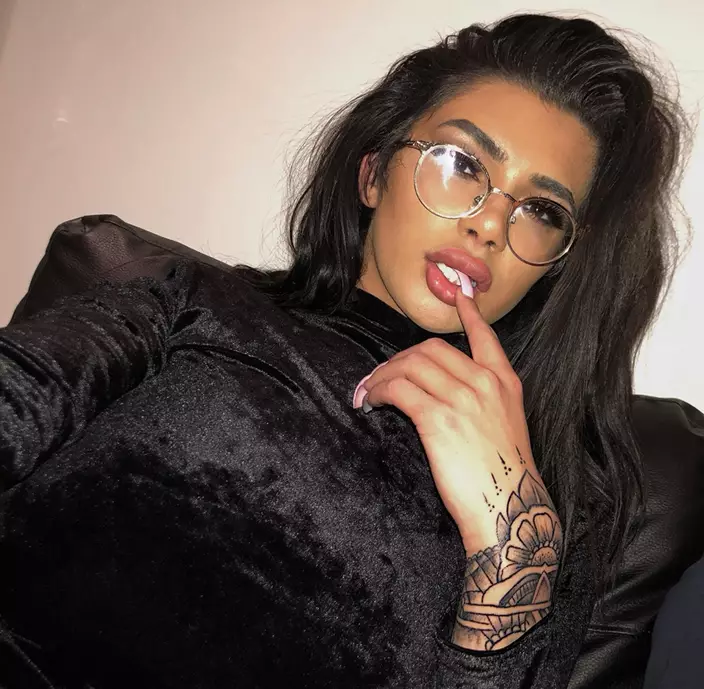
Kairah (Collect/PA Real Life)
And from then, she wasted no time in emulating her female role model, Kim Kardashian.
She has swapped jumpers and tracksuits for skinny jeans, skimpy dresses and colourful tops.
After adding extensions to her long black and now blonde hair and wearing a full face of make-up, she is a dead ringer for Kim.
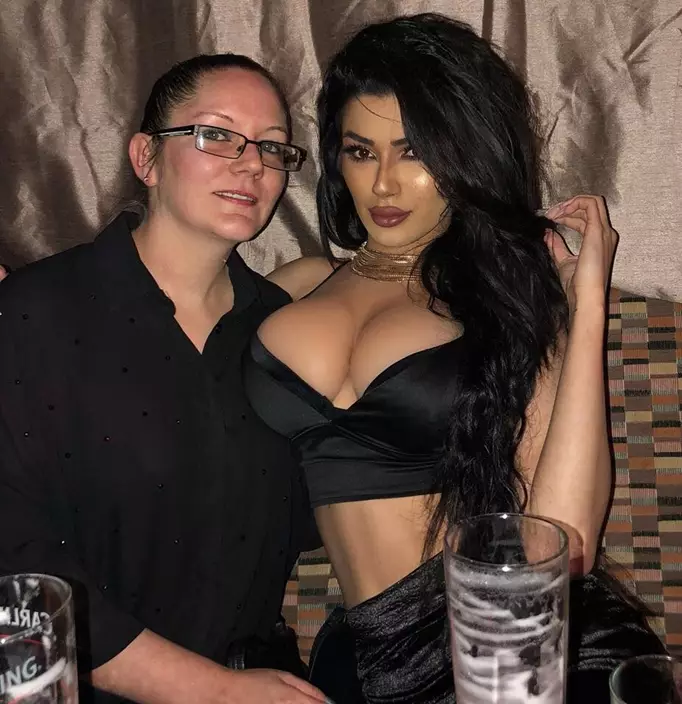
Kairah and mum Angela (Collect/PA Real Life)
But since she started modelling herself on the reality star two years ago – whose initials ‘KK’ match her own – Kairah has spent an eye-watering £14,710 on her look.
Funded by advertising and promoting beauty and fashion products on Facebook, she says she feels more confident that she ever has before.
Splashing £800 on hair extensions since 2016, £3,840 on lip fillers, £4,800 on make-up and £5,250 on seven pairs of designer Christian Louboutin shoes as well as £20 on the waist trainer, she says it is all worth it.

Kairah's bruised lips after having lip fillers (Collect/PA Real Life)
“I don’t care about the money, I finally feel like my true self,” she said.
“I get my fillers done every four months as my pout is what helps me feel like me.
“Without them I worry I am going to get found out, that people will know I was born a man.”

Kairah Kelly, before transition, aged 14 (Collect/PA Real Life)
Kairah has also worked hard on shrinking her waist from 28 inches down to 22 inches using a waist trainer.
But it has not been easy as Kairah admits wearing the corset-like top for 20 hours a day is not only painful but restrictive too.
“I feel like I am being suffocated, but I know it is worth it,” she said.
“I want to have a tiny waist, just like Kim Kardashian and am willing to go through pain to achieve that.
“I admit I do digitally enhance some of my photos, but they are 80 per cent really me.”
Now, two years after presenting at school as a girl, Kairah will start hormone blockers next month before preparing for gender reassignment surgery in the next two years.

Kairah (Collect/PA Real Life)
Kairah, who says her breasts have grown from flat-chested to a 32FF because the weight from her middle is redistributed to her upper and lower body by the waist trainer, is also in a relationship with a man she met online.
She smiled: “We’ve only been together six weeks but it’s going really well. I told him before we even met up that I am trans, but he was so supportive.
“I don’t want to give away any more details about him as it is such early days, but I feel really happy. I am finally the true me.”
BRIDGEPORT, W.Va. (AP) — High school athlete Becky Pepper-Jackson takes her position in the throwing circle, tunes out any distractions, then pivots and tosses the discus into the evening twilight.
Her focus is simple. Whether it’s trying to improve on a third-place finish at last year’s West Virginia state track meet or ignoring naysayers who don’t want a transgender girl on a girls' sports team, the Bridgeport High School sophomore just wants to enjoy time with her friends.
Anything else that might deflect her attention gets set aside. And, for now, that means not worrying about what the U.S. Supreme Court will decide by early summer in a case where she's the centerpiece over whether trans girls can compete.
“I’m not here to get an advantage,” Pepper-Jackson said. “I’ve been like pushed down and have people that just look at me nasty my whole life. And I’ve learned that that’s just something I’m going to have to deal with."
In 2021, Pepper-Jackson took a stand by challenging a newly signed law in West Virginia banning trans athletes from competing in female sports in middle and high schools and colleges. The U.S. Supreme Court in 2023 allowed Pepper-Jackson to continue competing in middle school while the lawsuit continued.
Now she's in high school, and the lawsuit is nearing the finish line. In January, the Supreme Court’s conservative majority, which has repeatedly ruled against transgender Americans in the past year, signaled it would rule the state bans don’t violate either the Constitution or the federal law known as Title IX, which prohibits sex discrimination in education.
The justices heard arguments in a second case from Idaho, where Lindsay Hecox sued over the state’s first-in-the-nation ban for the chance to try out for the women’s track and cross-country teams at Boise State University. She didn’t make either squad.
Pepper-Jackson is the only trans person who has sought to compete in girls sports in West Virginia. If the court rules that state bans are legal, her current track season will be her farewell tour. It’s not something she thinks about.
“I can’t make their decisions for them, so I just have to wait and see what they’ll say,” she said. “I try not to look at it if this could be my last season."
West Virginia Attorney General JB McCuskey said he's confident the state will prevail.
"West Virginia’s law does not exclude anyone; it simply says biological boys will compete against boys, and biological girls will compete against girls," McCuskey said in a statement. "On the athletic field, biological sex matters — gender identity does not."
Pepper-Jackson has publicly identified as a girl since she was 8 years old and long before that at home.
Her mother, Heather Jackson, said Becky wasn’t like her two older brothers.
“I noticed immediately that Becky was different,” Jackson said. “When she was old enough to say what she wanted, toys or clothing or anything, she was very profound in her opinion.”
It started with her asking for — and getting — a makeup kit for Christmas at age 3. She also started wearing her mom’s shirts as dresses.
“She would be very opinionated on what she wanted to wear,” Jackson said. “I just followed her lead from the very beginning.”
At the onset of puberty, Pepper-Jackson started taking puberty-blocking medication.
“Becky did not undergo male puberty,” said Aubrey Sparks, legal director for the American Civil Liberties Union’s West Virginia chapter. “And so when you hear, 'Well, this is unfair. Trans kids have an advantage.’ That’s just not the case here.”
In sixth grade, Pepper-Jackson heeded her girls' track coach’s advice to switch from highly competitive distance running to field events. As a high school freshman last year, she took third place in the discus and eighth in the shot put at the state meet.
Detractors have followed her closely, including Republican Gov. Patrick Morrisey.
In 2024, five athletes from a rival school refused to compete alongside Pepper-Jackson. The five received a standing ovation at a news conference a week later in Charleston, where Morrisey, then as the state's attorney general, announced the state would challenge a federal appeals court ruling favoring Pepper-Jackson.
At the 2025 state meet, a female sprinter stood victorious on the podium wearing a T-shirt that read, “Men don’t belong in women’s sports."
It’s been quieter so far this season. Pepper-Jackson has won both the discus and shot put in her first two meets and has cheered on teammates competing in other events.
“There’s a lot of core lessons you learn from being in sports that you don’t get anywhere else, like teamwork, sportsmanship,” she said.
Off the field, she plans to pursue music in college and a career as a band director.
Pepper-Jackson has paid attention to other trans girls who have excelled nationally in high school track.
AB Hernandez won gold in the girls high jump and triple jump at last year’s California state high school meet. Hernandez is now a senior at Jurupa Valley High School. Verónica Garcia won back-to-back 400-meter titles in Washington state in 2024 and 2025, and Ada Gallagher won the 200 meters at the Oregon state meet in 2024.
“I think it’s very inspiring,” Pepper-Jackson said.
The success of Hernandez renewed calls by some parents’ groups and conservatives, including President Donald Trump, for the state to ban trans girls from competing against other female athletes. California has a law on the books allowing students to participate on sports teams consistent with their gender identity, regardless of their sex assigned at birth.
When Hernandez qualified for three events last year, it sparked backlash that led the meet's governing body to let an additional girl compete and medal in events in which Hernandez was participating. It may have been the first of its kind rule-change in the nation.
Pepper-Jackson's biggest supporter is, of course, her mom. After a recent practice, the pair danced together, and Heather Jackson scooted across the grass to retrieve the discus after some of the athlete's throws.
Jackson said her daughter has handled the attention and scrutiny of her case “with astounding grace and intelligence and education, which is more than I would have been able to do at that age."
Pepper-Jackson said others have told her they look up to her, a notion she doesn’t understand because “I don’t see the gravity of this court case. I think it’s just common knowledge: Transgender girls should be able to be on the girls' sports team. I think that’s simple.”
Associated Press writer Sophie Austin in Sacramento, California, and AP videojournalist Patrick Aftoora-Orsagos in Clarksburg, West Virginia, contributed to this report.

Becky Pepper-Jackson prepares to throw a discus Tuesday, April 7, 2026, at Bridgeport High School in Bridgeport, W.VA. (AP Photo/John Raby)

West Virginia American Civil Liberties Union legal director Aubrey Sparks speaks Tuesday, April 14, 2026, at her office in Charleston, W.Va. (AP Photo/John Raby)

Becky Pepper-Jackson poses on the infield Tuesday, April 7, 2026, at Bridgeport High School in Bridgeport, W.VA. (AP Photo/John Raby)

Heather Jackson, left, and her daughter, Becky Pepper-Jackson, pose for a portrait Tuesday, April 7, 2026, at Bridgeport High School in Bridgeport, W.Va. (AP Photo/John Raby)

Becky Pepper-Jackson poses for a photo with a discus Tuesday, April 7, 2026, at Bridgeport High School in Bridgeport, W.VA. (AP Photo/John Raby)