Skip to Content Facebook Feature Image

White deer have unusual home in upstate NY _ old Army depot

News

White deer have unusual home in upstate NY _ old Army depot
News

News

White deer have unusual home in upstate NY _ old Army depot

2018-10-30 23:50 Last Updated At:10-31 18:05

Dennis Money unlocks the gate that blocks access to the 3,000-acre spread that these days almost serves as his home away from home, jumps into a van, and cautions his guests before proceeding.

"I won't guarantee you'll see one, but there's a good bet you will," Money, a retired utilities executive, says as they proceed past the 10-foot-high fence that keeps the world's largest herd of white, white-tailed deer in one place and safe.

Seconds later, one of the ghostly white creatures leaps out of the woods, stares for a second at the intruders, then darts away. It won't be the last on this day as Money, president of Seneca White Deer Inc., maps a route for another tour of a most unusual wildlife sanctuary — a military relic in the heart of the Finger Lakes region of upstate New York.
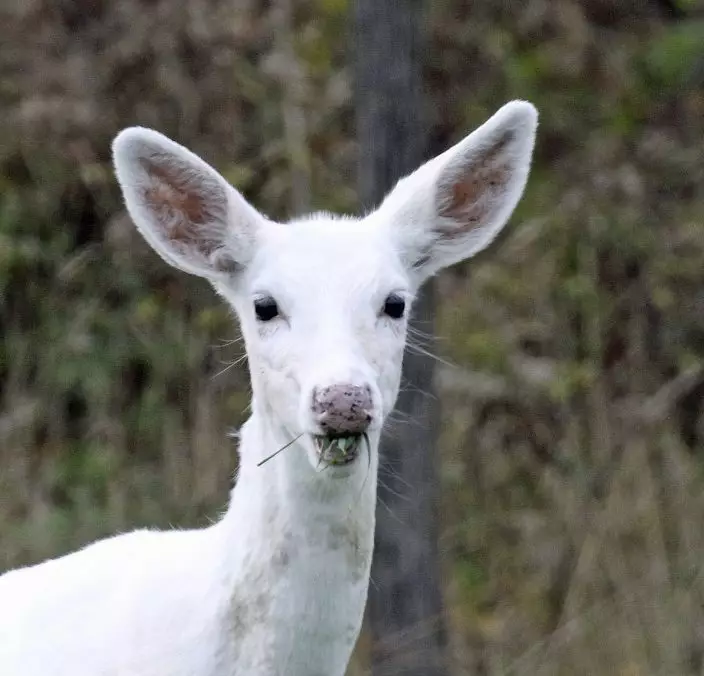
This Oct. 12, 2018 photo provided by Seneca White Deer Inc. shows a single white doe munching on grass at Deer Haven Park in Romulus, N.Y. (Dennis MoneySeneca White Deer Inc. via AP)

This Oct. 12, 2018 photo provided by Seneca White Deer Inc. shows a single white doe munching on grass at Deer Haven Park in Romulus, N.Y. (Dennis MoneySeneca White Deer Inc. via AP)

The former Seneca Army Depot, about 57 miles (92 kilometers) southwest of Rochester, was the U.S. Army's main East Coast munitions storage facility for six decades until it was decommissioned in 2000. Now it's home to approximately 75 white deer.

Seneca White Deer today conducts tours year-round — fall is a prime time for viewing — and helps make sure the deer have enough food to survive. The white deer are not albinos and their color makes them easy targets for predators and hunters.

"I absolutely love it. I'm so proud of what they're doing there," said 84-year-old Pidge Bower, who owns a 500-acre farm in nearby Potter, New York. "It blew me away. I love the white deer. I think they're beautiful and I'm glad they're protected."
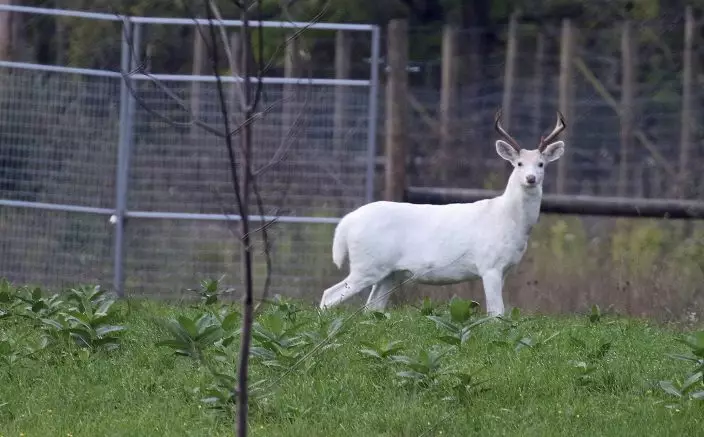
This Oct. 12, 2018 photo provided by Seneca White Deer Inc. shows a white buck surveying his domain at Deer Haven Park in Romulus, N.Y. (Dennis MoneySeneca White Deer Inc. via AP)

This Oct. 12, 2018 photo provided by Seneca White Deer Inc. shows a white buck surveying his domain at Deer Haven Park in Romulus, N.Y. (Dennis MoneySeneca White Deer Inc. via AP)

The history of how the depot became home to the deer is as fascinating as spotting one of the snowy white creatures. On the brink of entering World War II in 1941, the U.S. Army selected a site between Seneca Lake and Cayuga Lake to build a facility that would house the latest munitions. Construction of 519 concrete igloos, which still stand and are part of the tours, was completed in just four months along with 70 miles of roads that crisscrossed a 10,000-acre layout.

When all of the igloos were filled, it's estimated they held 100 million pounds of explosives. Documents found by Seneca White Deer suggest the depot housed the Army's largest stockpile of atomic weapons.

"We lived through those times," Bower said. "There were rumors locally, but you know what, most of them were probably true. The nuclear thing was huge, huge. The country folks knew something was going on. It was very obscure. It was rumored. 'Do you know what?' 'I don't believe that. Why would they do that?' It was just fascinating to me."
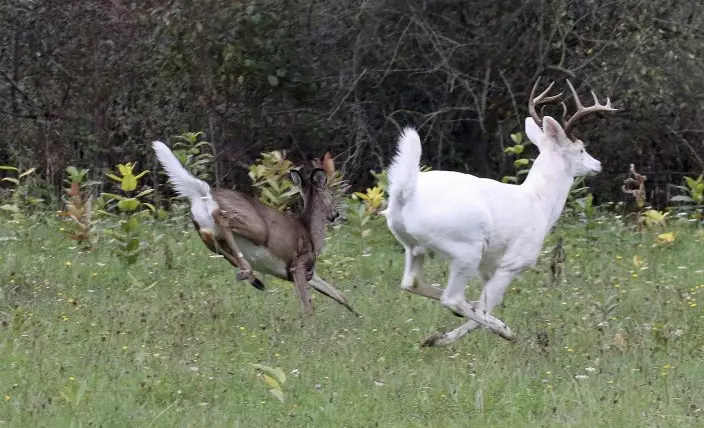
This Oct. 12, 2018 photo provided by Seneca White Deer Inc. shows a large white buck and a smaller brown deer fleeing from approaching humans at Deer Haven Park in Romulus, N.Y. (Dennis MoneySeneca White Deer Inc. via AP)

This Oct. 12, 2018 photo provided by Seneca White Deer Inc. shows a large white buck and a smaller brown deer fleeing from approaching humans at Deer Haven Park in Romulus, N.Y. (Dennis MoneySeneca White Deer Inc. via AP)

Several dozen white-tailed deer, which are native to the region, were trapped inside the 24-mile-long depot fence when it was erected and, shielded from predators and hunters, the herd multiplied. In 1949, two all-white deer, a natural variation of the white-tailed deer, were spotted by soldiers and protected on the depot grounds.

Over the ensuing decade the white deer population quickly grew to around 200. The herd then gradually declined, but after most of the depot grounds were transferred to a private owner two years ago preservation of the rare animals became a priority.

The depot also was the sight of an anti-nuclear protest throughout the summer of 1983 and into 1984, the first at any U.S. military property. It was conducted by about 15,000 women associated with the Seneca Women's Encampment for a Future of Peace and Justice, which was formed to protest the scheduled deployment of missiles to Europe.

Tours in 25-seat, air-conditioned buses last 90 minutes and start at the John and Josephine Ingle Welcome Center at 5632 NY Route 96A in Romulus, New York. The cost is $30 for adults, $27 for military and seniors, $15 for children ages 5 to 17 and kids under 5 are free. The tours are generally conducted all year from Thursday through Sunday. Seneca White Deer also offers specialty tours for hikers, photographers, and bicyclists.


DUBAI, United Arab Emirates (AP) — Nationwide protests challenging Iran's theocracy saw protesters flood the streets in the country's capital and its second-largest city into Sunday, crossing the two-week mark as violence surrounding the demonstrations has killed at least 116 people, activists said.

With the internet down in Iran and phone lines cut off, gauging the demonstrations from abroad has grown more difficult. But the death toll in the protests has grown, while 2,600 others have been detained, according to the U.S.-based Human Rights Activists News Agency.

Those abroad fear the information blackout will embolden hard-liners within Iran's security services to launch a bloody crackdown, despite warnings from U.S. President Donald Trump he's willing to strike the Islamic Republic to protect peaceful demonstrators.

Trump offered support for the protesters, saying on social media that “Iran is looking at FREEDOM, perhaps like never before. The USA stands ready to help!!!” The New York Times and Wall Street Journal, citing anonymous U.S. officials, said on Saturday night that Trump had been given military options for a strike on Iran, but hadn’t made a final decision.

The State Department separately warned: “Do not play games with President Trump. When he says he’ll do something, he means it.”

Online videos sent out of Iran, likely using Starlink satellite transmitters, purportedly showed demonstrators gathering in northern Tehran's Punak neighborhood. There, it appeared authorities shut off streets, with protesters waving their lit mobile phones. Others banged metal while fireworks went off.

Other footage purportedly showed demonstrators peacefully marching down a street and others honking their car horns on the street.

In Mashhad, Iran's second-largest city, some 725 kilometers (450 miles) northeast of Tehran, footage purported to show protesters confronting security forces. Flaming debris and dumpsters could be seen in the street, blocking the road. Mashhad is home to the Imam Reza shrine, the holiest in Shiite Islam, making the protests there carry heavy significance for the country's theocracy.

Protests also appeared to happen in Kerman, 800 kilometers (500 miles) southeast of Tehran.

Iranian state television on Sunday morning took a page from demonstrators, having their correspondents appear on streets in several cities to show calm areas with a date stamp shown on screen. Tehran and Mashhad were not included. They also showed pro-government demonstrations in Qom and Qazvin.

Supreme Leader Ayatollah Ali Khamenei has signaled a coming clampdown, despite U.S. warnings. Tehran escalated its threats Saturday, with Iran’s attorney general, Mohammad Movahedi Azad, warning that anyone taking part in protests will be considered an “enemy of God,” a death-penalty charge. The statement carried by Iranian state television said even those who “helped rioters” would face the charge.

Iran’s theocracy cut off the nation from the internet and international telephone calls on Thursday, though it allowed some state-owned and semiofficial media to publish. Qatar’s state-funded Al Jazeera news network reported live from Iran, but they appeared to be the only major foreign outlet able to work.

Iran’s exiled Crown Prince Reza Pahlavi, who called for protests Thursday and Friday, asked in his latest message for demonstrators to take to the streets Saturday and Sunday. He urged protesters to carry Iran’s old lion-and-sun flag and other national symbols used during the time of the shah to “claim public spaces as your own.”

Pahlavi’s support of and from Israel has drawn criticism in the past — particularly after the 12-day war. Demonstrators have shouted in support of the shah in some protests, but it isn’t clear whether that’s support for Pahlavi himself or a desire to return to a time before the 1979 Islamic Revolution.

The demonstrations began Dec. 28 over the collapse of the Iranian rial currency, which trades at over 1.4 million to $1, as the country’s economy is squeezed by international sanctions in part levied over its nuclear program. The protests intensified and grew into calls directly challenging Iran’s theocracy.

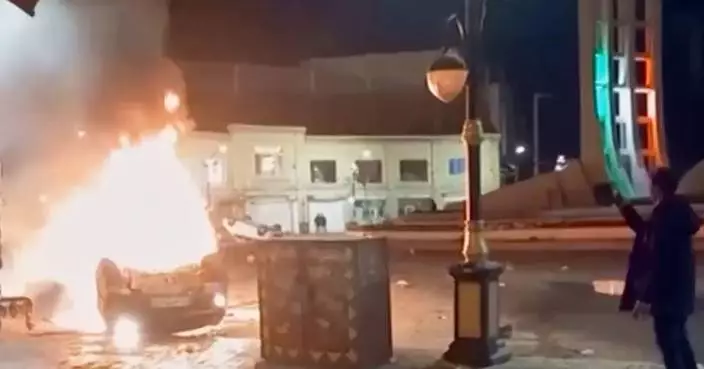
In this frame grab from footage circulating on social media from Iran showed protesters once again taking to the streets of Tehran despite an intensifying crackdown as the Islamic Republic remains cut off from the rest of the world in Tehran, Iran, Saturday Jan. 10, 2026. (UGC via AP)

In this frame grab from footage circulating on social media from Iran showed protesters once again taking to the streets of Tehran despite an intensifying crackdown as the Islamic Republic remains cut off from the rest of the world in Tehran, Iran, Saturday Jan. 10, 2026. (UGC via AP)

Recommended Articles