
Skip to Content Facebook Feature Image

Comic book genius Stan Lee, Spider-Man creator, dies at 95

ENT

Comic book genius Stan Lee, Spider-Man creator, dies at 95
ENT

ENT

Comic book genius Stan Lee, Spider-Man creator, dies at 95

2018-11-13 03:18 Last Updated At:15:56

Stan Lee, the creative dynamo who revolutionized the comic book and helped make billions for Hollywood by introducing human frailties in superheroes such as Spider-Man, the Fantastic Four and the Incredible Hulk, died Monday. He was 95.

Lee was declared dead at Cedars-Sinai Medical Center in Los Angeles, according to Kirk Schenck, an attorney for Lee's daughter, J.C. Lee.

As the top writer at Marvel Comics and later as its publisher, Lee was widely considered the architect of the contemporary comic book. He revived the industry in the 1960s by offering the costumes and action craved by younger readers while insisting on sophisticated plots, college-level dialogue, satire, science fiction, even philosophy.
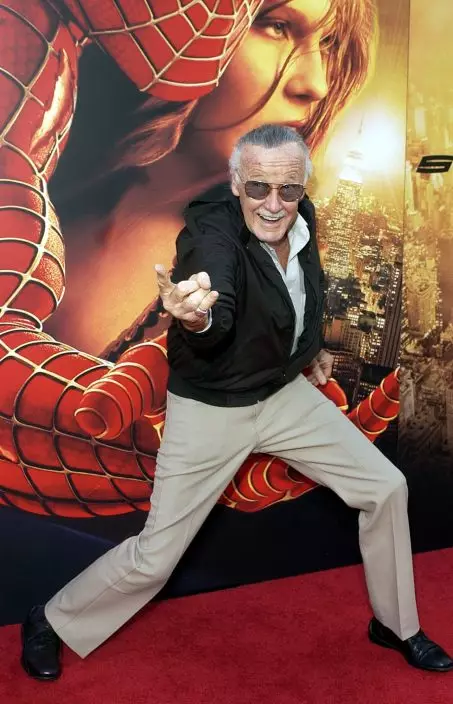
FILE - In this June 22, 2004, file photo, Spiderman creator and "Spider-Man 2" executive producer Stan Lee poses for photographers at the premiere of "Spider-Man 2" in Los Angeles. Comic book genius Lee, the architect of the contemporary comic book, has died. He was 95. The creative dynamo who revolutionized the comics by introducing human frailties in superheroes such as Spider-Man, The Fantastic Four and The Incredible Hulk, was declared dead Monday, Nov. 12, 2018, at Cedars-Sinai Medical Center in Los Angeles, according to Kirk Schenck, an attorney for Lee's daughter, J.C. Lee. (AP PhotoMatt Sayles, File)

FILE - In this June 22, 2004, file photo, Spiderman creator and "Spider-Man 2" executive producer Stan Lee poses for photographers at the premiere of "Spider-Man 2" in Los Angeles. Comic book genius Lee, the architect of the contemporary comic book, has died. He was 95. The creative dynamo who revolutionized the comics by introducing human frailties in superheroes such as Spider-Man, The Fantastic Four and The Incredible Hulk, was declared dead Monday, Nov. 12, 2018, at Cedars-Sinai Medical Center in Los Angeles, according to Kirk Schenck, an attorney for Lee's daughter, J.C. Lee. (AP PhotoMatt Sayles, File)

Millions responded to the unlikely mix of realistic fantasy, and many of his characters, including Spider-Man, the Hulk and X-Men went on to become stars of blockbuster films. Recent projects he helped make possible range from the films "Black Panther" and "Doctor Strange" to such TV series as "Agents of S.H.I.E.L.D" and "Guardians of the Galaxy."

"I think everybody loves things that are bigger than life. ... I think of them as fairy tales for grown-ups," he told The Associated Press in a 2006 interview. "We all grew up with giants and ogres and witches. Well, you get a little bit older and you're too old to read fairy tales. But I don't think you ever outgrow your love for those kind of things, things that are bigger than life and magical and very imaginative."

Lee considered the comic-book medium an art form and he was prolific: By some accounts, he came up with a new comic book every day for 10 years.

"I wrote so many I don't even know. I wrote either hundreds or thousands of them," he told the AP in 2006.

He hit his stride in the 1960s when he brought the Fantastic Four, the Hulk, Spider-Man, Iron Man and numerous others to life.

"It was like there was something in the air. I couldn't do anything wrong," he recalled.

His heroes, meanwhile, were a far cry from virtuous do-gooders such as rival DC Comics' Superman.

The Fantastic Four fought with each other. Spider-Man was goaded into superhero work by his alter ego, Peter Parker, who suffered from unrequited crushes, money problems and dandruff. The Silver Surfer, an alien doomed to wander Earth's atmosphere, waxed about the woeful nature of man. The Hulk was marked by self-loathing. Daredevil was blind and Iron Man had a weak heart.

"The beauty of Stan Lee's characters is that they were characters first and superheroes next," Jeff Kline, executive producer of the "Men in Black" animated television series, told The Blade of Toledo, Ohio, in 1998.

Some of Lee's creations became symbols of social change — the inner turmoil of Spider-Man represented '60s America, for example, while The Black Panther and The Savage She-Hulk mirrored the travails of minorities and women.

Lee scripted most of Marvel's superhero comics himself during the '60s, including the Avengers and the X-Men, two of the most enduring. In 1972, he became Marvel's publisher and editorial director; four years later, 72 million copies of Spider-Man were sold.

"He's become our Mickey Mouse," he once said of the masked, web-crawling crusader.

Lee also published several books, including "The Superhero Women" in 1977 and "How to Draw Comics the Marvel Way" the following year, when he was named publisher of the year by the Periodical and Book Association of America.

CBS turned the Hulk into a successful TV series, with Bill Bixby and Lou Ferrigno portraying the doomed scientist from 1978-82. A Spider-Man series ran briefly in 1978. Both characters were featured in animated TV series as well.

The first big-budget movie based on Lee's characters, "X-Men," was a smash in 2000, earning more than $130 million at North American theaters. "Spider-Man" did even better, taking in more than $400 million in 2002.

Associated Press writers Dave Zelio and John Rogers contributed to this story

DUBAI, United Arab Emirates (AP) — Nationwide protests challenging Iran's theocracy saw protesters flood the streets in the country's capital and its second-largest city into Sunday, crossing the two-week mark as violence surrounding the demonstrations has killed at least 116 people, activists said.

With the internet down in Iran and phone lines cut off, gauging the demonstrations from abroad has grown more difficult. But the death toll in the protests has grown, while 2,600 others have been detained, according to the U.S.-based Human Rights Activists News Agency.

Those abroad fear the information blackout will embolden hard-liners within Iran's security services to launch a bloody crackdown, despite warnings from U.S. President Donald Trump he's willing to strike the Islamic Republic to protect peaceful demonstrators.

Trump offered support for the protesters, saying on social media that “Iran is looking at FREEDOM, perhaps like never before. The USA stands ready to help!!!” The New York Times and Wall Street Journal, citing anonymous U.S. officials, said on Saturday night that Trump had been given military options for a strike on Iran, but hadn’t made a final decision.

The State Department separately warned: “Do not play games with President Trump. When he says he’ll do something, he means it.”

Online videos sent out of Iran, likely using Starlink satellite transmitters, purportedly showed demonstrators gathering in northern Tehran's Punak neighborhood. There, it appeared authorities shut off streets, with protesters waving their lit mobile phones. Others banged metal while fireworks went off.

Other footage purportedly showed demonstrators peacefully marching down a street and others honking their car horns on the street.

In Mashhad, Iran's second-largest city, some 725 kilometers (450 miles) northeast of Tehran, footage purported to show protesters confronting security forces. Flaming debris and dumpsters could be seen in the street, blocking the road. Mashhad is home to the Imam Reza shrine, the holiest in Shiite Islam, making the protests there carry heavy significance for the country's theocracy.

Protests also appeared to happen in Kerman, 800 kilometers (500 miles) southeast of Tehran.

Iranian state television on Sunday morning took a page from demonstrators, having their correspondents appear on streets in several cities to show calm areas with a date stamp shown on screen. Tehran and Mashhad were not included. They also showed pro-government demonstrations in Qom and Qazvin.

Supreme Leader Ayatollah Ali Khamenei has signaled a coming clampdown, despite U.S. warnings. Tehran escalated its threats Saturday, with Iran’s attorney general, Mohammad Movahedi Azad, warning that anyone taking part in protests will be considered an “enemy of God,” a death-penalty charge. The statement carried by Iranian state television said even those who “helped rioters” would face the charge.

Iran’s theocracy cut off the nation from the internet and international telephone calls on Thursday, though it allowed some state-owned and semiofficial media to publish. Qatar’s state-funded Al Jazeera news network reported live from Iran, but they appeared to be the only major foreign outlet able to work.

Iran’s exiled Crown Prince Reza Pahlavi, who called for protests Thursday and Friday, asked in his latest message for demonstrators to take to the streets Saturday and Sunday. He urged protesters to carry Iran’s old lion-and-sun flag and other national symbols used during the time of the shah to “claim public spaces as your own.”

Pahlavi’s support of and from Israel has drawn criticism in the past — particularly after the 12-day war. Demonstrators have shouted in support of the shah in some protests, but it isn’t clear whether that’s support for Pahlavi himself or a desire to return to a time before the 1979 Islamic Revolution.

The demonstrations began Dec. 28 over the collapse of the Iranian rial currency, which trades at over 1.4 million to $1, as the country’s economy is squeezed by international sanctions in part levied over its nuclear program. The protests intensified and grew into calls directly challenging Iran’s theocracy.

In this frame grab from footage circulating on social media from Iran showed protesters once again taking to the streets of Tehran despite an intensifying crackdown as the Islamic Republic remains cut off from the rest of the world in Tehran, Iran, Saturday Jan. 10, 2026. (UGC via AP)

In this frame grab from footage circulating on social media from Iran showed protesters once again taking to the streets of Tehran despite an intensifying crackdown as the Islamic Republic remains cut off from the rest of the world in Tehran, Iran, Saturday Jan. 10, 2026. (UGC via AP)

Recommended Articles