A former prosecutor in the Central Park Five case has resigned from at least two nonprofit boards as backlash intensified following the release of the Netflix series "When They See Us," a miniseries that dramatizes the events surrounding the trial.
On Tuesday, the president of Vassar College posted a letter on its website saying that Linda Fairstein had resigned as a Board of Trustees member.
"I am told that Ms. Fairstein felt that, given the recent widespread debate over her role in the Central Park case, she believed that her continuing as a Board member would be harmful to Vassar," Elizabeth H. Bradley wrote.

FILE- In this March 26, 1988 file photo, prosecutor Linda Fairstein, left, is shown during a news conference in New York. Fairstein was the top Manhattan sex crimes prosecutor when five teenagers were wrongly charged with the 1989 rape and beating of a woman jogging in New York's Central Park. Since the release of the Netflix series "When They See Us," a miniseries that dramatizes the events surrounding the trial, she has resigned from at least two nonprofit boards as backlash from the case intensified. Seated at the table from left are Fairstein, District Attorney Robert Morgenthau, and Ellen Levin, whose daughter Jennifer Levin was murdered in 1986. (AP PhotoCharles Wenzelberg, File)
The victims-services agency, Safe Horizon, also confirmed Fairstein's resignation on Tuesday, thanking her for "her decades of pioneering work on behalf of victims of sexual assault and abuse."
Messages requesting comment from Fairstein were not immediately returned.
Fairstein was the top Manhattan sex crimes prosecutor when five teenagers were charged with the 1989 rape and beating of a female investment banker jogging in Central Park. The attack became a national symbol of urban mayhem at a time when New York City's murder rate was nearing its historical peak.
The teens said they were coerced into confessing their involvement in the attack. Their convictions were overturned in 2002 after convicted murderer and serial rapist Matias Reyes confessed to committing the crime alone, and DNA linked him to it.
Fairstein observed the boys' 1989 interrogation, conducted by another prosecutor and police. She didn't personally try the case.
Since its collapse, she has denied the teens were coerced and has defended authorities' conduct in the case, explored in a 2013 documentary by Ken Burns.
The city reached a roughly $41 million settlement with the five the next year, while not admitting any wrongdoing.
DUBAI, United Arab Emirates (AP) — Nationwide protests challenging Iran's theocracy saw protesters flood the streets in the country's capital and its second-largest city into Sunday, crossing the two-week mark as violence surrounding the demonstrations has killed at least 116 people, activists said.
With the internet down in Iran and phone lines cut off, gauging the demonstrations from abroad has grown more difficult. But the death toll in the protests has grown, while 2,600 others have been detained, according to the U.S.-based Human Rights Activists News Agency.
Those abroad fear the information blackout will embolden hard-liners within Iran's security services to launch a bloody crackdown, despite warnings from U.S. President Donald Trump he's willing to strike the Islamic Republic to protect peaceful demonstrators.
Trump offered support for the protesters, saying on social media that “Iran is looking at FREEDOM, perhaps like never before. The USA stands ready to help!!!” The New York Times and Wall Street Journal, citing anonymous U.S. officials, said on Saturday night that Trump had been given military options for a strike on Iran, but hadn’t made a final decision.
The State Department separately warned: “Do not play games with President Trump. When he says he’ll do something, he means it.”
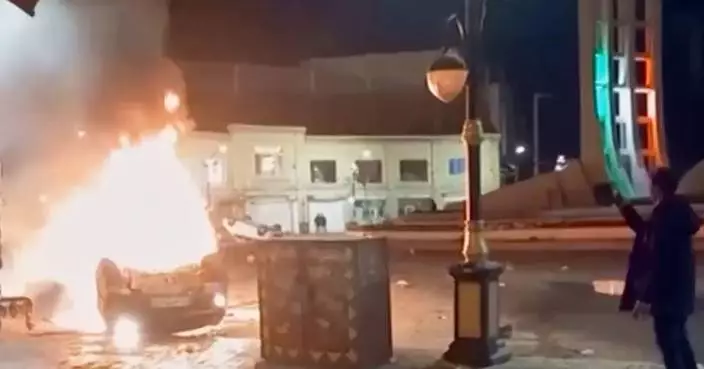
Online videos sent out of Iran, likely using Starlink satellite transmitters, purportedly showed demonstrators gathering in northern Tehran's Punak neighborhood. There, it appeared authorities shut off streets, with protesters waving their lit mobile phones. Others banged metal while fireworks went off.
Other footage purportedly showed demonstrators peacefully marching down a street and others honking their car horns on the street.
In Mashhad, Iran's second-largest city, some 725 kilometers (450 miles) northeast of Tehran, footage purported to show protesters confronting security forces. Flaming debris and dumpsters could be seen in the street, blocking the road. Mashhad is home to the Imam Reza shrine, the holiest in Shiite Islam, making the protests there carry heavy significance for the country's theocracy.
Protests also appeared to happen in Kerman, 800 kilometers (500 miles) southeast of Tehran.
Iranian state television on Sunday morning took a page from demonstrators, having their correspondents appear on streets in several cities to show calm areas with a date stamp shown on screen. Tehran and Mashhad were not included. They also showed pro-government demonstrations in Qom and Qazvin.
Supreme Leader Ayatollah Ali Khamenei has signaled a coming clampdown, despite U.S. warnings. Tehran escalated its threats Saturday, with Iran’s attorney general, Mohammad Movahedi Azad, warning that anyone taking part in protests will be considered an “enemy of God,” a death-penalty charge. The statement carried by Iranian state television said even those who “helped rioters” would face the charge.
Iran’s theocracy cut off the nation from the internet and international telephone calls on Thursday, though it allowed some state-owned and semiofficial media to publish. Qatar’s state-funded Al Jazeera news network reported live from Iran, but they appeared to be the only major foreign outlet able to work.
Iran’s exiled Crown Prince Reza Pahlavi, who called for protests Thursday and Friday, asked in his latest message for demonstrators to take to the streets Saturday and Sunday. He urged protesters to carry Iran’s old lion-and-sun flag and other national symbols used during the time of the shah to “claim public spaces as your own.”
Pahlavi’s support of and from Israel has drawn criticism in the past — particularly after the 12-day war. Demonstrators have shouted in support of the shah in some protests, but it isn’t clear whether that’s support for Pahlavi himself or a desire to return to a time before the 1979 Islamic Revolution.
The demonstrations began Dec. 28 over the collapse of the Iranian rial currency, which trades at over 1.4 million to $1, as the country’s economy is squeezed by international sanctions in part levied over its nuclear program. The protests intensified and grew into calls directly challenging Iran’s theocracy.

In this frame grab from footage circulating on social media from Iran showed protesters once again taking to the streets of Tehran despite an intensifying crackdown as the Islamic Republic remains cut off from the rest of the world in Tehran, Iran, Saturday Jan. 10, 2026. (UGC via AP)