"First Cosmic Velocity" (G.P. Putnam's Sons), by Zach Powers
"First Cosmic Velocity" is a cleverly conceived and beautifully delivered novel that looks at the struggle for space supremacy from the Soviet side of the Cold War.
As the U.S.-USSR battle unfolds in the book, a tug of war also ensues between the Soviet cosmonauts brought to the program and the strict propaganda demands of their communist state. Two key figures picked to fly, Leonid and Nadya, embody this conflict, as deadly failures in Soviet rocketry put the lives of space pioneers in danger.
Actually, there are two Leonids and two Nadyas. As imagined by Zach Powers in this debut novel, the degree of secrecy in the Soviet space program is so great that identical twins are chosen in their youth to become cosmonauts — and given the same name. That way, if one dies in space, the catastrophe can be concealed and the living twin can make appearances to receive public accolades as if nothing bad happened.
This fictional twist is brought off convincingly by Powers. He plays with actual Soviet foibles of the space era, including the USSR's refusal to make public the name of the director of the country's space program. As the Soviets did, Powers simply calls him the Chief Designer.
A humorous element appears when Premier Nikita Khrushchev — unaware of the use of twins — wants his little pet dog to be the first canine in orbit, a four-legged hero of the Soviet Union. There is no arguing with the premier, and a search for a lookalike dog ensues. But in the end, this is no laughing matter.
The space program drama is set in 1964, when the Americans and Soviets each had achieved various "firsts" in the race to claim territorial rights in the heavens and big political points on Earth. Instead of pride and uplift among the program's key players, however, there is an overarching somberness to the narrative, an edge of anxiety over the prospect of lethal failures in the Soviet path to the stars.
Powers also describes the grim lives of the twins in their Ukrainian village in 1950, when poverty, desperate hunger and Stalinist-era brutality destroyed friends and families all around them.
The darkness and gravity of the narrative is mixed with stirring prose and dialogue that make "First Cosmic Velocity" a novel of ideas from the Cold War era. As one of the cosmonauts' colleagues says, the Soviet state rid its people of religion and their faith in a god. "And now," she says, "we fly our cosmonauts to the front door of heaven, knock, and find it vacant."
Online:
http://zachpowers.com/
DUBAI, United Arab Emirates (AP) — Nationwide protests challenging Iran's theocracy saw protesters flood the streets in the country's capital and its second-largest city into Sunday, crossing the two-week mark as violence surrounding the demonstrations has killed at least 116 people, activists said.
With the internet down in Iran and phone lines cut off, gauging the demonstrations from abroad has grown more difficult. But the death toll in the protests has grown, while 2,600 others have been detained, according to the U.S.-based Human Rights Activists News Agency.
Those abroad fear the information blackout will embolden hard-liners within Iran's security services to launch a bloody crackdown, despite warnings from U.S. President Donald Trump he's willing to strike the Islamic Republic to protect peaceful demonstrators.
Trump offered support for the protesters, saying on social media that “Iran is looking at FREEDOM, perhaps like never before. The USA stands ready to help!!!” The New York Times and Wall Street Journal, citing anonymous U.S. officials, said on Saturday night that Trump had been given military options for a strike on Iran, but hadn’t made a final decision.
The State Department separately warned: “Do not play games with President Trump. When he says he’ll do something, he means it.”
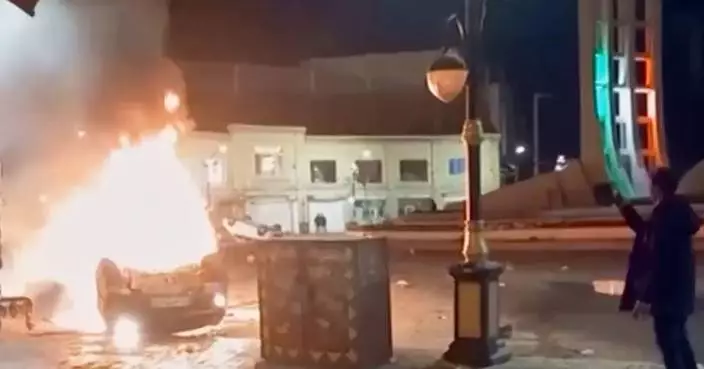
Online videos sent out of Iran, likely using Starlink satellite transmitters, purportedly showed demonstrators gathering in northern Tehran's Punak neighborhood. There, it appeared authorities shut off streets, with protesters waving their lit mobile phones. Others banged metal while fireworks went off.
Other footage purportedly showed demonstrators peacefully marching down a street and others honking their car horns on the street.
In Mashhad, Iran's second-largest city, some 725 kilometers (450 miles) northeast of Tehran, footage purported to show protesters confronting security forces. Flaming debris and dumpsters could be seen in the street, blocking the road. Mashhad is home to the Imam Reza shrine, the holiest in Shiite Islam, making the protests there carry heavy significance for the country's theocracy.
Protests also appeared to happen in Kerman, 800 kilometers (500 miles) southeast of Tehran.
Iranian state television on Sunday morning took a page from demonstrators, having their correspondents appear on streets in several cities to show calm areas with a date stamp shown on screen. Tehran and Mashhad were not included. They also showed pro-government demonstrations in Qom and Qazvin.
Supreme Leader Ayatollah Ali Khamenei has signaled a coming clampdown, despite U.S. warnings. Tehran escalated its threats Saturday, with Iran’s attorney general, Mohammad Movahedi Azad, warning that anyone taking part in protests will be considered an “enemy of God,” a death-penalty charge. The statement carried by Iranian state television said even those who “helped rioters” would face the charge.
Iran’s theocracy cut off the nation from the internet and international telephone calls on Thursday, though it allowed some state-owned and semiofficial media to publish. Qatar’s state-funded Al Jazeera news network reported live from Iran, but they appeared to be the only major foreign outlet able to work.
Iran’s exiled Crown Prince Reza Pahlavi, who called for protests Thursday and Friday, asked in his latest message for demonstrators to take to the streets Saturday and Sunday. He urged protesters to carry Iran’s old lion-and-sun flag and other national symbols used during the time of the shah to “claim public spaces as your own.”
Pahlavi’s support of and from Israel has drawn criticism in the past — particularly after the 12-day war. Demonstrators have shouted in support of the shah in some protests, but it isn’t clear whether that’s support for Pahlavi himself or a desire to return to a time before the 1979 Islamic Revolution.
The demonstrations began Dec. 28 over the collapse of the Iranian rial currency, which trades at over 1.4 million to $1, as the country’s economy is squeezed by international sanctions in part levied over its nuclear program. The protests intensified and grew into calls directly challenging Iran’s theocracy.

In this frame grab from footage circulating on social media from Iran showed protesters once again taking to the streets of Tehran despite an intensifying crackdown as the Islamic Republic remains cut off from the rest of the world in Tehran, Iran, Saturday Jan. 10, 2026. (UGC via AP)