
Skip to Content Facebook Feature Image

Teen overcomes social anxiety by becoming a ‘furry’ – dressing up as her wolf alterego Cosmo

Teen overcomes social anxiety by becoming a ‘furry’ – dressing up as her wolf alterego Cosmo

Teen overcomes social anxiety by becoming a ‘furry’ – dressing up as her wolf alterego Cosmo

2019-11-29 20:00 Last Updated At:20:01

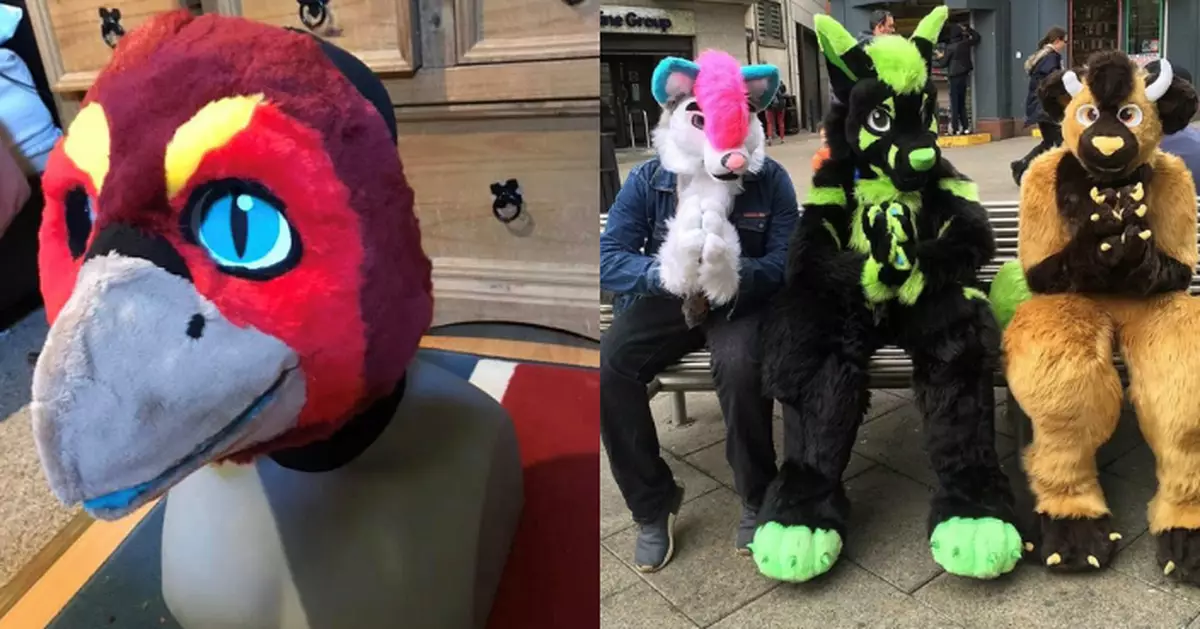
Nervous Sophie Whitehead, 18, has cured her chronic social anxiety by joining a movement of ‘furries’ and wearing a top-to-toe animal suit.

BODY

A nervous teenager has cured her chronic social anxiety by joining a movement of ‘furries’ and assuming the alter ego of a wolf with human characteristics called Cosmo – performing everyday tasks dressed top-to-toe in an animal suit.

A talented seamstress, Sophie Whitehead, 18, of Leeds, West Yorkshire, has even put her textiles BTEC to good use by running up suits for fellow ‘furries,’ who she charges up to £1,100 a time for a bespoke costume.

Struggling throughout life to make friends, Sophie told how everything changed when she stumbled across YouTube videos featuring the ‘furry fandom’ – a subculture of people who like to dress and behave as animals with human characteristics.

Now making a living creating costumes for fellow ‘furries’, having transformed her bedroom at her mum’s house where she lives into a workshop, she said: “I was drawn to the furry community as a way to escape everyday life.

“I have quite bad social anxiety, which makes me awkward and hard to talk to.

“Now I have a second furry family that I see in – and out – of my fur suit, it’s been a lot like therapy.”

A loner until she discovered the ‘furry fandom’ on YouTube aged 16, the community has improved her confidence and even given her an income.

“I was always on my own – a bit of a loner – and to pass the time I watched a lot of animal videos,” Sophie recalled.

“I’d watch cats and dogs doing silly things. Then one day a video about furries popped up in my suggested videos.”

“After watching it, I wanted to delve deeper and here I am, two years later, a fully-fledged furry,” she added.

Starting out by talking to other ‘furries’ online through social media and forums, three months later, Sophie splashed out £100 to order a fur suit head online.

She said: “The online community was a great place to talk, not just about furries but about feelings and hardships.”

“I found for the first time I could talk about my social anxiety and how I felt alone, and other people completely understood,” she continued.

“So, eventually, I ordered a wolf’s head online from America, but when it arrived, I realised it wasn’t very good at all.

“I stripped it back and did it up and, although looking back it was hideous, that was the start of my work as a fur suit maker.”

At first, Sophie confined her suit wearing to the family home.

She said: “It was quite scary trying it on for the first time.  It’s a lot different seeing it online and on YouTube.

“You always see them from the outside, so being inside one, it can be overwhelming how warm it is.”

“It’s like wearing an incredibly thick onesie in the middle of summer, so you have to build up your endurance to how long you can wear it,” she continued.

“I have to wear a cool down vest to keep my temperate down as it gets very hot, but it’s worth it for the fun.

“I used to only be able to wear it for 10 minutes, but now I can do two or three hours depending on the weather.”

She added: “Going to the toilet can be a bit of a nightmare, too, so you always go before or after climbing in. Fur suits in the bathroom are a big no no because it takes about 10 minutes to take it off and another 20 minutes to put it back on.”

Describing her family’s reaction, Sophie explained how, at first, her mum was concerned about the motivation behind ‘furry fandom.’

“I mostly wore my suit around the house, but my mum, Angela, a cleaner, didn’t understand what it was about at all,” Sophie said.

She continued: “She was a bit lost for words when she saw me in the fur suit for the first time, she sort of just looked at me and went, ‘Oh my.’

“I was so excited to get it I wasn’t paying much attention but I could see the confusion in her face, even though I’d told her about the wolf’s head prior to wearing it.”

“It was quite weird with her, which I understand. She was worried it might have been some sexual thing that I’d got in to, but I explained to her that it wasn’t about that.”

She added: “I told her it was just for fun, but it didn’t take her long to see how it was helping my social anxiety.

“Part of it’s down to being able to identify with a whole community of people for the first time and on the other side of things I am able to escape from everyday life and hide behind Cosmo’s persona.”

Three months later, Sophie sold the first wolf’s head for £100 on eBay, saying she “didn’t identify with the character” properly, and started searching on social media for a ‘furry’ she felt at home with.

“I saw Cosmo on a Facebook page and I fell in love with his design – his colours in particular really stood out, which is something I’ve never liked to do,” she recalled.

“It’s hard to explain, but Cosmo’s the kind of person that I want to be.

“He looks awesome and confident – the total opposite of me – and when I put him on I feel like I can push away my shyness to become those things.”

Splashing out £400 for the whole suit from a Facebook seller, a week after it arrived, in December 2017, Sophie went to her first meet up, where “60 or so” ‘furries’ from the surrounding area gathered together in a local pub to have a drink and a dance.

“It was really scary not knowing anybody,” she said. “I wasn’t sure my newfound confidence as Cosmo would pay off but it really did.

“Stepping out as Cosmo for the first time it was something totally different and despite the nerves it’s a moment I’ll always remember.”

“He isn’t big into talking, that’s how his character played out in my mind, but that doesn’t stop him socialising and making friends,” she continued.

“He’s outgoing and likes to be the centre attention – in a nice way. He will use hand gestures and body language to portray his coolness, like waving his hands around and slouching against walls.

“Luckily, I didn’t have to walk to my first meetup in public, I got dropped off by my mum and changed into my outfit at the venue, but it turns out most of the public react well when they see it.”

“Although it can be quite scary when people think they can grab you because you’re dressed up – especially when you don’t have your peripheral vision, because of the fur suit,” she added.

Now going to monthly ‘furry’ meet ups in Leeds city centre, Sophie has also developed a strong circle of friends, who she sees every week.

“We’ll go for drinks and dinner or out to the cinema – anything you’d normally do at a social,” she explained.

“We normally start off a meet up by going to a bar in our fur suits, but we will take them off later in the day, depending on what we’re all up to,” she added.

“I’ve made friends I think I will keep for life through the community. I even have two furries coming over on Christmas Day, although I’m not sure we’ll be suited up!”

Being part of the ‘furry fandom’ has transformed Sophie’s life.

She said: “When I’m in my fur suit I don’t feel like Sophie Whitehead, I turn into Cosmo.

“He’s separate from me and I’m separate from him. It feels like a release and there’s no pressure whatsoever.”

Hoping to help “other misfits find their pack,” in mid-2018 Sophie started creating and selling fur suits and parts for potential ‘furries’.

Converting part of her attic room into a workshop, she has two sewing machines, a large work desk and a chest of drawers full of fake fur, foam padding and vinyl.

“I spend about five hours a day working on different fur suits – it’s a very long process,” she said.

“I don’t often make full suits, I’ll do paws and heads, and it’s always to order.”

“I have made a full fur suit which I sold for about £1,100 but it varies from suit to suit,” she continued.

“My mum’s been a great help in it all, especially with the business side of things.”

Admitting she does not recognise the girl she used to be before becoming a ‘furry’, Sophie hopes speaking out will explain why it appeals.

“People are so often scared of things that are different and want to label or spoil them,” she said.

“TV programmes and popular culture portray being a furry as a sexual thing but as far as I know that’s not the case at all. It certainly isn’t in the furry circles I’m part of – it’s all about fun.

“I’ve made friends I think I will keep for life through the community. I even have two furries coming over on Christmas Day, although I’m not sure we’ll be suited up!”

She concluded:  “Even my mum thinks it’s great and sees that it’s given me a way to be myself and make friends – and it’s all thanks to Cosmo.”

SEOSAN, South Korea (AP) — Hwang Seong-yeol stood at the edge of a golden field, watching nervously as a combine harvester crawled through his rice, churning up mud and stalks. Its steady hum filled the damp autumn air as grain poured into a truck waiting at the other end of the muddy paddy.

It was the final day of what Hwang said was one of his toughest seasons in three decades of farming. He and other farmers feel helpless against increasingly erratic weather that they link to climate change and damage to their crops. It has complicated their work and cast uncertainty over their futures.

Hwang is one of five South Korean farmers who recently sued the state utility Korea Electric Power Corporation and its power-generating subsidiaries, alleging that their reliance on coal and other fossil fuels has accelerated climate change and damaged their crops.

The lawsuit raises questions about whether power companies’ role in driving climate change, and the resulting agricultural losses, can be quantified. It is the first of its kind in South Korea, said Yeny Kim, a lawyer with the Seoul-based nonprofit Solutions for Our Climate, who is handling the case.

The case underscores the challenges South Korea, a manufacturing power that industrialized long after the Western nations now pressuring others to abandon fossil fuels, faces in transitioning to cleaner energy.

Hwang's fields are on a reclaimed coastal plain along South Korea’s western sea, where glimmering waterways crisscross dark, rich soil and flocks of migratory geese drift overhead, moving like a giant, living quilt.

A remarkably rainy September and October followed a bitterly cold spring that stunted plant growth. Summer floods caused further damage before the wet autumn bred fungal disease.

Hwang would have preferred to harvest in drier weather but had to do so sooner as relentless rains pushed rice stalks into the soil, causing the ripe grains to sprout. That day in late October was only the second dry day after 18 straight days of rain.

“It’s really unsettling – we know how much rice we should normally get from 30,000 pyeong (25 acres) of land, but the yield has been steadily declining every year,” said Hwang, who expects this year’s harvest to be 20% to 25% below normal.

“We began to question why it’s always the farmers — who haven’t done anything wrong — that end up suffering the consequences of the climate crisis. Shouldn’t we be demanding something from those who are actually causing it?”

Farmers are “inherently vulnerable" to climate change, said Kim, the lawyer.

In an annual climate report in April, South Korea’s government detailed how a year of extreme weather events in 2024, the country’s hottest year ever, triggered a series of “agricultural disasters” of heavy summer rains that destroyed thousands of hectares (acres) of cropland, followed by weeks of intense heat that wrecked still more crops, mostly rice.

Kim and her colleagues decided to file the lawsuit, which represents plaintiffs from across South Korea, after speaking with Hwang and others at farmers markets.

They say KEPCO, which holds a monopoly on electricity transmission and fully owns its subsidiaries, should bear some blame for the destabilized weather, citing what they say are excessive carbon emissions and a lagging transition to renewable energy.

From 2011-2022, the companies produced about 30% of South Korea’s greenhouse gas emissions and roughly 0.4% of global emissions, based on Kim's analysis of publicly available data.

“Therefore, they should also bear 0.4% of the responsibility for the farmers’ losses,” Kim said.

The lawsuit seeks initial damage claims of 5 million won ($3,400) per client, an amount likely to be adjusted as the case proceeds. The plaintiffs are also symbolically seeking 2,035 won ($1.4) each to urge the government to phase out coal power plants by 2035, ahead of its 2040 target.

Renewable energy accounted for only 10.5% of the national energy mix in 2024, and the five KEPCO subsidiaries relied on coal for more than 71% of the electricity they produced that year, according to government data.

KEPCO told The Associated Press it considers carbon reduction a key responsibility, citing its goal of cutting emissions 40% by 2030 from 2018 levels. But it declined to comment further on the lawsuit, saying it “cannot share information that could influence the verdict.”

Experts say mounting debt, now at over 200 trillion won ($137 billion), that accumulated over decades of government policies that kept electricity rates low for households and industries, limits the utility's ability to expand and modernize the power grid or invest in renewable energy.

Yun Sun-Jin, a professor at Seoul National University, said the lawsuit has symbolic value but questioned whether blame could fall solely on KEPCO, given that everyone benefits from its cheap electricity.

It would be difficult to prove the utility directly caused farm losses, when climate change is a “global problem,” she said.

It does draw attention to South Korea's need for a more effective approach to renewable energy, Yun said, including deregulating solar investments, expanding sources such as offshore wind, and ending KEPCO’s monopoly over electricity transmission to encourage other competitors with diverse technologies.

South Korea is expected to reach its target of 32.95% renewable energy by around 2038 — far slower than the 33.49% average in 2023 among developed economies in the Organization for Economic Cooperation and Development, according to the Institute for Energy Economics and Financial Analysis.

Some experts, including Yun, warn that South Korea’s slow shift to renewable energy could hinder its ambitions in advanced semiconductors and artificial intelligence, as its tech giants face global pressure to operate on clean power.

“Climate change and carbon neutrality are not just environmental concerns — they are economic issues, ultimately about jobs and our survival,” Yun said.

The impact of extreme weather resulting from climate change is far reaching in South Korea.

Farmers now face higher costs and must use more labor to produce the same or lower yields.

Ma Yong-un, an apple farmer in the southeastern town of Hamyang, said he is using more pesticides as pests and diseases become harder to control due to prolonged heat and humidity. The apples that thrived in cooler weather during his father's days are less plentiful and tasty, he said.

From tangerine farmers on Jeju island to strawberry growers in Sancheong to the southeast, farmers are trying to devise ways to survive.

For the first time since he began farming in 2011, Ma coated all the fruit on his 2,200 trees with a mixture of copper sulfate and lime to prevent fungal infections and skin damage from intense sunlight.

He began to think seriously about climate change in 2018, when a heavy April snowstorm damaged flower buds, leading to one of his worst harvests. Farming is becoming harder each year and he constantly wonders how much longer he can carry on.

“I think about that every day,” said Ma, who is raising two teenage boys with his wife. “The biggest concern is my children.”

A farmer works at a rice paddy in Seosan, South Korea, Monday, Oct. 20, 2025. (AP Photo/Ahn Young-joon)

A farmer works at a rice paddy in Seosan, South Korea, Monday, Oct. 20, 2025. (AP Photo/Ahn Young-joon)

Hwang Seong-yeol, a South Korean rice farmer, shows crops damaged by a fungal disease that spread during an abnormally rainy autumn at his rice paddy in Seosan, South Korea, Monday, Oct. 20, 2025. (AP Photo/Ahn Young-joon)

Hwang Seong-yeol, a South Korean rice farmer, shows crops damaged by a fungal disease that spread during an abnormally rainy autumn at his rice paddy in Seosan, South Korea, Monday, Oct. 20, 2025. (AP Photo/Ahn Young-joon)

Farmers use combine harvesters at a rice paddy of farmer Hwang Seong-yeol in Seosan, South Korea, Monday, Oct. 20, 2025. (AP Photo/Ahn Young-joon)

Farmers use combine harvesters at a rice paddy of farmer Hwang Seong-yeol in Seosan, South Korea, Monday, Oct. 20, 2025. (AP Photo/Ahn Young-joon)

A general view of the Dangjin Power Station is seen in Dangjin, South Korea, Monday, Oct. 20, 2025. (AP Photo/Ahn Young-joon)

A general view of the Dangjin Power Station is seen in Dangjin, South Korea, Monday, Oct. 20, 2025. (AP Photo/Ahn Young-joon)

Hwang Seong-yeol, a South Korean rice farmer, watches crops damaged by a fungal disease that spread during an abnormally rainy autumn at his rice paddy in Seosan, South Korea, Monday, Oct. 20, 2025. (AP Photo/Ahn Young-joon)

Hwang Seong-yeol, a South Korean rice farmer, watches crops damaged by a fungal disease that spread during an abnormally rainy autumn at his rice paddy in Seosan, South Korea, Monday, Oct. 20, 2025. (AP Photo/Ahn Young-joon)

Recommended Articles