
Skip to Content Facebook Feature Image

Trump aims to box in Biden abroad, but it may not work

News

Trump aims to box in Biden abroad, but it may not work
News

News

Trump aims to box in Biden abroad, but it may not work

2020-11-23 13:05 Last Updated At:13:10

On its way out the door, the Trump administration is enacting new rules, regulations and orders that it hopes will box in President-elect Joe Biden's administration on numerous foreign policy matters and cement President Donald Trump’s “America First” legacy in international affairs.

Yet, the push may not work, as many of these decisions can be withdrawn or significantly amended by the incoming president when he takes office on Jan. 20.

In recent weeks, the White House, State Department and other agencies have been working overtime to produce new policy pronouncements on Iran, Israel, China and elsewhere that aim to lock in Trump's vision for the world. Some have attracted significant attention while others have flown largely under the radar.
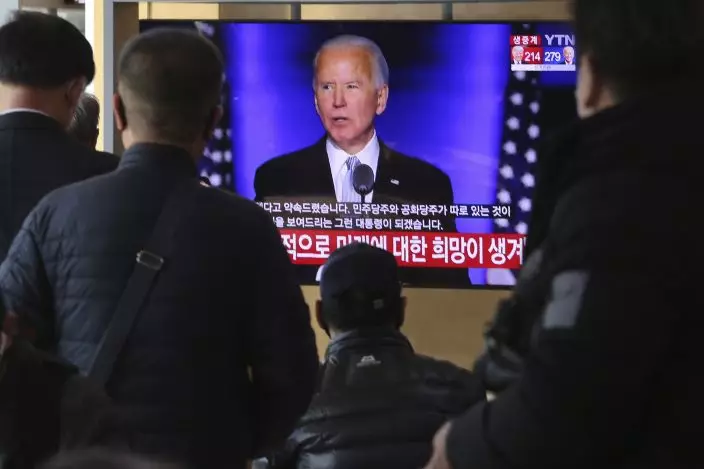
FILE - In this Nov. 8, 2020, file photo people watch a TV screen showing the live-broadcast of President-elect Joe Biden speaking, at the Seoul Railway Station in Seoul, South Korea. (AP PhotoAhn Young-joon, File)

FILE - In this Nov. 8, 2020, file photo people watch a TV screen showing the live-broadcast of President-elect Joe Biden speaking, at the Seoul Railway Station in Seoul, South Korea. (AP PhotoAhn Young-joon, File)

And, while Biden could reverse many of them with a stroke of the pen, some will demand the time and attention of his administration when it comes into power with a host of other priorities that perhaps need more urgent attention.

The most recent of these moves took place this past week as Secretary of State Mike Pompeo made what may be his last visit to Israel as secretary of state and delivered two announcements in support of Israel's claims to territory claimed by the Palestinians.

Biden's team has remained silent about these announcements, but Biden has made clear he supports few, if any, of them and will reverse many as he intends to return to a more traditional policy toward Israel and the Palestinians.
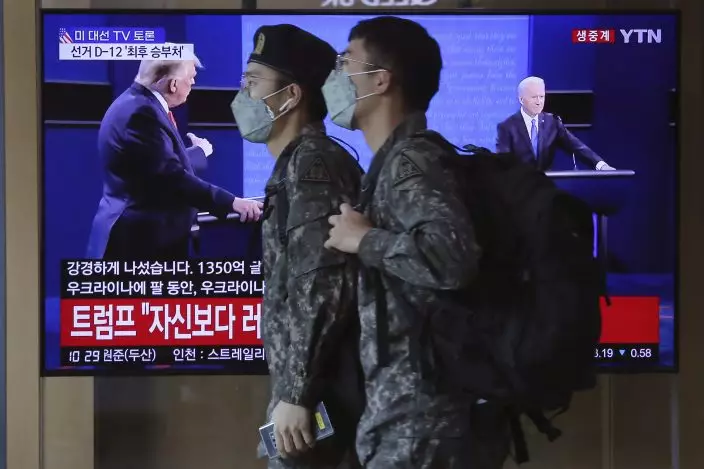
FILE - In this Oct. 23, 2020, file photo South Korean army soldiers pass by a TV screen showing a live broadcast of U.S. President Donald Trump, left, and Democratic presidential candidate former Vice President Joe Biden during the final presidential debate, at the Seoul Railway Station in Seoul, South Korea. The Korean letters read "U.S. presidential election TV debate." (AP PhotoAhn Young-joon, File)

FILE - In this Oct. 23, 2020, file photo South Korean army soldiers pass by a TV screen showing a live broadcast of U.S. President Donald Trump, left, and Democratic presidential candidate former Vice President Joe Biden during the final presidential debate, at the Seoul Railway Station in Seoul, South Korea. The Korean letters read "U.S. presidential election TV debate." (AP PhotoAhn Young-joon, File)

The Trump administration’s determined efforts to thwart potential Biden policy reversals actually began months earlier, half a world away from the Jewish state, with China, even before the former vice president was formally declared the Democratic Party’s presidential nominee.

As opinion polls started to show Biden as a clear favorite to beat Trump in November, the administration began to move even as the president maintained a public face of defiance and absolute confidence in his reelection.

Some officials point to a July 13 declaration from Pompeo that the United States would now reject virtually all of China's territorial claims in the South Chine Sea, a 180-degree shift from previous administrations' positions that all such claims should be handled by arbitration.
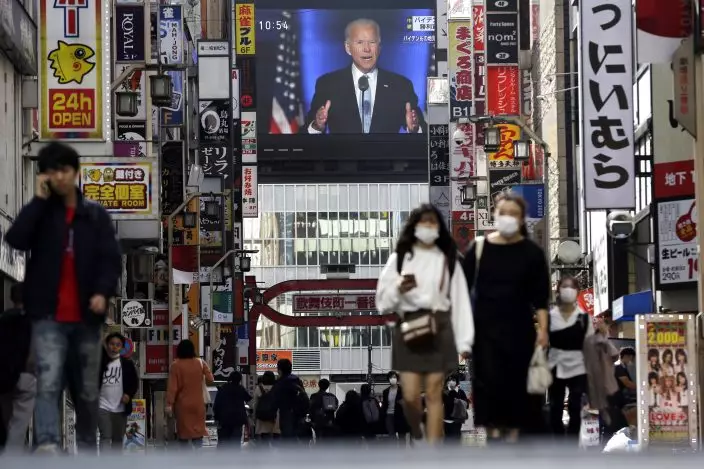
FILE - In this Nov. 8, 2020, file photo a screen shows a live broadcast of President-elect Joe Biden speaking at the Shinjuku shopping district in Tokyo. (AP PhotoKiichiro Sato, File)

FILE - In this Nov. 8, 2020, file photo a screen shows a live broadcast of President-elect Joe Biden speaking at the Shinjuku shopping district in Tokyo. (AP PhotoKiichiro Sato, File)

While many of Trump’s foreign policy decisions from early on have been designed to blow up the previous administration's foreign policy achievements — withdrawing from the Iran nuclear deal, the Paris Climate Accord and the Trans Pacific Partnership on trade — the South China Sea decision was the first to be linked by administration officials to the possibility that Biden might be the next president.

One administration official said at the time that decisions made after that would all be taken with an eye toward Biden becoming president. Thus, the fear that Trump might be a one-term president began to take hold in July and has been followed by an acceleration of pronouncements aimed mainly at thwarting any reversal by Biden.

A look at some of those moves:

ISRAEL

On Thursday, before making an unprecedented trip to an Israeli settlement in the West Bank, Pompeo announced that the U.S, would henceforth consider “antisemitic” the groups that advocate for Palestinian rights by supporting the Boycott, Divestment and Sanctions movement against Israel.

He also announced a change in import labeling rules that will require products made in settlements to be identified as “Made in Israel.” The product labeling will take some time to take effect and, as yet, no groups have been hit with the antisemitic designation. But, even if they are implemented, Biden could reverse them on Day One.

Those moves followed numerous other Israel-friendly steps the administration has taken since it came to office. They include recognizing Jerusalem as the capital, moving the U.S. Embassy there from Tel Aviv, and cutting off aid to the Palestinian Authority and the U.N. refugee agency that works with Palestinians. While Biden is unlikely to move the embassy back to Tel Aviv, the other measures can be reversed quickly.

IRAN

Pompeo and other officials have spoken of a new push for sanctions against Iran, but the fact is that the administration has been ramping up such penalties since Trump withdrew from the 2015 nuclear deal two years ago. New sanctions could potentially target supporters of Iranian-backed militia in Iraq and Afghanistan along with the Shiite Houthi movement in Yemen, which has been involved in a disastrous war with the country's internationally recognized government.

Biden has spoken of wanting to rejoin the nuclear accord, and Iranian officials have said they would be willing to come back into compliance with the accord if he does. Biden could eliminate many of the Trump administration's reimposed sanctions by executive order, but it remains unclear how high a priority it will be for him.

BROADER MIDDLE EAST

While the withdrawal of significant numbers of U.S. forces from Afghanistan and Iraq — bringing troop levels down to 2,500 in each country — is a clear indication of Trump's intentions, Biden's approach remains less certain. The withdrawals could be delayed or slow-rolled by the Pentagon, and it remains unclear how the State Department will handle staffing at its embassies in Baghdad and Kabul, both of which are dependent on U.S. military support.

Pompeo has threatened to close the U.S. Embassy in Baghdad unless rocket attacks by Iranian-backed militias against the area in which it's located are halted. However, despite the troop withdrawal determination last week, there has been no announcement about the embassy's status.

CHINA

Although the administration's most strident actions against China began more than a year ago, they have gained momentum since March, when Trump determined that he would at once blame China for the spread of the novel coronavirus and accuse Biden of being soft on Beijing.

Since then, the administration has steadily ramped up sanctions against China over Taiwan, Tibet, trade, Hong Kong and the South China Sea. It has also moved against the Chinese telecoms giant Huawei and sought restrictions on Chinese social media applications like TikTok and WeChat.

Last week, the State Department's policy planning office released a 70-page China policy strategy document. While it contains little in the way of immediate policy recommendations, it advocates for increased support and cooperation with Taiwan. Indeed, as the document was released, U.S. officials were meeting with Taiwanese counterparts in Washington to discuss economic cooperation.

RUSSIA

Sunday marked the formal withdrawal of the U.S. from the “Open Skies Treaty” with Russia, which allowed each country overflight rights to inspect military facilities. The withdrawal, six months after the U.S. notified the Russians of its intent, leaves only one arms-control pact still in force between the former Cold War foes — the New START treaty, which limits the number of nuclear warheads each may have. That treaty will expire in February.

The Trump administration had said it wasn't interested in extending the New START treaty unless China also joined, something Beijing has rejected. In recent weeks, however, the administration has eased its stance and said it's willing to consider an extension. As the transition to the Biden administration approaches, those negotiations remain a work in progress.

NUUK, Greenland (AP) — Troops from several European countries continued to arrive in Greenland on Thursday in a show of support for Denmark as talks between representatives of Denmark, Greenland and the U.S. highlighted “fundamental disagreement” over the future of the Arctic island.

Denmark announced it would increase its military presence in Greenland on Wednesday as foreign ministers from Denmark and Greenland were preparing to meet with White House representatives in Washington. Several European partners — including France, Germany, the U.K., Norway, Sweden and the Netherlands — started sending symbolic numbers of troops already on Wednesday or promised to do so in the following days.

The troop movements were intended to portray unity among Europeans and send a signal to President Donald Trump that an American takeover of Greenland is not necessary as NATO together can safeguard the security of the Arctic region amid rising Russian and Chinese interest.

“The first French military elements are already en route” and “others will follow,” French President Emmanuel Macron announced Wednesday, as French authorities said about 15 soldiers from the mountain infantry unit were already in Nuuk for a military exercise.

Germany will deploy a reconnaissance team of 13 personnel to Greenland on Thursday, the Defense Ministry said.

On Thursday, Danish Defense Minister Troels Lund Poulsen said the intention was “to establish a more permanent military presence with a larger Danish contribution,” according to Danish broadcaster DR. He said soldiers from several NATO countries will be in Greenland on a rotation system.

Danish Foreign Minister Lars Løkke Rasmussen, flanked by his Greenlandic counterpart Vivian Motzfeldt, said Wednesday that a “fundamental disagreement” over Greenland remains with Trump after they held highly anticipated talks at the White House with Vice President JD Vance and Secretary of State Marco Rubio.

Rasmussen added that it remains “clear that the president has this wish of conquering over Greenland” but that dialogue with the U.S. would continue at a high level over the following weeks.

Inhabitants of Greenland and Denmark reacted with anxiety but also some relief that negotiations with the U.S. would go on and European support was becoming visible.

Greenland's Prime Minister Jens-Frederik Nielsen welcomed the continuation of “dialogue and diplomacy.”

“Greenland is not for sale,” he said Thursday. “Greenland does not want to be owned by the United States. Greenland does not want to be governed from the United States. Greenland does not want to be part of the United States.”

In Greenland’s capital, Nuuk, local residents told The Associated Press they were glad the first meeting between Greenlandic, Danish and American officials had taken place but suggested it left more questions than answers.

Several people said they viewed Denmark’s decision to send more troops, and promises of support from other NATO allies, as protection against possible U.S. military action. But European military officials have not suggested the goal is to deter a U.S. move against the island.

Maya Martinsen, 21, said it was “comforting to know that the Nordic countries are sending reinforcements” because Greenland is a part of Denmark and NATO.

The dispute, she said, is not about “national security” but rather about “the oils and minerals that we have that are untouched.”

On Wednesday, Poulsen announced a stepped-up military presence in the Arctic “in close cooperation with our allies,” calling it a necessity in a security environment in which “no one can predict what will happen tomorrow.”

“This means that from today and in the coming time there will be an increased military presence in and around Greenland of aircraft, ships and soldiers, including from other NATO allies,” Poulsen said.

Asked whether the European troop movements were coordinated with NATO or what role the U.S.-led military alliance might play in the exercises, NATO referred all questions to the Danish authorities. However, NATO is currently studying ways to bolster security in the Arctic.

The Russian embassy in Brussels on Thursday lambasted what it called the West's “bellicose plans” in response to “phantom threats that they generate themselves”. It said the planned military actions were part of an “anti-Russian and anti-Chinese agenda” by NATO.

“Russia has consistently maintained that the Arctic should remain a territory of peace, dialogue and equal cooperation," the embassy said.

Rasmussen announced the creation of a working group with the Americans to discuss ways to work through differences.

“The group, in our view, should focus on how to address the American security concerns, while at the same time respecting the red lines of the Kingdom of Denmark,” he said.

Commenting on the outcome of the Washington meeting on Thursday, Poulsen said the working group was “better than no working group” and “a step in the right direction.” He added nevertheless that the dialogue with the U.S. did not mean “the danger has passed.”

Speaking on Thursday, Danish Prime Minister Mette Frederiksen said the American ambition to take over Greenland remains intact despite the Washington meeting, but she welcomed the creation of the working group.

The most important thing for Greenlanders is that they were directly represented at the meeting in the White House and that “the diplomatic dialogue has begun now,” Juno Berthelsen, a lawmaker for the pro-independence Naleraq opposition party, told AP.

A relationship with the U.S. is beneficial for Greenlanders and Americans and is “vital to the security and stability of the Arctic and the Western Alliance,” Berthelsen said. He suggested the U.S. could be involved in the creation of a coastguard for Greenland, providing funding and creating jobs for local people who can help to patrol the Arctic.

Line McGee, 38, from Copenhagen, told AP that she was glad to see some diplomatic progress. “I don’t think the threat has gone away,” she said. “But I feel slightly better than I did yesterday.”

Trump, in his Oval Office meeting with reporters, said: “We’ll see how it all works out. I think something will work out.”

Niemann reported from Copenhagen, Denmark, and Ciobanu from Warsaw, Poland.

Denmark's Foreign Minister Lars Løkke Rasmussen and Greenland's Foreign Minister Vivian Motzfeldt speak at a news conference at the Embassy of Denmark, Wednesday, Jan. 14, 2026, in Washington. (AP Photo/John McDonnell)

Denmark's Foreign Minister Lars Løkke Rasmussen and Greenland's Foreign Minister Vivian Motzfeldt speak at a news conference at the Embassy of Denmark, Wednesday, Jan. 14, 2026, in Washington. (AP Photo/John McDonnell)

People walk on a street in Nuuk, Greenland, Wednesday, Jan. 14, 2026. (AP Photo/Evgeniy Maloletka)

People walk on a street in Nuuk, Greenland, Wednesday, Jan. 14, 2026. (AP Photo/Evgeniy Maloletka)

From center to right, Greenland Foreign Minister Vivian Motzfeldt, Denmark's Ambassador Jesper Møller Sørensen, rear, and Danish Foreign Minister Lars Løkke Rasmussen, right, arrive on Capitol Hill to meet with senators from the Arctic Caucus, in Washington, Wednesday, Jan. 14, 2026. (AP Photo/J. Scott Applewhite)

From center to right, Greenland Foreign Minister Vivian Motzfeldt, Denmark's Ambassador Jesper Møller Sørensen, rear, and Danish Foreign Minister Lars Løkke Rasmussen, right, arrive on Capitol Hill to meet with senators from the Arctic Caucus, in Washington, Wednesday, Jan. 14, 2026. (AP Photo/J. Scott Applewhite)

An Airbus A400M transport aircraft of the German Air Force taxis over the grounds at Wunstorf Air Base in the Hanover region, Germany, Thursday, Jan. 15, 2026 as troops from NATO countries, including France and Germany, are arriving in Greenland to boost security. (Moritz Frankenberg/dpa via AP)

An Airbus A400M transport aircraft of the German Air Force taxis over the grounds at Wunstorf Air Base in the Hanover region, Germany, Thursday, Jan. 15, 2026 as troops from NATO countries, including France and Germany, are arriving in Greenland to boost security. (Moritz Frankenberg/dpa via AP)

Fishermen load fishing lines into a boat in the harbor of Nuuk, Greenland, Wednesday, Jan. 14, 2026. (AP Photo/Evgeniy Maloletka)

Fishermen load fishing lines into a boat in the harbor of Nuuk, Greenland, Wednesday, Jan. 14, 2026. (AP Photo/Evgeniy Maloletka)

Greenland Foreign Minister Vivian Motzfeldt, left, and Danish Foreign Minister Lars Løkke Rasmussen, arrive on Capitol Hill to meet with members of the Senate Arctic Caucus, in Washington, Wednesday, Jan. 14, 2026. (AP Photo/J. Scott Applewhite)

Greenland Foreign Minister Vivian Motzfeldt, left, and Danish Foreign Minister Lars Løkke Rasmussen, arrive on Capitol Hill to meet with members of the Senate Arctic Caucus, in Washington, Wednesday, Jan. 14, 2026. (AP Photo/J. Scott Applewhite)

Recommended Articles