A Florida judge sentenced a 21-year-old man to 24 years in prison for killing an Ohio mother and her young daughter in a 2018 traffic crash.
Hillsborough Circuit Judge Christopher Nash heard hours of testimony on Thursday before announcing his decision to send Cameron Herrin to prison.
“It’s impossible to have greater harm than occurred in this case,” the judge said.
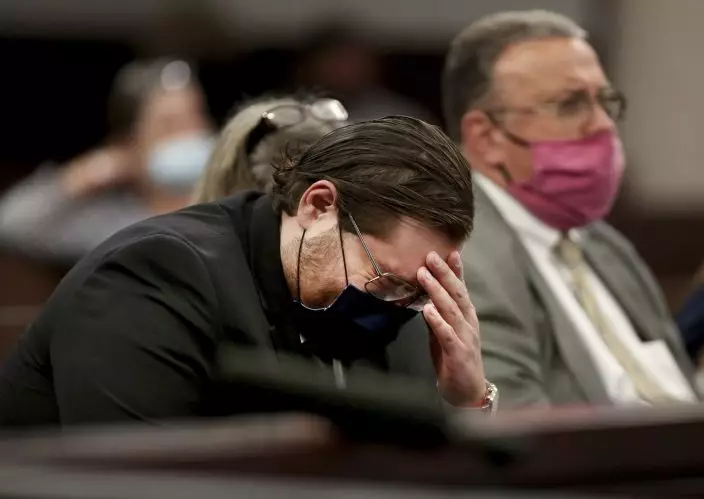
David Raubenolt, center, reacts as his brother shares a victim impact statement during Cameron Herrin's sentencing hearing on Thursday, April 8, 2021, at the Hillsborough County Edgecomb Courthouse before 13th Judicial Circuit Court Judge Christopher Nash in downtown Tampa, Fla. Herrin was sentenced to 24 years in prison for killing Raubenolt's wife and young daughter in a 2018 traffic crash. (Douglas R. CliffordTampa Bay Times via AP)
Herrin's family members began to weep as sheriff's deputies placed him in handcuffs after the hearing, the Tampa Bay Times reported.
“I feel responsible for this accident,” Herrin's mother, Cheryl Herrin, told the judge on Thursday. “If I could, I would step in front of Cameron, and I would accept the punishment you might render.”
Herrin hit Jessica Reisinger-Raubenolt and her 1-year-old daughter Lillia with the Mustang he'd received for his high school graduation two days earlier. They were visiting Tampa from Jeromesville, Ohio.
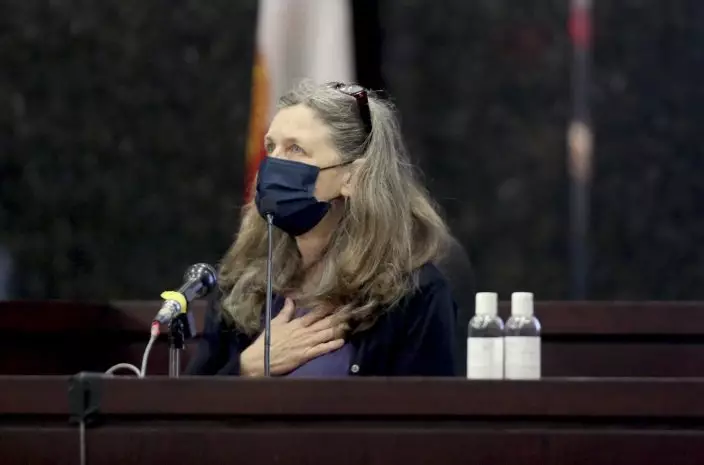
Pamela Reisinger, mother of Jessica Reisinger-Raubenolt, recalls memories of her daughter while giving her victim impact statement at Cameron Herrin's sentencing hearing on Thursday, April 8, 2021, at the Hillsborough County Edgecomb Courthouse before 13th Judicial Circuit Court judge Christopher Nash in downtown Tampa, Fla. Herrin was sentenced to 24 years in prison for killing the Ohio mother and her young daughter in a 2018 traffic crash. (Douglas R. CliffordTampa Bay Times via AP)
He was heading to a gym on the morning of May 23, 2018. Witnesses later told investigators that Herrin and his friend John Barrineau, who was driving a Nissan, appeared to be racing on Tampa's Bayshore Boulevard. Police said Reisinger-Raubenolt, 24, was pushing her daughter in a stroller when Herrin's car hit them.
Barrineau also pleaded guilty and is serving a six-year prison sentence, WFTS reported.
Prosecutors presented evidence that the Mustang topped 100 mph (160 kph) moments before the crash, rapidly decelerating to 30 and 40 mph (48 and 64 kph) at the time of impact.
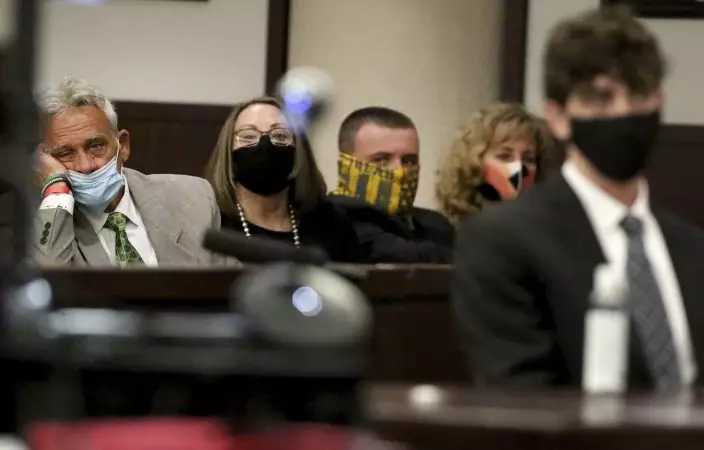
Cameron Herrin's family from left: father Chris Herrin, mother Cheryl Herrin, brother Tristan Herrin and aunt Kim Salter attend a sentencing hearing for Herrin, right, on Thursday, April 8, 2021, at the Hillsborough County Edgecomb Courthouse before 13th Judicial Circuit Court Judge Christopher Nash in downtown Tampa, Fla. Herrin was sentenced to 24 years in prison for killing an Ohio mother and her young daughter in a 2018 traffic crash. (Douglas R. CliffordTampa Bay Times via AP)
David Raubenolt spoke for nearly an hour, telling the court that his wife loved children and was a parent who passed out notes to airplane passengers, apologizing if their child started to cry. He said he sweats when he enters his daughter's room, where her crib remains untouched.
“It is critical for you to understand that you’ve created everlasting pain and depths of sorrow,” he said.
This story has been edited to correct the spelling of the victim's name: Reisinger-Raubenolt.
HAVANA (AP) — Cuban President Miguel Díaz-Canel said Monday that his administration is not in talks with the U.S. government, a day after President Donald Trump threatened the Caribbean island in the wake of the U.S. attack on Venezuela.
Díaz-Canel posted a flurry of brief statements on X after Trump suggested that Cuba “make a deal, BEFORE IT IS TOO LATE.” He did not say what kind of deal.
Díaz-Canel wrote that for “relations between the U.S. and Cuba to progress, they must be based on international law rather than hostility, threats, and economic coercion.”
He added: “We have always been willing to hold a serious and responsible dialogue with the various US governments, including the current one, on the basis of sovereign equality, mutual respect, principles of International Law, and mutual benefit without interference in internal affairs and with full respect for our independence.”
His statements were reposted by Cuban Foreign Minister Bruno Rodríguez on X.
On Sunday, Trump wrote that Cuba would no longer live off oil and money from Venezuela, which the U.S. attacked on Jan. 3 in a stunning operation that killed 32 Cuban officers and led to the arrest of President Nicolás Maduro.
Cuba was receiving an estimated 35,000 barrels a day from Venezuela before the U.S. attacked, along with some 5,500 barrels daily from Mexico and roughly 7,500 from Russia, according to Jorge Piñón of the Energy Institute at the University of Texas at Austin, who tracks the shipments.
On Monday, Mexican President Claudia Sheinbaum once again declined to provide data on current oil shipments or say whether such shipments would increase when Venezuelan supplies end. She insisted that the aid “has been ongoing for a long time; it’s not new.”
Sheinbaum said Mexico’s fuel supply to Cuba is not a concern for her country because “there is enough oil” — even though production of state-owned oil company Petróleos Mexicanos is steadily declining. She reiterated that her government is willing to facilitate dialogue between the U.S. and Cuba if both agree.
Even with oil shipments from Venezuela, widespread blackouts have persisted across Cuba given fuel shortages and a crumbling electric grid. Experts worry a lack of petroleum would only deepen the island's multiple crises that stem from an economic paralysis during the COVID-19 pandemic and a radical increase in U.S. sanctions following the first Trump administration, which aim to force a change in Cuba's political model.
The communist government has said U.S. sanctions cost the country more than $7.5 billion between March 2024 and February 2025, a staggering sum for an island whose tourism revenue reached some $3 billion annually at its peak in the previous decade.
The crisis also has triggered a large wave of migration primarily to the United States, where Cubans enjoyed immigration privileges as exiles. Those privileges were curtailed before Trump closed U.S. borders.
The situation between the U.S. and Cuba is “very sad and concerning,” said Andy S. Gómez, retired dean of the School of International Studies and senior fellow in Cuban Studies at the University of Miami.
He said he sees Díaz-Canel’s latest comments “as a way to try and buy a little bit of time for the inner circle to decide what steps it’s going to take.”
Gómez said he doesn’t visualize Cuba reaching out to U.S. officials right now.
“They had every opportunity when President (Barack) Obama opened up U.S. diplomatic relations, and yet they didn’t even bring Cuban coffee to the table,” Gómez said. “Of course, these are desperate times for Cuba.”
Michael Galant, senior research and outreach associate at the Center for Economic and Policy Research in Washington, D.C., said he believes Cuba might be willing to negotiate.
“Cuba has been interested in finding ways to ease sanctions,” he said. “It's not that Cuba is uncooperative.”
Galant said topics for discussion could include migration and security, adding that he believes Trump is not in a hurry.
“Trump is hoping to deepen the economic crisis on the island, and there are few costs to Trump to try and wait that out,” he said. “I don’t think it’s likely that there will be any dramatic action in the coming days because there is no rush to come to the table.”
Cuba's president stressed on X that “there are no talks with the U.S. government, except for technical contacts in the area of migration.”
As tensions remained heightened, life went on as usual for many Cubans, although some were more concerned than others.
Oreidy Guzmán, a 32- year-old food delivery person, said he doesn't want anything bad to happen to Cubans, “but if something has to happen, the people deserve change.”
Meanwhile, 37-year-old homemaker Meilyn Gómez said that while she doesn't believe the U.S. would invade Cuba, she was preparing for any possible outcome under Trump: “He'll find entertainment anywhere.”
The current situation is dominating chatter among Cubans on the island and beyond.
“Cuban people talk and talk,” said 57-year-old bartender Rubén Benítez, “but to be honest, eleven, eight or nine million will take to the streets to defend what little we have left.”
Coto reported from San Juan, Puerto Rico. Associated Press reporter María Verza in Mexico City contributed to this report.
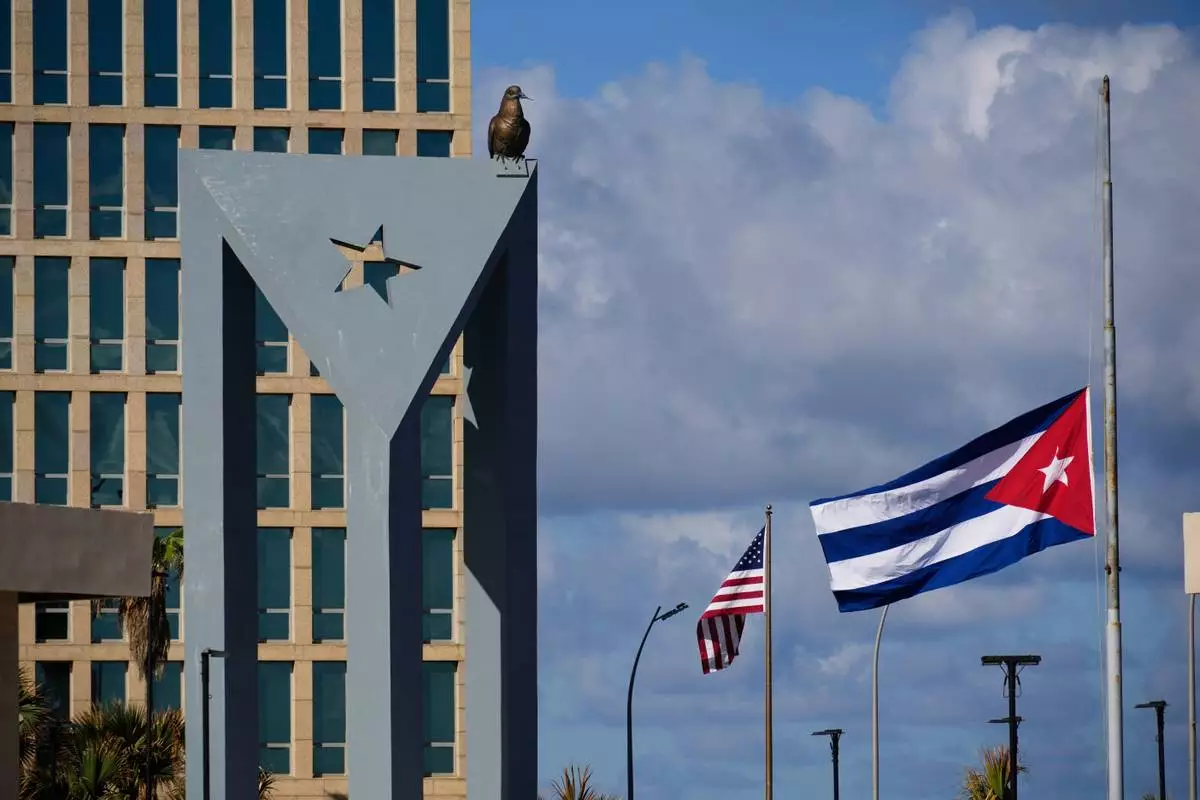
The Cuban flag flies at half-mast at the Anti-Imperialist Tribune near the U.S. embassy in Havana, Cuba, Monday, Jan. 5, 2026, in memory of Cubans who died two days before in Caracas, Venezuela during the capture of Venezuelan President Nicolas Maduro by U.S. forces. (AP Photo/Ramon Espinosa)