Skip to Content Facebook Feature Image

China's deep-sea heavy-duty mining vehicle reaches record depth in sea trials

China

China

China

China's deep-sea heavy-duty mining vehicle reaches record depth in sea trials

2024-07-09 22:14 Last Updated At:07-10 01:27

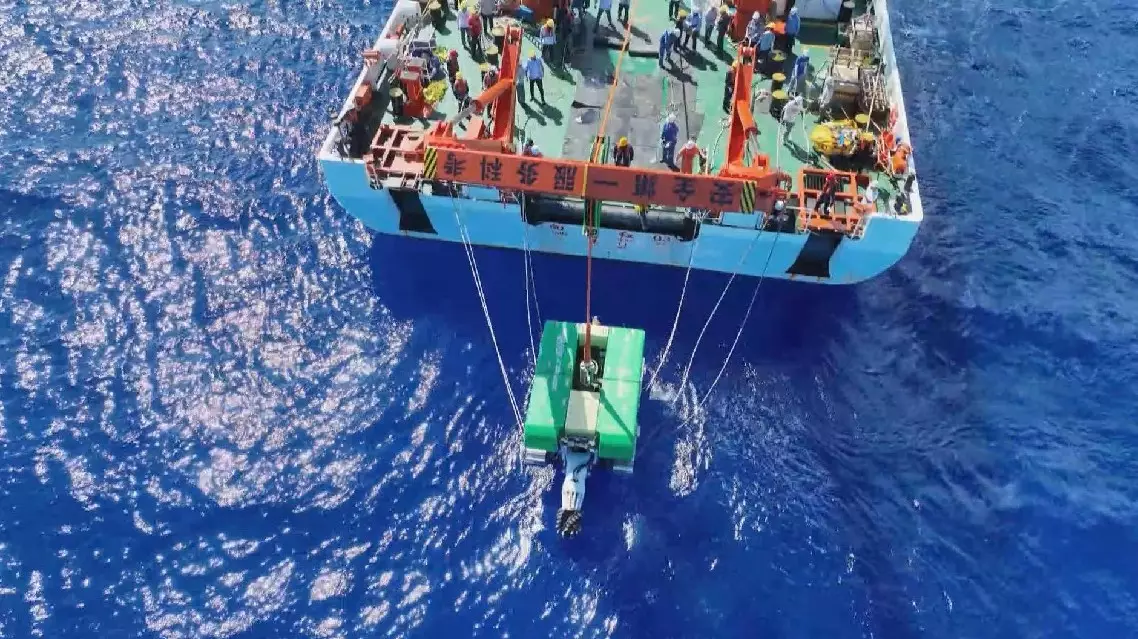
China's deep-sea heavy-duty mining vehicle "Kaituo 2" has completed sea trials at depths exceeding 4,000 meters, setting new records in deep-sea mining in China, the Shanghai municipal government said Tuesday.

Deep ocean seabed is rich in mineral resources such as polymetallic nodules, cobalt-rich crusts and polymetallic sulfides, as well as important key materials for new energy, aerospace and defense industries such as copper, cobalt, nickel and manganese.

In the deep-sea trials conducted on June 23, the vehicle, independently developed by Shanghai Jiao Tong University, successfully completed five consecutive dives in the polymetallic crust and nodule area in the western Pacific Ocean, including one dive to a depth of 4,102.8 meters.

Under various complex seabed terrain conditions such as steep and rugged underwater mountains with an average slope of more than 20 degrees and a maximum slope of 36 degrees, as well as high viscosity or soft sediment on the seabed, the vehicle completed various travel experiments, including straight-line moving, large curvature rotation in place, climbing and obstacle crossing.

"Kaituo 2 has demonstrated its powerful underwater rock drilling and collection capabilities and successfully extracted about 200 kilograms of various types of deep-sea mineral samples," said Yang Jianmin, chief scientist for Kaituo 2 equipment at Shanghai Jiao Tong University.

In order to make the vehicle move more freely, the team developed a four-track travel technology to help it adapt to complex seabed terrain. Kaituo 2 is able to autonomously sense the mining environment, and the four tracks can adjust the direction and status in real time according to the actual seabed terrain, the first domestic deep sea mine to be able to do that.

Kaituo 2 is also pioneering a composite drilling and mining technology for polymetallic crusts, nodules and sulfide and the heavy-load deployment and recovery technology for deep-sea non-metallic umbilical cables, making breakthroughs in key technologies like the comprehensive perception of deep-sea environmental sound and light and the intelligent control of seabed mining operations.

It's also equipped with comprehensive environmental monitoring equipment, which monitors the deep-sea plume and underwater noises to an international standard.

"During the sea trial, deep-sea mining vehicle Kaituo 2 successfully completed multiple and continuous deep-sea deployment and recovery and seabed mining operations, under wind force six and sea condition level four. The technical performance of the equipment fully met the design indicators, showing that the vehicle has powerful and efficient mining ability and strong climbing and obstacle-crossing capabilities," said Yang.

China is a pioneer investor and contractor in the development of international seabed mining areas, with the most exclusive exploration rights and mining priorities. It owns a total of five mining areas in various seabed areas, including the Pacific Ocean and Indian Ocean, where the reserve of strategic minerals such as manganese, nickel and cobalt can meet the country's needs in the next decades.

The success of Kaituo 2's sea trials will help China to realize the sustainable utilization and development of seabed resources as soon as possible.
China's deep-sea heavy-duty mining vehicle reaches record depth in sea trials
China's deep-sea heavy-duty mining vehicle reaches record depth in sea trials
China's benchmark Shanghai Composite Index closed almost flat on Monday amid a wide sell-off of artificial intelligence-related stocks triggered by calls from top executives of major U.S. AI developers to slow the pace of AI development, according to Timothy Pope, an analyst for China Global Television Network (CGTN).

The Shanghai Composite Index dropped 0.07 percent to 3,885.33 points on Monday, while the Shenzhen Component Index closed 0.64 percent lower at 13,384.57 points.

The ChiNext Index, tracking China's Nasdaq-style board of growth enterprises, lost 1.10 percent to close at 3,285.58 points Monday. The STAR Composite Index, which reflects the performance of stocks on China's sci-tech innovation board, closed 0.35 percent lower at 1,811.23 points.

Pope noted that despite the overall resilience of major indexes, AI hardware stocks were among the biggest losers on the day.

"The Chinese mainland markets proved pretty resilient today actually as global AI stocks wobbled. We saw oil prices jump and interest-rate hike bets rising as well. The Shanghai Composite Index ended the session pretty much flat, while the Shenzhen Component [Index] lost a little more than half of 1 percent. AI stocks around the world sank today after the Anthropic CEO Dario Amodei published an essay calling for a slowdown in the development of frontier AI models. That was also backed up by OpenAI boss Sam Altman and some other industry leaders as well. But critically for Chinese companies, Amodei also called for tighter restrictions on exports of advanced AI chips and semiconductor equipment to China. We saw AI shares on the A-share have been caught in a bit of a rotation cycle already lately, with investors switching in and out pretty aggressively from these AI hardware stocks. So that added some extra momentum to today's move out of that sector. They were falling and were one of the weaker sectors today," said Pope.

The analyst said stocks of listed big state-own banks saw an injection of capitals from investors amid AI sell-off.

"Investors took some shelter in financial stocks. The big state-owned banks were once again helping to support the Shanghai index and investors were also waiting for the latest bank-lending data, although that wasn't released before the close of the markets today. There was also a small rebalance in the STAR 50 today. A handful of new companies joined the high-tech index, but that didn't fundamentally change things for the pressured tech sector," he said.

Pope highlighted that Chinese investors will witness a slew of data release in the rest of the week, helping them to have a more comprehensive grasp of the status of the country's domestic demand.

"For the week ahead in China, it's going to be very data-heavy. Tomorrow we have a big data dump including fixed-asset investment, property data, retail sales and industrial production and that's really going to give the market some clues about the state of domestic demand after those very strong trade figures that we saw last week," he said.

Chinese stocks resilient as calls for AI slowdown trigger sell-off: analyst

Chinese stocks resilient as calls for AI slowdown trigger sell-off: analyst

Recommended Articles