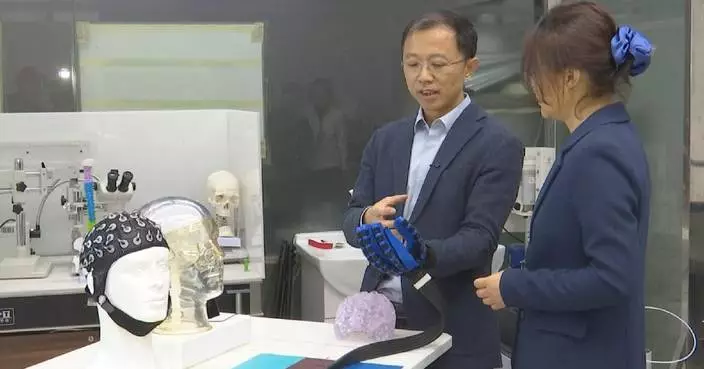
China's National Medical Products Administration (NMPA) on Monday approved the country's third medical device standard for brain-computer interfaces (BCI), the world's first product standard for BCIs that uses AI algorithms to process brainwave data.
Effective September 1, 2027, the standard will set unified requirements for the collection, processing, labeling, storage and access of brainwave data.
"The new standard provides clear technical specifications for various things. For example, how electrodes should be placed, how high the sampling frequency should be, and how data should be collected and recorded. In the future, when BCI medical devices are used, the datasets on which device training relies will be of high quality, decoding performance will be better guaranteed, and diagnosis and treatment will be safer and more effective," said Li Shu, deputy director of the medical device institute under the National Institutes for Food and Drug Control (NIFDC) and also a standard drafter.
Li underscored the standard's importance given the current fragmented state of electroencephalogram (EEG) data collection.
"Before the new standard was released, research institutions and companies used different collection methods for EEG data. Some used 64 channels, others 128 channels. Sampling frequencies also varied, with some using 2 Hz and others using 1,000 Hz. Annotation methods differed as well. The data collected this way was hard to compare and be reused," said Li.
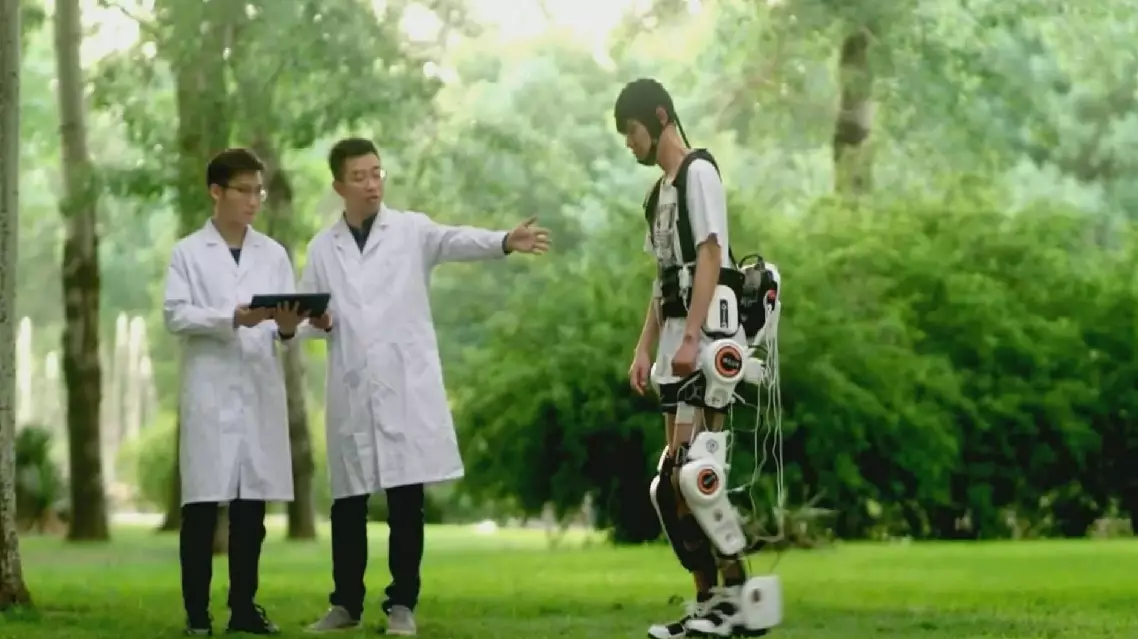
BCI medical devices function like intelligent machines that can "read" brain signals. They must "learn" from large amounts of EEG data and "train" AI algorithms to accurately understand a patient's intentions. The process is closely tied to both treatment outcomes and patient safety.
"For example, they can be used to help paralyzed patients control a robotic arm with their thoughts, or help patients with speech disorders express what they want to say. But if the quality of the data used for training is uneven -- like using blurry photos to train a facial recognition system, the device may ultimately fail to decode the patient's true intentions, affecting treatment outcomes and even posing safety risks," said Zheng Jia, deputy director of the Institute for Medical Device Standardization of the NIFDC. "
With the new standard, EEG datasets in the research and development and production of BCI medical devices will be unified.
"The new standard allows data from different research departments to be benchmarked against each other and shared for reuse. It gives research and development departments a unified quality threshold, clarifying what kind of data can be used for development. It allows production departments to trace and track EEG data generated at different times. And ultimately, it helps regulatory and evaluation departments establish a unified technical yardstick," said Li.
"Simply speaking, this standard moves the emerging BCI industry from 'everyone speaking their own language' to 'a unified dialogue,' allowing these medical devices to enter the market faster and in a more standardized way," said Yuan Peng, deputy director of the Department of Medical Device Registration under the NMPA.
China approves 3rd medical device standard for brain-computer interface