The Paris Olympic Games made history by hosting the first "Marathon for All", an event that allowed the general public to run the Olympic marathon route at night. Among all the runners, Huang Xuemei, an amateur runner from China and an IT programmer at Xiamen International Bank, distinguished herself by being the first to cross the finish line. Her remarkable performance surpassed that of several professional athletes in the main race, including two members from the Chinese national team.

The Paris Olympic Games made history by hosting the first "Marathon for All". (AP Photo)
The "Marathon for All" offers a chance for amateur runners to run the same 42-kilometer route as professional athletes. Together with those who ran the 10-kilometer route a total of 40,048 runners, including 120 amateur runners from China, were lucky enough to be chosen to participate through a lot drawing system.
Click to Gallery
The Paris Olympic Games made history by hosting the first "Marathon for All". (AP Photo)
Huang Xuemei is an IT programmer (Weibo Photo)
Huang Xuemei (Weibo Photo)
Huang Xuemei (Weibo Photo)
Huang Xuemei (Weibo Photo)

Huang Xuemei is an IT programmer (Weibo Photo)
According to Beijing Daily’s official Weibo, Huang Xuemei completed the marathon in 2 hours 41 minutes and 3 seconds, making her the first female runner to cross the finish line. When comparing her time to professional race results, she ranked number 70 among 91 professional athletes, surpassing Chinese runner Xia Yuyu, who finished the 72nd with a record of 2 hours 42 minutes and 10 seconds, and Bai Li, another national team member, who finished number 76 with a record of 2 hours 44 minutes and 44 seconds.
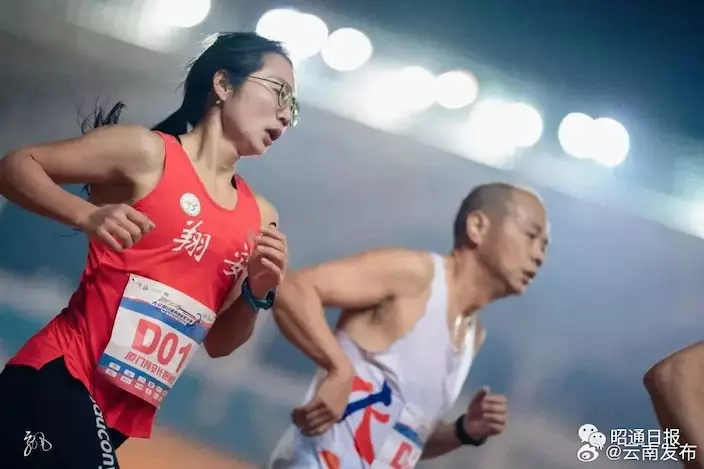
Huang Xuemei (Weibo Photo)
Huang Xuemei, a graduate of Southeast University with a degree in computer science, currently works as a programmer in the IT development department at Xiamen International Bank. According to Xiamen Net (www.xmnn.cn), Huang, in her 30s , who came from Zhaotong of Yunnan province, is not a professional athlete and has not received formal athletic training.
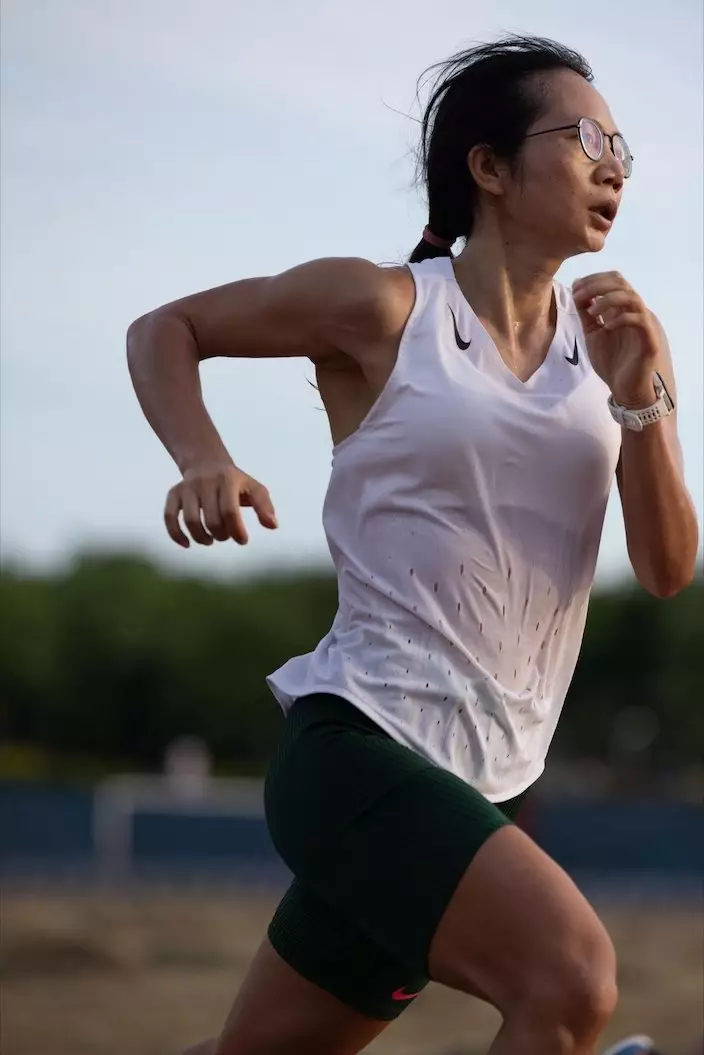
Huang Xuemei (Weibo Photo)
Xiamen Network further reported that Huang first discovered her talent in running during an 800-meter physical fitness test in her third year of high school. In the same year, she secured a second place in her school's long-distance running event, outpacing members of the school team. Her outstanding performance led to an invitation to join the school’s orienteering team. Since then, running has become part of Huang’s life, and she dedicated her spare time to training.
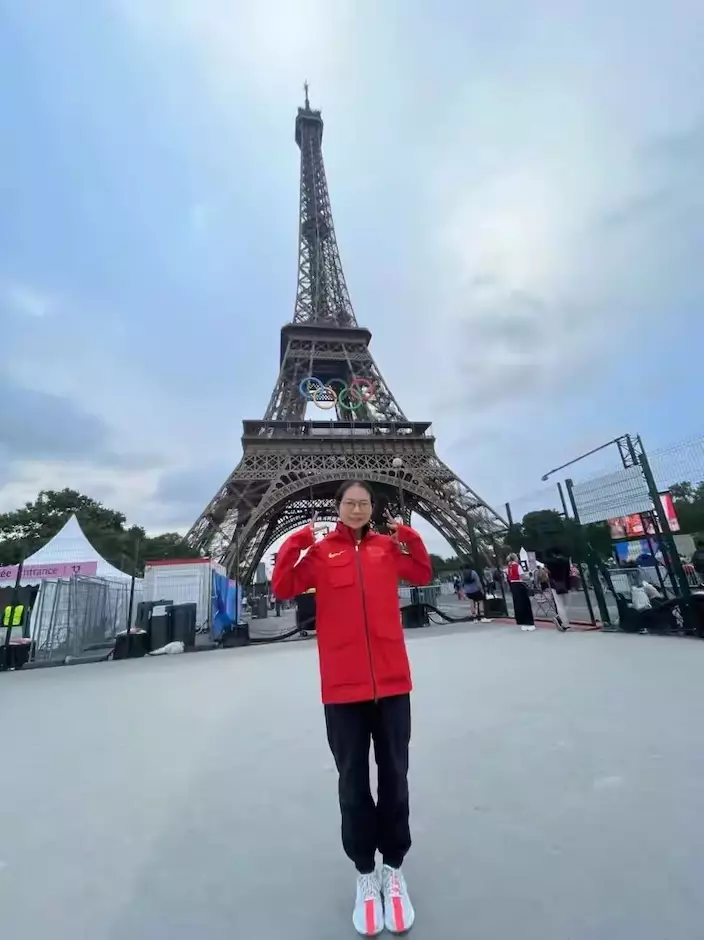
Huang Xuemei (Weibo Photo)
Huang Xuemei trains herself according to the training manual developed by coaches of the athletic association. She achieved a result of 1 hour and 18 minutes in the Haicang Half Marathon in November 2022. In the 2023 Beijing Marathon, she secured the 7th place in the international women's category and the 3rd place in the domestic women's category. In the 2024 C&D Xiamen Marathon, she finished second among domestic women. Moreover, in the 2024 IAAF Xiamen Diamond League, Huang Xuemei won the 5,000m gold medal in the women's open category. She has since been lauded as the "leading figure in public marathons." Huang Xuemei's personal best marathon time is 2 hours and 32 minutes, which also stands as the best time achieved by an amateur female marathon runner in China.
Mao Paishou
** 博客文章文責自負,不代表本公司立場 **
The 2024 Paris Olympics commenced on Saturday, marking the return of the Olympic Games to the city of romance after 100 years .
The 1924 Paris Olympic Games introduced many pioneering practices, including the first use of the Olympic motto "Faster, Higher, Stronger" and the concept of the Olympic Village. The Games also produced legends, such as Finnish track and field athlete Paavo Johannes Nurmi, who won an unprecedented five gold medals at a single Games.
For the people of China, perhaps the most significant figure of the Games was Eric Liddell, the legendary British Olympic champion known in China as Li Ailui. His significance lies not only in his world-record win in the men’s 400 meters and the Oscar-winning film "Chariots of Fire" based on his story but also because he was born in China, died in China, and dedicated his life to China.
Today, the Tianjin Sports Museum has a special section dedicated to Li's life and legacy.
Born to his Scottish parents in Tianjin, China, in 1902, Li returned to Scotland at the age of five for education. He demonstrated exceptional athletic talent at a young age, excelling in school running competitions, and becoming captain of the rugby and cricket teams. In 1920, he enrolled at the University of Edinburgh, where his athletic prowess continued to shine, winning multiple sprint championships in Scotland and across the UK.
At the 1924 Paris Olympics, Li was a top contender for the gold medal in the 100 meters. However, the Olympic schedule conflicted with his religious commitments, leading him to forgo the 100-meter and the 4x100-meter relay in favor of the 200-meter and 400-meter, despite having limited preparation time for these events.
Li ultimately triumphed, winning a bronze medal in the 200 meters and breaking the world record in the 400 meters with a time of 47.06 seconds.
Following his Olympic success, Li made the surprising decision to return to Tianjin, his birthplace, at the height of his athletic career after earning a science degree from the University of Edinburgh.
Many were puzzled by Li's choice to return to Tianjin. Zhao Yan, a curator at the Tianjin Sports Museum, suggests that family reasons and value choices influenced his decision. Li wished to reunite with his parents in Tianjin and believed his life would be more meaningful in China. As Li once said, "From birth to death, although everyone seems to be on the same track, what each person does is different, so the meaning of life is also different."
Back in Tianjin, Li became a science and physical education teacher at a middle school, teaching chemistry and mathematics, training sports talents, and promoting the Olympic spirit. Under his guidance, the school established football, basketball, baseball, table tennis, tennis, and volleyball teams, becoming the top sports school in Tianjin at the time.
Li is also known as the "Father of the Minyuan - People's Park" in Tianjin. When the Minyuan Stadium was undergoing renovation in 1925, Li made numerous suggestions regarding its track structure, lighting, and spectators’ stands based on the design of Stamford Bridge Stadium in England. His input helped transform Minyuan Stadium into one of the best stadiums in Asia at that time.
In 1929, Li won his last gold medal in the men's 500 meters at the "World Track and Field Meet" held at Minyuan Stadium, defeating Germany's Otto Felsa.
In 1934, at the age of 32, Li married Florence Mackenzie, a Canadian, in Tianjin, and they had two daughters.
The outbreak of World War II shattered many families worldwide. In 1941, Li sent his pregnant wife and their children back to Canada while he remained in Tianjin to help the wounded and assist refugees. In 1943, he was arrested by the Japanese and imprisoned in Weixian (now Weifang) concentration camp.
Despite the harsh conditions, Li taught science and organized sports activities for young people in the camp, inspiring fellow prisoners with his optimism. However, his long imprisonment and poor nutrition took a toll on his health. Li died of a brain tumor in early 1945, ending his short life journey at 43.
In 1988, a memorial was unveiled at Li’s grave in Weifang, made of granite from the Isle of Mull, his native Scotland, with inscriptions in Chinese and English: "They should have soared like winged eagles; they should have raced forward, never to tire."
Li's story and legacy continue to be celebrated worldwide. Many visit Tianjin to trace in his footsteps.
This year, on the 100th anniversary of his gold medal at the Paris Olympic Games, various exhibitions have been held in his honor.
Ke Chunna, a representative of the Scottish Government in China, stated that Li is a hero and idol for the Scottish people and a good friend of the Chinese people. He is remembered not only for his Olympic achievements but also for his passion, integrity, empathy, zest for life, and love for society.
Liu Jianbin, director of the Tianjin Sports Museum, believes that despite changes in identity and environment, Li's heart remained consistent—persisting in his simple faith and pursuing the meaning of life. This spirit and strength transcend time and space, enlightening people.