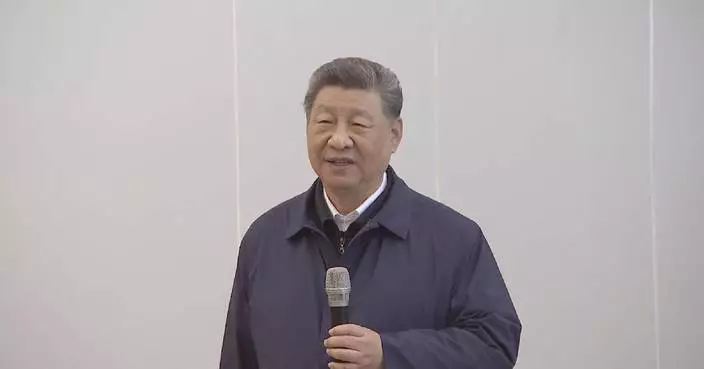
China's public security agencies have tightened efforts to crack down on major transnational crimes like telecom fraud over recent years, arresting over 50,000 fraud suspects operating in northern Myanmar, said a leading official from China's Ministry of Public Security on Tuesday.
In recent years, China's public security agencies have expanded cooperation with the law enforcement departments of the relevant other countries, establishing various cooperation mechanisms for joint operations to combat cross-border crime, said Qi Yanjun, Vice-Minister of Public Security.
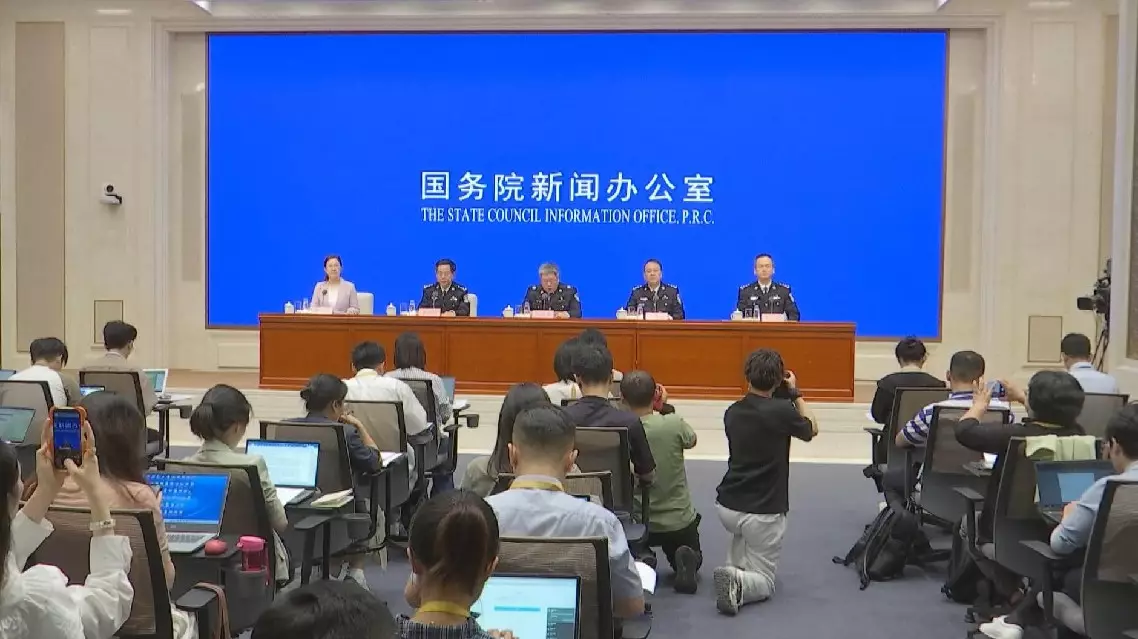
"Through our effective law enforcement cooperation, the Myanmar’s police have handed over 10 chief fraud ringleaders including Bai Suocheng to us in a single delivery. By far, more than 50,000 fraud suspects in northern Myanmar have been captured. We have also launched joint crackdown on crimes involving China in the Golden Triangle region, and carried out joint special operations to crack down on transnational crimes with law enforcement agencies in Laos, Cambodia, Thailand and other countries, to severely punish all kinds of transnational crimes involving China," Qi said at a press conference in Beijing.
In the next step, China's public security organs will make every effort to promote closer, more pragmatic law enforcement cooperation with foreign counterparts. Meanwhile, China will constructively join regional and multilateral law enforcement cooperation organizations within the framework of the United Nations, Interpol, the Shanghai Cooperation Organization, etc, actively participate in global public security governance, and contribute Chinese wisdom and solutions to the fight against transnational crime.
In response to rampant transnational crimes such as online gambling and telecom and online fraud that arouse strong public resentment, as well as vicious crimes such as kidnapping, murder, and gang-related crimes that occur abroad and involve China, we will strengthen practical cooperation with law enforcement agencies of the relevant countries in case coordination, evidence exchange, and the arrest and repatriation of criminal suspects, make full use of Interpol's resource advantages in combating transnational crime, and always maintain a high-pressure crackdown on all types of transnational crimes involving China," Qi said.
China tightens crackdown on telecom fraud: vice-minister

Agreements signed between China and Kyrgyzstan at the 2026 Shanghai Cooperation Organization (SCO) Summit in Bishkek are expected to inject fresh momentum into Kyrgyzstan’s growing technology sector, especially in digital economy, artificial intelligence (AI) and clean energy, an expert said.
The summit, held Monday and Tuesday in the Kyrgyz capital, ran under the theme "25 Years of the SCO: Together Towards Sustainable Peace, Development, and Prosperity" and brought together leaders from more than 20 countries.
In an interview with China Global Television Network (CGTN), Chubak Temirov, deputy director of the High Tech Park of the Kyrgyz Republic, said the SCO’s 25 years of trust now pave the way for joint technology ventures beyond Kyrgyzstan’s domestic market.
"The SCO spent 25 years building relationships and trust between our countries, between China and Kyrgyzstan and all other members. And I believe the next stage should be about building things together, in relation to technology; technologies, companies, research, products, and maybe new markets. Today, technology company in Bishkek doesn't necessarily think only about our domestic market, which is only 7.4 million people. We think broader, in relation to all SCO countries, or even global market," Temirov said.
In his meeting with Kyrgyz President Sadyr Japarov on Monday, Chinese President Xi Jinping said China and Kyrgyzstan should work together to build the Belt and Road Joint Laboratory and strengthen cooperation in areas including AI.
Echoing President Xi's words, Temirov identified local-language AI applications as the most immediate opportunity for Kyrgyzstan, while emphasizing that the best form of technology transfer lies in building local capacity to develop future products independently -- a partnership model that could deepen bilateral collaboration following the summit.
"I think the immediate practical opportunities for Kyrgyzstan in AI would be the local language AI. For example, let's imagine just a farmer in rural area, in some remote mountain in Kyrgyzstan, as you know, Kyrgyzstan is a mountainous country, could speak to an AI assistant in Kyrgyz language and receive information about weather, maybe agriculture. A student could have an AI tutor, for example, in his own language, in native language. Or a citizen could interact with digital public services, right? Digital public services now, in every country, are becoming a major trend of digitalization. Everyone now, just sitting from home, can get any public service s and get different things to make his life easier, right?" he said.
"China has a big scale from infrastructure and a mature AI ecosystem. The best technology transfer is not when you receive any finished product. As I said, it's when your people gain capability to build already the next product themselves, right? This is the kind of China-Kyrgyzstan technology partnership I would see as a really good example. I truly believe that after this summit, we can go to a new layer of friendship and collaboration. And I see more opportunities between China and Kyrgyzstan in AI in general, and in other technologies," he added.
China, Kyrgyzstan double down on tech innovation at SCO Summit