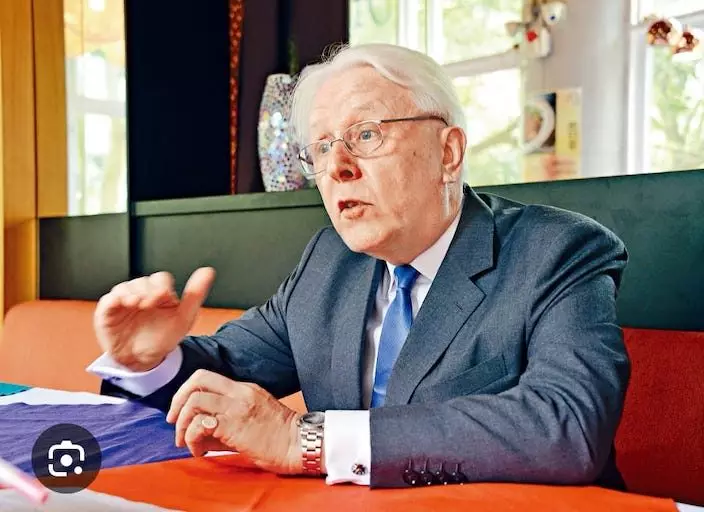

A bunch of pro-democracy supporters, alongside a group of hawkish British politicians, held a gathering two days ago to celebrate the 80th birthday of Chris Patten, the last Governor of Hong Kong. Patten, known for his deep addiction to political manoeuvring, has never stopped doing his bits to stir unrest in Hong Kong. For instance, after the recent conviction of two Stand News executives on charges of incitement, Patten resurfaced, voicing his dissatisfaction and indulging in self-promotion. A senior media figure, who has followed Patten’s political activities for over 30 years, vividly recalls how, during his tenure as Governor of Hong Kong, Patten employed a series of cunning political tactics that left long-lasting issues for Hong Kong after the handover. This media colleague revealed three hidden stories to me, each highlighting Patten's high level of political craftiness.
The First Story: A Knighthood as Bait
The late former Executive Council member Lee Peng-fei disclosed the first secret in his memoirs. According to Lee, less than 10 days after Patten’s arrival in Hong Kong in 1992, he invited Lee to breakfast. After a round of flattery, Patten abruptly suggested recommending Lee for a knighthood. Since Lee only held a Certificate of Identity (CI) and was not a British citizen, his first reaction was disbelief: "Can I really be a knight?" Patten quickly reassured him, “No problem. I will recommend you to the Queen.”
Lee, however, suspected ulterior motives. At the time, he was leading the Co-operative Resources Centre, the precursor to the Liberal Party, which held 25 solid votes in the Legislative Council. It became clear to Lee that Patten intended to secure his support by offering him a knighthood, thereby gaining control over the Legislative Council.
Nevertheless, Lee did not take the bait. He refused to be manipulated, leading to a confrontation during an Executive Council meeting. The meeting was meant to review relations with China. Lee pointed out that most issues had already been resolved under Patten's predecessor, Sir David Wilson, but Patten and Chief Secretary David Ford disregarded him, clearly seeking to undo past agreements. Lee stood his ground, resulting in a heated and unproductive meeting.
As a result of his defiance, Lee not only lost the opportunity for a knighthood but was also removed from the Executive Council.
The Second Story: Consolidating Power
The second story revolves around how Patten skilfully restructured the core decision-making body of the Executive Council. Former Chief Secretary David Akers-Jones revealed in his memoirs that shortly after taking office, Patten decided to restructure the Executive Council to align with his new policies. Senior Executive Council member Lydia Dunn suggested that, to allow Patten to govern freely, all current members should resign. In the end, only Dunn was reappointed, and no Legislative Council members were included in the new lineup.
Akers-Jones noted that this was a calculated move by Patten to eliminate troublesome Executive Council members who had been involved in drafting the Basic Law. These individuals would have undoubtedly opposed Patten's future political agenda had they remained on the Council.
The Third Story: Luring Martin Lee into the “Trojan Horse Scheme”
Patten not only controlled the Executive Council but also strategically aligned himself with pro-democracy leaders. One of his key manoeuvrers was forming an alliance with Martin Lee, chairman of the United Democrats of Hong Kong (the precursor to the Democratic Party). This was part of Patten’s broader strategy to cultivate pro-Western forces in Hong Kong to counter Beijing after the handover, a so-called "Trojan Horse" strategy.
A senior media colleague recalls that shortly before Patten assumed his role as Governor of Hong Kong, he met in London with Martin Lee and Yeung Sum, vice-chairman of the United Democrats of Hong Kong. They discussed disbanding the Executive Council, which operated similarly to a cabinet, and replacing its members with a new group.
One week earlier, Lee Peng-fei and other members of the Co-operative Resources Centre had also visited the UK but were met with a cold reception. In stark contrast, Lee and Yeung were warmly welcomed by British government officials, indicating that they had already been identified as key players in the political strategy being formulated.
Upon Patten’s arrival in Hong Kong, he treated Martin Lee as a key ally. Patten’s vocal advocacy for "democracy" and his willingness to confront China impressed Lee, who saw Patten as a different kind of Governor. After Patten’s first policy address, Lee was even more encouraged by his rhetoric. In private, he reportedly told a British journalist, “Chris Patten has come up with a brilliant idea to bring real and full democracy to Hong Kong... the comrades were ecstatic last night!” Patten’s psychological tactics eventually drew Lee and his allies into close collaboration.
These three hidden stories reveal Patten’s skilful use of political deception, leaving Hong Kong with lasting problems. The damage caused by his actions has resulted in significant turmoil. However, after enduring these painful experiences, the public has seen through his schemes, and his influence has significantly diminished.
Nevertheless, Patten’s nature as a “political player” is unlikely to change. He doesn’t want to be left alone and will continue to engage in political games, and it remains crucial to remain vigilant against such manipulative politicians.
Lai Ting Yiu
What Say You?
** 博客文章文責自負,不代表本公司立場 **