Consumer Price Indices for August 2024
The Census and Statistics Department (C&SD) released today (September 20) the Consumer Price Index (CPI) figures for August 2024. According to the Composite CPI, overall consumer prices rose by 2.5% in August 2024 over the same month a year earlier, the same as that in July 2024. Netting out the effects of all Government's one-off relief measures, the year-on-year rate of increase in the Composite CPI (i.e. the underlying inflation rate) in August 2024 was 1.2%, also the same as that in July 2024.
On a seasonally adjusted basis, the average monthly rate of increase in the Composite CPI for the 3-month period ending August 2024 was 0.6%, the same as that for the 3-month period ending July 2024. Netting out the effects of all Government's one-off relief measures, the corresponding rates of increase were both 0.2%.
Analysed by sub-index, the year-on-year rates of increase in the CPI(A), CPI(B) and CPI(C) were 3.2%, 2.2% and 1.9% respectively in August 2024, as compared to 3.1%, 2.3% and 2.0% respectively in July 2024. Netting out the effects of all Government's one-off relief measures, the year-on-year rates of increase in the CPI(A), CPI(B) and CPI(C) were 1.1%, 1.2% and 1.3% respectively in August 2024, as compared to 1.0%, 1.2% and 1.4% respectively in July 2024.
On a seasonally adjusted basis, for the 3-month period ending August 2024, the average monthly rates of increase in the CPI(A), CPI(B) and CPI(C) were 0.8%, 0.5% and 0.4% respectively, same as those for the 3-month period ending July 2024. Netting out the effects of all Government's one-off relief measures, the average monthly rates of increase in the seasonally adjusted CPI(A), CPI(B) and CPI(C) for the 3-month period ending August 2024 were 0.2%, 0.1% and 0.2% respectively, and the corresponding rates of increase for the 3-month period ending July 2024 were all 0.2%.
Amongst the various components of the Composite CPI, year-on-year increases in prices were recorded in August 2024 for alcoholic drinks and tobacco (20.8%), electricity, gas and water (4.8%), housing (3.3%), transport (2.8%), meals out and takeaway food (2.4%), miscellaneous services (2.2%), miscellaneous goods (0.9%), and basic food (0.8%).
On the other hand, year-on-year decreases in the components of the Composite CPI were recorded in August 2024 for clothing and footwear (-1.8%), and durable goods (-0.9%).
Taking the first 8 months of 2024 together, the Composite CPI rose by 1.8% over a year earlier. The respective increases in the CPI(A), CPI(B) and CPI(C) were 2.2%, 1.7% and 1.6% respectively. The corresponding increases after netting out the effects of all Government's one-off relief measures were 1.0%, 0.9%, 1.1% and 1.3% respectively.
For the 3 months ending August 2024, the Composite CPI rose by 2.1% over a year earlier, while the CPI(A), CPI(B) and CPI(C) rose by 2.7%, 1.9% and 1.8% respectively. The corresponding increases after netting out the effects of all Government's one-off relief measures were 1.1%, 1.0%, 1.1% and 1.3% respectively.
For the 12 months ending August 2024, the Composite CPI was on average 2.0% higher than that in the preceding 12-month period. The respective increases in the CPI(A), CPI(B) and CPI(C) were 2.4%, 1.9% and 1.8% respectively. The corresponding increases after netting out the effects of all Government's one-off relief measures were 1.2%, 1.1%, 1.2% and 1.5% respectively.
Commentary
A Government spokesman said that underlying consumer price inflation remained modest in August. Prices of meals out and takeaway food increased at a moderated pace over a year earlier, and those of basic food inched up further. Prices of energy-related items continued to show visible decline. Price pressures on other major components remained broadly in check.
Looking ahead, overall inflation should stay mild in the near term. Domestic cost may face some moderate upward pressures as the Hong Kong economy continues to grow. External price pressures should moderate further in broad terms, though geopolitical tensions may pose uncertainties. The Government will continue to monitor the situation.
Further information
The CPIs and year-on-year rates of change at section level for August 2024 are shown in Table 1. The time series on the year-on-year rates of change in the CPIs before and after netting out the effects of all Government's one-off relief measures are shown in Table 2. For discerning the latest trend in consumer prices, it is also useful to look at the changes in the seasonally adjusted CPIs. The time series on the average monthly rates of change during the latest 3 months for the seasonally adjusted CPIs are shown in Table 3. The rates of change in the original and the seasonally adjusted Composite CPI and the underlying inflation rate are presented graphically in Chart 1.
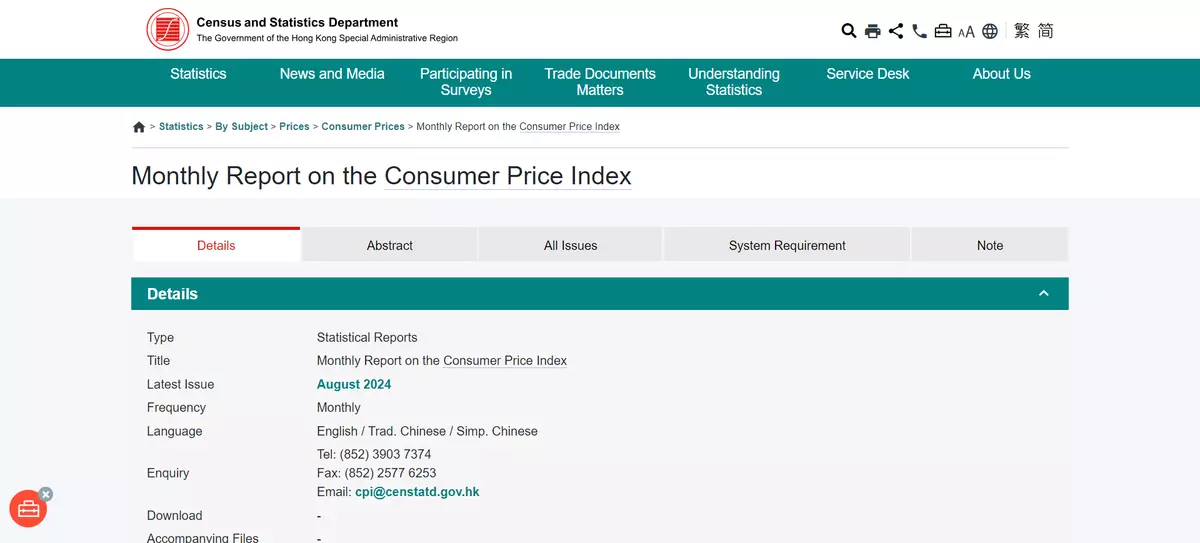
More detailed statistics are given in the "Monthly Report on the Consumer Price Index". Users can browse and download this publication at the website of the C&SD (www.censtatd.gov.hk/en/EIndexbySubject.html?pcode=B1060001&scode=270).
For enquiries about the CPIs, please contact the Consumer Price Index Section of the C&SD (Tel: 3903 7374 or email: cpi@censtatd.gov.hk).