Southwest China's Yunnan Province is revitalizing its vast and colorful rural areas with diversified strategies which have yield fruitful results in ethnic-special rural tourism and agriculture with moder technologies.
Nestled in the remote corners of Yunan's Dulongjiang Township lies the picturesque village of Kelaoluo, a place where tradition meets modernity in the most unique way.
Once the most isolated village along the China-Myanmar border, Kelaoluo is now a burgeoning rural tourism hotspot, offering visitors a glimpse into the rich cultural tapestry of the Dulong ethnic group.
The first key to happiness here is the transformation of homes. The traditional "Muleng houses," where generations of Dulong people lived, were made of wood, often drafty and smoky due to open fire cooking.
The entire Dulong ethnic group was lifted out of poverty in 2018 and all people moved into spacious, comfortable homes with gas stoves, refrigerators, laundry machines and TVs.
As Dulongjiang became a National 4A-level Tourist Attraction in 2021, these brick-and-mortar homes were given a "Muleng house" facade to preserve the unique architectural style and cultural nostalgia.
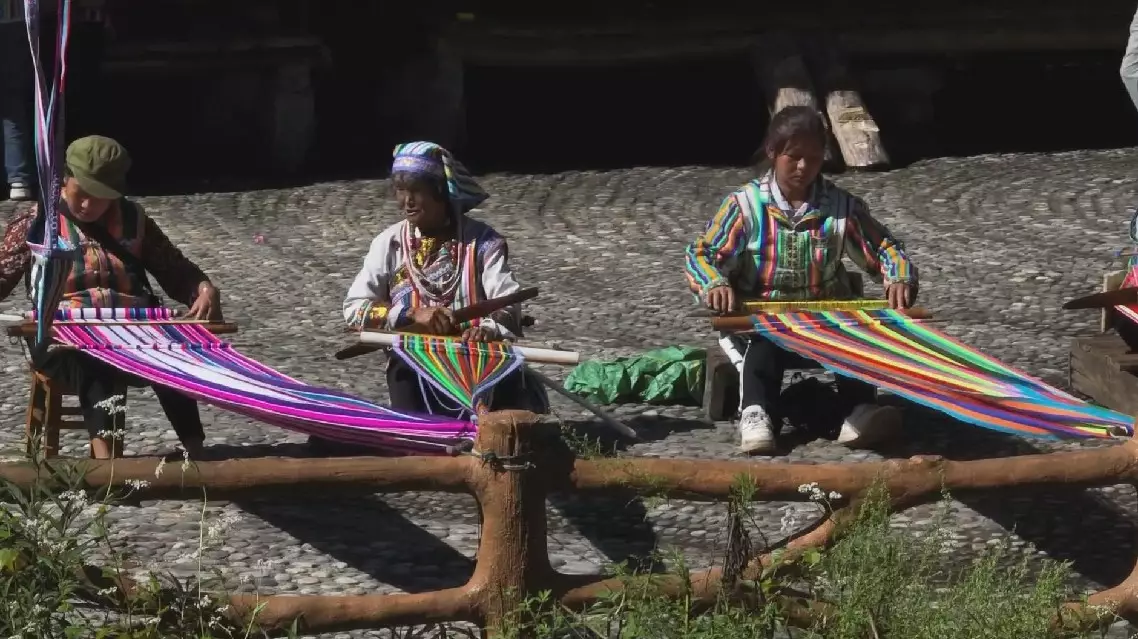
The refurbished house is part of the special tourist experience, which is another key to happiness. Apart from local specialties like lingzhi mushrooms, honey and toadstool, the rainbow-colored Dulong blankets have offered tourists a fresh, immersive experience.
To maximize the value of the Dulong blanket industry, households skilled in weaving now have "rainbow courtyards" at their doorsteps, allowing skillful weaving artists to perform in front of visitors while turning their craft itself into a scenic attraction.
There are already 100 such live performance spots across Dulongjiang Township.
Another remote village Yunshan, located in Yunnan's Lancang Lahu Autonomous County, was once trapped in a cycle of poverty. But this rural community has now become a beacon of hope and innovation, thanks to an unlikely alliance between villagers and top scientists.
Since 2015, Zhu Youyong, a plant pathologist and member of the Chinese Academy of Engineering, has led a team to assist Lancang. Their pioneering work resulted in the successful cultivation of high-quality rice in dry land by 2022.
"When it comes to income, the changes have been dramatic. With the help of the academician-led expert team, our Yunshan Village planted high quality rice in dry land and developed characteristic breeding industry. The income has increased several times over the previous years. Now the life of us common people is getting better and better," said Zhang Wenqing, a villager.
After the rice harvest, the fields are not left idle. Instead, they are planted with winter potatoes, diversifying the agricultural landscape and ensuring year-round productivity.
"The highest yield is 10.5 tons per hectare, and the potatoes yield more than 30 tons per hectare, adding more than 60,000 yuan to each hectare," said Li Fu, another villager, also outstanding student at the first academician class.
These advancements have also drawn young talent back to the village.
"I came back to Yunshan Village in 2021. I saw two good projects in the market outside, and brought them back to our hometown for development. I'm here with everyone to find more channels, make more money, realizing my personal value while contributing to my hometown," said Li Sibao, a young entrepreneur.
This story of progress is just one of many across Yunnan Province, where infrastructure improvements and economic growth have transformed rural communities.
With 100 percent of the province's 8,502 impoverished villages now connected by paved roads and power, and with full fiber optic coverage, the average disposable income for rural residents has seen a significant rise, reflecting the broader success of rural revitalization efforts in the region.
Remote Yunnan villages embrace modernization with ethnic-special tourism, advanced agriculture
Remote Yunnan villages embrace modernization with ethnic-special tourism, advanced agriculture